
一次性使用与可重复使用导尿管在间歇性导尿治疗尿潴留中的应用:一项多中心、前瞻性、随机对照、非劣效性试验(COMPaRE)的方案。
Single use versus reusable catheters in intermittent catheterisation for treatment of urinary retention: a protocol for a multicentre, prospective, randomised controlled, non-inferiority trial (COMPaRE).
机构信息
Department of Urology, Erasmus Medical Center, Rotterdam, The Netherlands.
Department of Urology, Erasmus Medical Center, Rotterdam, The Netherlands
出版信息
BMJ Open. 2022 Apr 11;12(4):e056649. doi: 10.1136/bmjopen-2021-056649.
INTRODUCTION
Chronic urinary retention is a common lower urinary tract disorder, mostly neurogenic or idiopathic in origin. The preferred treatment is clean intermittent urinary self-catheterisation (CISC) four to six times a day. In most European countries, virtually all patients use single use catheters, which is in contrast to several countries where the use of reusable catheters is more common. The available literature on the use of reusable catheters is conflicting and until now, no randomised controlled trial with sufficient power has been performed to investigate if reusable catheters for CISC is as safe as single use catheters.
METHODS AND ANALYSIS
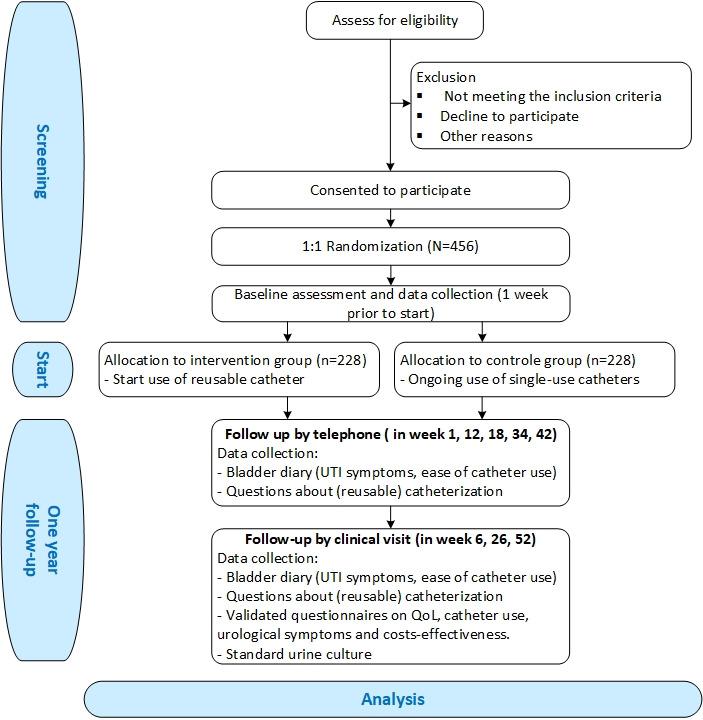
We described this protocol for a prospective, randomised controlled non-inferiority trial to investigate if the use of reusable catheters is as safe as single use catheters for CISC patients, measured by symptomatic urinary tract infections (sUTIs). Secondary objectives are adverse events due to a sUTI, urethral damage, stone formation, quality of life and patient satisfaction. A cost-effectiveness analysis will also be performed. 456 Participants will be randomised into two groups stratified for age, gender, menopausal status and (non-)neurogenic underlying disorder. The intervention group will replace the reusable catheter set every 2 weeks for a new set and replace the cleaning solution every 24 hours. The control group continues to use its own catheters. The primary outcome (amount of sUTIs from baseline to 1 year) will be tested for non-inferiority. Categorical outcome measures will be analysed using χ tests and quantitative outcome variables by t-tests or Mann-Whitney U tests. Two-sided p values will be calculated.
ETHICS AND DISSEMINATION
This protocol was reviewed and approved by the Medical Ethics Committee of the Erasmus MC (MEC 2019-0134) and will be performed according to the Standard Protocol Items: Recommendations for Interventional Trials (SPIRIT) checklist for non-inferiority trials. The results of this randomised controlled non-inferiority trial will be published in a peer-reviewed journal and will be publicly available.
TRIAL REGISTRATION NUMBER
NL8296.
介绍
慢性尿潴留是一种常见的下尿路疾病,主要由神经源性或特发性原因引起。首选的治疗方法是每天进行四到六次清洁间歇性导尿(CISC)。在大多数欧洲国家,几乎所有患者都使用一次性导尿管,而在一些国家,更常见的是使用可重复使用的导尿管。关于可重复使用导尿管的使用的现有文献存在矛盾,迄今为止,还没有进行过足够有力的随机对照试验来调查 CISC 时使用可重复使用导尿管是否与一次性导尿管一样安全。
方法和分析
我们描述了这项前瞻性、随机对照非劣效性试验的方案,以调查 CISC 患者使用可重复使用导尿管是否与一次性导尿管一样安全,通过有症状的尿路感染(sUTI)来衡量。次要目标是由于 sUTI 引起的不良事件、尿道损伤、结石形成、生活质量和患者满意度。还将进行成本效益分析。456 名参与者将根据年龄、性别、绝经状态和(非)神经源性潜在疾病进行分层,随机分为两组。干预组将每 2 周更换一套可重复使用的导管套件,并每 24 小时更换一次清洁溶液。对照组继续使用自己的导管。主要结局(从基线到 1 年的 sUTI 数量)将进行非劣效性检验。分类结局测量将使用 χ 检验进行分析,定量结局变量将使用 t 检验或 Mann-Whitney U 检验进行分析。将计算双侧 p 值。
伦理和传播
本方案已由伊拉斯姆斯医学中心医学伦理委员会审查和批准(MEC 2019-0134),并将按照标准干预试验项目建议:干预试验的建议(SPIRIT)清单进行。这项随机对照非劣效性试验的结果将发表在同行评议的期刊上,并公开发布。
试验注册号
NL8296。
 Zotero 插件