
对成熟阻滞患者进行全外显子组测序:预防反复阴性睾丸精子提取结果的潜在附加诊断工具。
Whole-exome sequencing in patients with maturation arrest: a potential additional diagnostic tool for prevention of recurrent negative testicular sperm extraction outcomes.
机构信息
Université Paris-Saclay, UVSQ, INRAE, BREED, Jouy-en-Josas, France.
École Nationale Vétérinaire d'Alfort, BREED, Maisons-Alfort, France.
出版信息
Hum Reprod. 2022 May 30;37(6):1334-1350. doi: 10.1093/humrep/deac057.
STUDY QUESTION
Could whole-exome sequencing (WES) be useful in clinical practice for men with maturation arrest (MA) after a first testicular sperm extraction (TESE)?
SUMMARY ANSWER
WES in combination with TESE yields substantial additional information and may potentially be added as a test to predict a negative outcome of a recurrent TESE in patients with MA.
WHAT IS KNOWN ALREADY
At present, the only definitive contraindications for TESE in men with non-obstructive azoospermia (NOA) are a 46,XX karyotype and microdeletions in the azoospermia factor a (AZFa) and/or AZFb regions. After a first negative TESE with MA, no test currently exists to predict a negative outcome of a recurrent TESE.
STUDY DESIGN, SIZE, DURATION: In a cohort study, we retrospectively included 26 patients with idiopathic NOA caused by complete MA diagnosed after a first TESE.
PARTICIPANTS/MATERIALS, SETTING, METHODS: Twenty-six men with MA at the spermatocyte stage in all seminiferous tubules, according to a histopathological analysis performed independently by two expert histologists, and a normal karyotype (i.e. no AZF gene microdeletions on the Y chromosome) were included. Single-nucleotide polymorphism comparative genomic hybridization array and WES were carried out. The results were validated with Sanger sequencing. For all the variants thought to influence spermatogenesis, we used immunohistochemical techniques to analyse the level of the altered protein.
MAIN RESULTS AND THE ROLE OF CHANCE
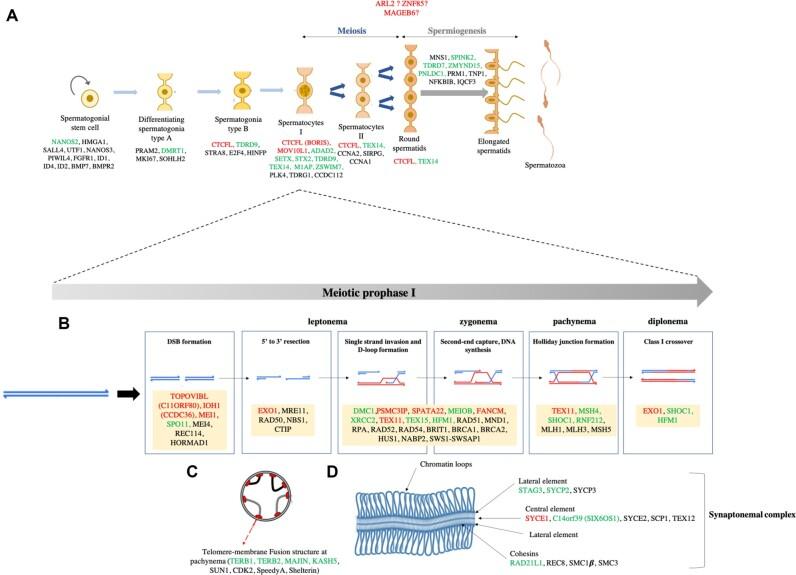
Deleterious homozygous variants were identified in all seven consanguineous patients and in three of the 19 non-consanguineous patients. Compound heterozygous variants were identified in another 5 of the 19 non-consanguineous patients. No recurrent variants were identified. We found new variants in genes known to be involved in azoospermia or MA [including testis expressed 11 (TEX11), meiotic double-stranded break formation protein 1 (MEI1), proteasome 26s subunit, ATPase 3 interacting protein (PSMC3IP), synaptonemal complex central element protein 1 (SYCE1) and Fanconi anaemia complementation group M (FANCM) and variants in genes not previously linked to human MA (including CCCTC-binding factor like (CTCFL), Mov10 like RISC complex RNA helicase 1 (MOV10L1), chromosome 11 open reading frame 80 (C11ORF80) and exonuclease 1 (EXO1)].
LARGE SCALE DATA
Data available on request.
LIMITATIONS, REASONS FOR CAUTION: More data are required before WES screening can be used to avoid recurrent TESE, although screening should be recommended for men with a consanguineous family background. WES is still a complex technology and can generate incidental findings.
WIDER IMPLICATIONS OF THE FINDINGS
Our results confirmed the genetic aetiology of MA in most patients: the proportion of individuals with at least one pathologic variant was 50% in the overall study population and 100% in the consanguineous patients. With the exception of MEI1 (compound heterozygous variants of which were identified in two cases), each variant corresponded to a specific gene-confirming the high degree of genetic heterogeneity in men with MA. Our results suggest that WES screening could help to avoid recurrent, futile TESE in men with MA in general and in consanguineous individuals in particular, but these results need to be confirmed in future studies before clinical implementation.
STUDY FUNDING/COMPETING INTEREST(S): The study was funded by the Fondation Maladies Rares (Paris, France), Merck (Kenilworth, NJ, USA), IRSF (Montigny le Bretonneux, France) and Agence de la Biomédecine (Saint Denis, France). There are no competing interests.
TRIAL REGISTRATION NUMBER
N/A.
研究问题
全外显子组测序(WES)在首次睾丸精子提取(TESE)后发生成熟阻滞(MA)的男性的临床实践中是否有用?
总结答案
WES 结合 TESE 可提供大量额外信息,并且可能被添加为预测 MA 患者复发性 TESE 阴性结果的测试。
已知情况
目前,非梗阻性无精子症(NOA)男性进行 TESE 的唯一明确禁忌证是 46,XX 核型和无精子因子 a(AZFa)和/或 AZFb 区域的微缺失。在首次 TESE 后发生 MA 的情况下,目前尚无测试可预测复发性 TESE 的阴性结果。
研究设计、大小和持续时间:在一项队列研究中,我们回顾性纳入了 26 名首次 TESE 后诊断为完全 MA 的特发性 NOA 男性患者。
参与者/材料、设置、方法:纳入 26 名所有生精小管中均处于精母细胞阶段的 MA 男性,通过两位专家组织病理学家独立进行的组织病理学分析,并具有正常核型(即 Y 染色体上无 AZF 基因微缺失)。进行单核苷酸多态性比较基因组杂交阵列和 WES。结果用 Sanger 测序验证。对于所有被认为影响精子发生的变异,我们使用免疫组织化学技术分析改变蛋白的水平。
主要结果和机会的作用
在所有 7 名近亲结婚的患者和 19 名非近亲结婚的患者中的 3 名患者中发现了有害的纯合变异。在另外 5 名非近亲结婚的患者中发现了复合杂合变异。未发现复发性变异。我们在已知参与无精子症或 MA 的基因中发现了新的变异[包括睾丸表达 11(TEX11)、减数分裂双链断裂形成蛋白 1(MEI1)、蛋白酶体 26 亚基、ATPase 3 相互作用蛋白(PSMC3IP)、联会复合体中央元件蛋白 1(SYCE1)和范可尼贫血互补组 M(FANCM)以及以前与人类 MA 无关的基因中的变异(包括 CCCTC 结合因子样(CTCFL)、Mov10 样 RISC 复合物 RNA 解旋酶 1(MOV10L1)、11 号染色体开放阅读框 80(C11ORF80)和外切核酸酶 1(EXO1)]。
大规模数据
需要时提供数据。
局限性、谨慎的原因:尽管 WES 筛查应该推荐给有近亲家族史的男性,但在避免复发性 TESE 之前,还需要更多的数据。WES 仍然是一种复杂的技术,并且可以产生偶然发现。
研究结果的更广泛影响
我们的结果证实了大多数患者 MA 的遗传病因:在整个研究人群中,至少有一个病理变异的个体比例为 50%,在近亲结婚的患者中为 100%。除了 MEI1(发现了两种情况下的复合杂合变异)之外,每个变异都对应于一个特定的基因,证实了 MA 男性的高度遗传异质性。我们的研究结果表明,WES 筛查可以帮助避免一般情况下 MA 男性和特别是近亲结婚男性的复发性、无益的 TESE,但这些结果需要在未来的研究中得到证实,然后才能在临床实施。
研究资金/竞争利益:该研究由罕见病基金会(巴黎,法国)、默克(肯尼沃斯,新泽西州,美国)、IRSF(蒙蒂尼勒布雷顿努瓦,法国)和生物医学机构(圣但尼,法国)资助。没有竞争利益。
试验注册编号
无。


 Zotero 插件