
作为一种设计抗菌肽的策略,对自由能景观的调制。
Modulation of free energy landscapes as a strategy for the design of antimicrobial peptides.
机构信息
Bioinformatics and Computational Biosciences Branch, National Institute of Allergy and Infectious Diseases, National Institutes of Health, Bethesda, MD, 20892, USA.
出版信息
J Biol Phys. 2022 Jun;48(2):151-166. doi: 10.1007/s10867-022-09605-z. Epub 2022 Apr 14.
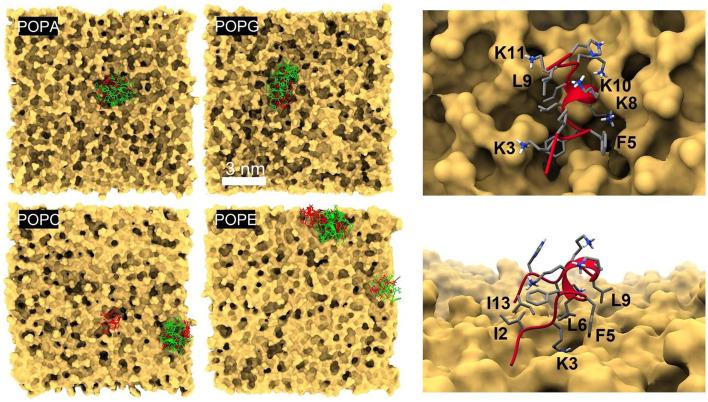
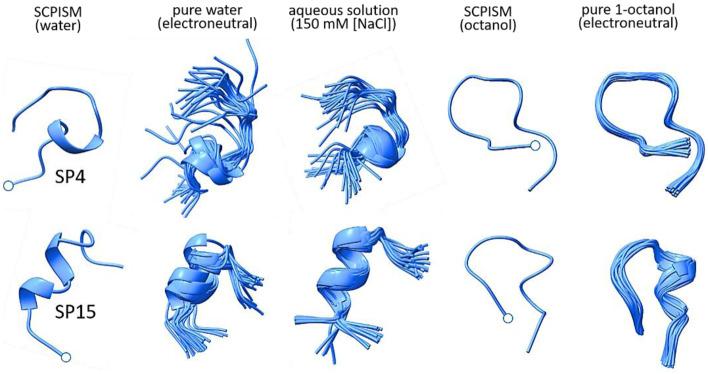
Computational design of antimicrobial peptides (AMPs) is a promising area of research for developing novel agents against drug-resistant bacteria. AMPs are present naturally in many organisms, from bacteria to humans, a time-tested mechanism that makes them attractive as effective antibiotics. Depending on the environment, AMPs can exhibit α-helical or β-sheet conformations, a mix of both, or lack secondary structure; they can be linear or cyclic. Prediction of their structures is challenging but critical for rational design. Promising AMP leads can be developed using essentially two approaches: traditional modeling of the physicochemical mechanisms that determine peptide behavior in aqueous and membrane environments and knowledge-based, e.g., machine learning (ML) techniques, that exploit ever-growing AMP databases. Here, we explore the conformational landscapes of two recently ML-designed AMPs, characterize the dependence of these landscapes on the medium conditions, and identify features in peptide and membrane landscapes that mediate protein-membrane association. For both peptides, we observe greater conformational diversity in an aqueous solvent than in a less polar solvent, and one peptide is seen to alter its conformation more dramatically than the other upon the change of solvent. Our results support the view that structural rearrangement in response to environmental changes is central to the mechanism of membrane-structure disruption by linear peptides. We expect that the design of AMPs by ML will benefit from the incorporation of peptide conformational substates as quantified here with molecular simulations.
抗菌肽 (AMPs) 的计算设计是开发针对耐药菌的新型药物的一个有前途的研究领域。AMPs 天然存在于许多生物体中,从细菌到人类,这是一种经过时间考验的机制,使它们作为有效的抗生素具有吸引力。根据环境的不同,AMPs 可以呈现 α-螺旋或 β-折叠构象、两者的混合物或缺乏二级结构;它们可以是线性的或环状的。预测它们的结构具有挑战性,但对于合理设计至关重要。可以使用两种主要方法来开发有前途的 AMP 先导物:传统建模用于确定肽在水相和膜环境中行为的物理化学机制,以及基于知识的方法,例如机器学习 (ML) 技术,利用不断增长的 AMP 数据库。在这里,我们探索了两种最近通过 ML 设计的 AMP 的构象景观,研究了这些景观对介质条件的依赖性,并确定了在肽和膜景观中介导蛋白-膜相互作用的特征。对于这两种肽,我们观察到在水溶剂中比在非极性溶剂中有更大的构象多样性,并且一种肽在溶剂变化时比另一种肽更剧烈地改变其构象。我们的结果支持这样一种观点,即线性肽破坏膜结构的机制的核心是对环境变化的结构重排。我们预计,通过 ML 设计 AMP 将受益于通过分子模拟在这里定量的肽构象亚稳态的纳入。



 Zotero 插件