
生长调节剂浸种处理调节印度南瓜(印度笋瓜)在半干旱条件下的产量、生理和抗氧化防御。
Seed priming with growth regulators modulates production, physiology and antioxidant defense of Indian squash (Praecitrullus fistulosus) under semi-arid conditions.
机构信息
Department of Agronomy, College of Agriculture, University of Sargodha, Sargodha, Pakistan.
Department of Agronomy, Bahauddin Zakariya University, Multan, Pakistan.
出版信息
PLoS One. 2022 Apr 14;17(4):e0265694. doi: 10.1371/journal.pone.0265694. eCollection 2022.
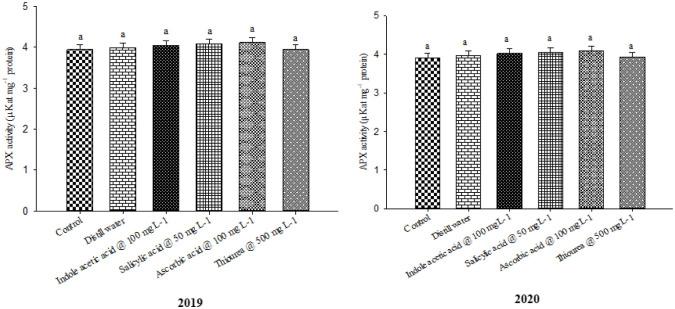
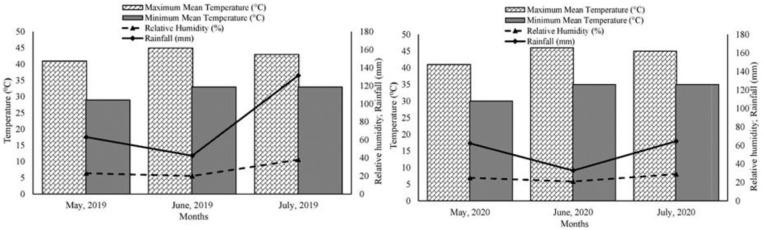
Indian squash (Praecitrullus fistulosus) crop faces heat and drought during its growth that is considered the most important abiotic stress in semi-arid areas. Seed priming with growth regulators enhances stress tolerance; hence, mitigates the adverse effects of unpredictable stresses due to adverse weather conditions. This two-year (2019 and 2020) study was conducted to infer the role of seed priming in improving heat tolerance of Indian squash (cultivar Sahavi) through improvement in physiological and antioxidant defense systems. Six treatments that included no priming (control), hydropriming, priming with indole acetic acid (IAA) at 100 mg L-1, salicylic acid (SA) at 50 mg L-1, ascorbic acid (AA) at 100 mg L-1 and thiourea at 500 mg L-1 each for 06 hours) were included in the study. Results revealed that priming with AA and SA significantly (P ≤ 0.05) enhanced germination (39 and 47%), germination index (57 and 58%), plant height (23 and 22%), vine length (15 and 14%), number of fruits per plant (62%), fruit weight per plant (66 and 67%), economic yield (32%), photosynthesis rate (18 and 17%), protein content (10%), proline (23%), glycine betaine (3%), malondialdehyde content (11 and 10%) and catalase activity (24%) compared to control treatment. Furthermore, seed priming with AA and SA significantly (P ≤ 0.05) shortened the mean germination time (25 and 28%) compared to the control. The results indicated that AA and SA had significant potential to mitigate adverse effects of heat stress in Indian squash. Findings from this study showed that seed priming with AA and SA promoted heat-stress tolerance and enhanced growth and productivity of Indian squash.
印度南瓜(Praecitrullus fistulosus)在生长过程中面临高温和干旱,这被认为是半干旱地区最重要的非生物胁迫。用生长调节剂进行种子引发可以提高植物的抗逆性;因此,可以减轻由于恶劣天气条件导致的不可预测的胁迫的不利影响。这项为期两年(2019 年和 2020 年)的研究旨在通过改善生理和抗氧化防御系统,推断种子引发在提高印度南瓜(品种 Sahavi)耐热性方面的作用。研究包括六个处理,分别为:不引发(对照)、水引发、吲哚乙酸(IAA)引发浓度为 100mg/L、水杨酸(SA)引发浓度为 50mg/L、抗坏血酸(AA)引发浓度为 100mg/L 和硫脲引发浓度为 500mg/L,每个处理引发 06 小时。结果表明,用 AA 和 SA 引发显著(P≤0.05)提高了发芽率(39%和 47%)、发芽指数(57%和 58%)、株高(23%和 22%)、藤长(15%和 14%)、每株果实数(62%)、单株果实重量(66%和 67%)、经济产量(32%)、光合速率(18%和 17%)、蛋白质含量(10%)、脯氨酸(23%)、甘氨酸甜菜碱(3%)、丙二醛含量(11%和 10%)和过氧化氢酶活性(24%),与对照处理相比。此外,与对照相比,用 AA 和 SA 引发显著(P≤0.05)缩短了平均发芽时间(25%和 28%)。结果表明,AA 和 SA 具有减轻印度南瓜热胁迫不利影响的巨大潜力。本研究结果表明,用 AA 和 SA 进行种子引发可以促进印度南瓜耐热性,并提高其生长和产量。


 Zotero 插件