
哺乳动物和鱼类细胞焦亡的比较综述
A Comparative Review of Pyroptosis in Mammals and Fish.
作者信息
Song Zixi, Zou Jiahong, Wang Mengya, Chen Zhenwei, Wang Qingchao
机构信息
Engineering Research Center of Green Development for Conventional Aquatic Biological Industry in the Yangtze River Economic Belt, Ministry of Education, College of Fisheries, Huazhong Agricultural University, Wuhan, 430070, People's Republic of China.
出版信息
J Inflamm Res. 2022 Apr 11;15:2323-2331. doi: 10.2147/JIR.S361266. eCollection 2022.
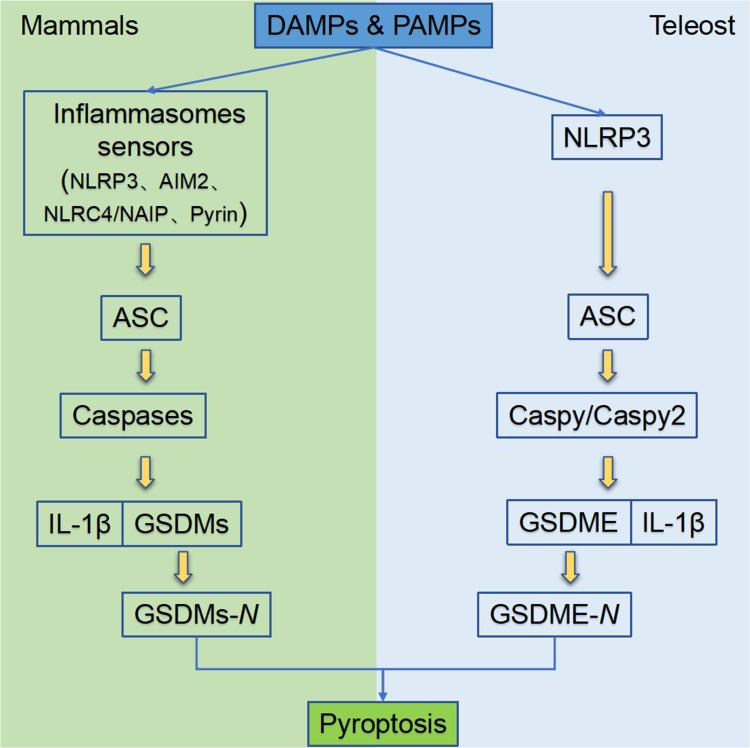
Pyroptosis is a form of programmed cell death, which is executed by gasdermin family proteins. Under the stimulation of pathogen- and/or damage-associated molecular patterns, pattern recognition receptors (PRRs) such as Nod like receptors could recruit apoptosis-associated speck-like protein containing a CARD (ASC) and pro-caspases to form inflammasomes and then activate caspases through various pathways. The activated caspases then cleave gasdermin family proteins, and N-terminal (NT) domains of gasdermins were released to form oligomeric pores, resulting in the increased membrane permeability, cell swelling, and final pyroptosis. During this process, caspases also promote the maturation and release of inflammatory cytokines such as IL-1β and IL-18, thus pyroptosis is also named inflammatory cell death. Unlike numerous gasdermin family proteins in mammals, only gasdermin E (GSDME) has been identified in fish. GSDME in fish can be cleaved by caspase-a/-b to release its NT domain and induce pyroptosis. Studies indicated that pyroptosis in fish mainly depends on NLR family pyrin domain-containing 3 (NLRP3) inflammasome. ASC and different caspase proteins also were identified in different fish species. The influences of pathogenic microorganism infection and environmental pollutants on fish pyroptosis were studied in recent years. Considering that fish living environment is affected by multiple factors such as water salinity, temperature, oxygen supply, and highly fluctuating food supply, the in-depth research about fish pyroptosis will contribute to revealing the mechanism of pyroptosis during evolution.
细胞焦亡是一种程序性细胞死亡形式,由gasdermin家族蛋白执行。在病原体和/或损伤相关分子模式的刺激下,诸如Nod样受体等模式识别受体(PRR)可募集含半胱天冬酶激活和招募结构域的凋亡相关斑点样蛋白(ASC)和前半胱天冬酶以形成炎性小体,然后通过各种途径激活半胱天冬酶。激活的半胱天冬酶随后切割gasdermin家族蛋白,gasdermin的N端(NT)结构域被释放以形成寡聚孔,导致膜通透性增加、细胞肿胀并最终发生细胞焦亡。在此过程中,半胱天冬酶还促进炎性细胞因子如IL-1β和IL-18的成熟和释放,因此细胞焦亡也被称为炎性细胞死亡。与哺乳动物中众多的gasdermin家族蛋白不同,在鱼类中仅鉴定出gasdermin E(GSDME)。鱼类中的GSDME可被半胱天冬酶-a/-b切割以释放其NT结构域并诱导细胞焦亡。研究表明,鱼类的细胞焦亡主要依赖含NLR家族吡咯结构域3(NLRP3)的炎性小体。在不同鱼类中也鉴定出了ASC和不同的半胱天冬酶蛋白。近年来对病原微生物感染和环境污染物对鱼类细胞焦亡的影响进行了研究。鉴于鱼类的生存环境受到水盐度、温度、氧气供应和食物供应高度波动等多种因素的影响,对鱼类细胞焦亡的深入研究将有助于揭示进化过程中细胞焦亡的机制。


 Zotero 插件