
下尿路功能障碍患者中瞬时受体电位香草酸 1 和瞬时受体电位香草酸 4 的变化。
Changes in transient receptor potential vanilloid 1 and transient receptor potential vanilloid 4 in patients with lower urinary tract dysfunction.
机构信息
Department of Urology, Bucheon St. Mary's Hospital, College of Medicine, The Catholic University of Korea, Seoul, Korea.
Institute of Clinical Medicine Research, Bucheon St. Mary's Hospital, Bucheon, Korea.
出版信息
Investig Clin Urol. 2022 May;63(3):309-315. doi: 10.4111/icu.20210418. Epub 2022 Mar 23.
PURPOSE
We investigated the association between transient receptor potential vanilloid (TRPV) expression in human urothelium tissue and lower urinary tract dysfunction (LUTD).
MATERIALS AND METHODS
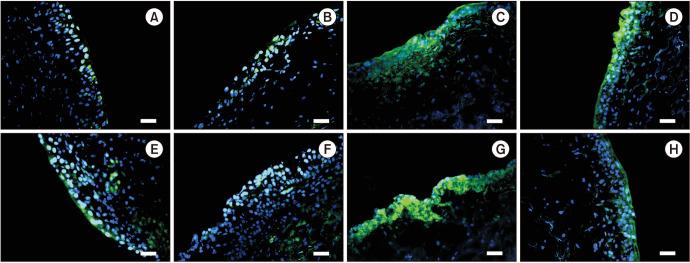
We prospectively enrolled men who planned to undergo surgical treatment for benign prostatic obstruction to analyze TRPV1 and TRPV4 expression in the urothelium using enzyme-linked immunosorbent assay and immunofluorescence staining. Patients were divided into two groups based on urodynamics: the detrusor underactivity (DU) group and the non-DU group. Levels of TRPV1 and TRPV4 were compared between the two groups. We also divided patients into two groups according to degree of subjective urinary urgency symptoms using a 5-point urinary sensation scale and compared the differences in TRPV1 and TRPV4 levels between the two groups. The correlations between urodynamic parameters with TRPV1 or TRPV 4 in all patients were also analyzed.
RESULTS
The levels of TRPV1 and TRPV 4 were not significantly different between the DU group (n=10) and the non-DU group (n=11). When we divided the patients according to degree of subjective urgency, the level of TRPV1 was not significantly different between the urgency group (n=10) and the non-urgency group (n =11), but the level of TRPV4 was significantly increased in the urgency group (p=0.029). There was no significant correlation between the level of TRPV1 or TRPV4 and urodynamic parameters in any patients.
CONCLUSIONS
TRPV4 could be a useful diagnostic biomarker for patients with LUTD.
目的
我们研究了人类尿路上皮组织中瞬时受体电位香草酸(TRPV)表达与下尿路功能障碍(LUTD)之间的关系。
材料与方法
我们前瞻性地招募了计划接受良性前列腺增生手术治疗的男性患者,使用酶联免疫吸附试验和免疫荧光染色分析尿路上皮中 TRPV1 和 TRPV4 的表达。根据尿动力学将患者分为逼尿肌活动低下(DU)组和非-DU 组。比较两组之间 TRPV1 和 TRPV4 的水平。我们还根据主观尿急症状的 5 分感觉量表将患者分为两组,并比较两组之间 TRPV1 和 TRPV4 水平的差异。还分析了所有患者的尿动力学参数与 TRPV1 或 TRPV4 的相关性。
结果
DU 组(n=10)和非-DU 组(n=11)之间 TRPV1 和 TRPV4 的水平无显著差异。当我们根据主观尿急程度将患者分组时,尿急组(n=10)和非尿急组(n=11)之间 TRPV1 的水平无显著差异,但尿急组 TRPV4 的水平显著升高(p=0.029)。在任何患者中,TRPV1 或 TRPV4 的水平与尿动力学参数均无显著相关性。
结论
TRPV4 可能是 LUTD 患者的有用诊断生物标志物。

 Zotero 插件