
非酒精性脂肪性肝病与冠状动脉疾病的关系:一项孟德尔随机化研究。
Relationship between NAFLD and coronary artery disease: A Mendelian randomization study.
机构信息
Division of Endocrinology and Metabolic Diseases , Department of Internal Medicine , Maastricht University Medical Center , Maastricht , The Netherlands.
5211Laboratory for Metabolism and Vascular Medicine , Maastricht University , Maastricht , The Netherlands.
出版信息
Hepatology. 2023 Jan 1;77(1):230-238. doi: 10.1002/hep.32534. Epub 2022 May 18.
BACKGROUND AND AIMS
There is an ongoing debate on whether NAFLD is an active contributor or an innocent bystander in the pathogenesis of coronary artery disease (CAD). The aim of the present study was to assess the causal relationship between NAFLD and CAD.
APPROACH AND RESULTS
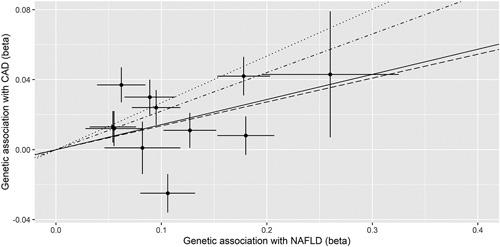
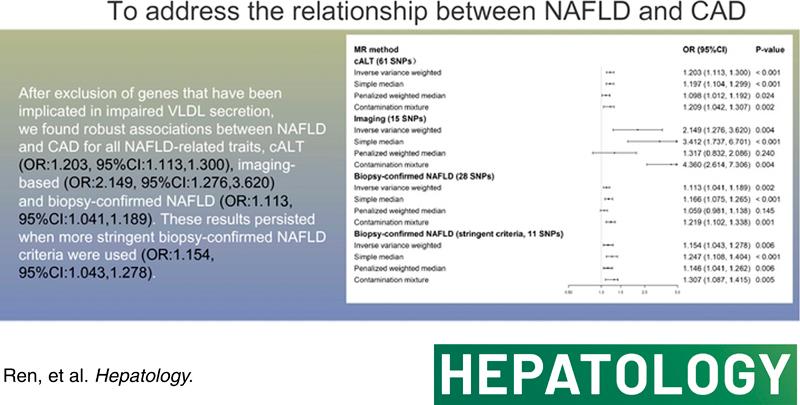
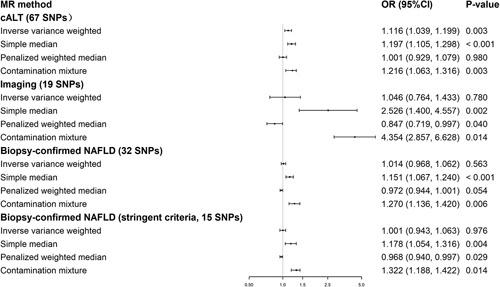
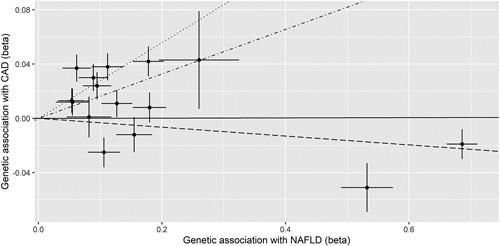
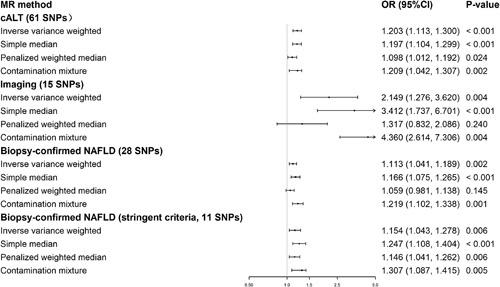
We performed two-sample Mendelian randomization (MR) analyses using summary-level data to assess the association between genetically predicted NAFLD (i.e., chronically elevated serum alanine aminotransferase levels [cALT], imaging-based and biopsy-confirmed NAFLD) and risk of CAD. Analyses were repeated after exclusion of NAFLD susceptibility genes that are associated with impaired VLDL secretion.Inverse-variance weighted MR analyses showed a statistically significant association between genetically predicted cALT and risk of CAD (OR: 1.116, 95% CI: 1.039, 1.199), but not for the other NAFLD-related traits (OR: 1.046, 95% CI: 0.764, 1.433 and OR: 1.014, 95% CI: 0.968, 1.062 for imaging-based and biopsy-confirmed NAFLD, respectively). MR-Egger regression revealed a statistically significant intercept, indicative of directional pleiotropy, for all traits. Repeat analyses after exclusion of genes associated with impaired VLDL secretion showed consistent associations between genetically predicted NAFLD and CAD for all traits (i.e., cALT [OR: 1.203, 95% CI: 1.113, 1.300]), imaging-based (OR: 2.149, 95% CI: 1.276, 3.620) and biopsy-confirmed NAFLD (OR: 1.113, 95% CI: 1.041, 1.189), which persisted when more stringent biopsy-confirmed NAFLD criteria were used (OR: 1.154, 95% CI: 1.043, 1.278) or when more stringent MR methods were applied. MR-Egger regression did not show a statistically significant intercept.
CONCLUSION
The two-sample MR analyses showed a robust association between genetically predicted NAFLD and CAD after exclusion of genetic variants that are implicated in impaired VLDL secretion.
背景和目的
关于非酒精性脂肪性肝病(NAFLD)是否是冠状动脉疾病(CAD)发病机制中的一个活跃的致病因素还是一个无辜的旁观者,目前存在争议。本研究的目的是评估 NAFLD 和 CAD 之间的因果关系。
方法和结果
我们使用两样本 Mendelian 随机化(MR)分析,使用汇总水平数据评估遗传预测的 NAFLD(即慢性升高的血清丙氨酸氨基转移酶水平[cALT]、影像学和活检证实的 NAFLD)与 CAD 风险之间的关联。在排除与 VLDL 分泌受损相关的 NAFLD 易感性基因后,重复了分析。反向方差加权 MR 分析显示,遗传预测的 cALT 与 CAD 风险之间存在统计学显著的关联(OR:1.116,95%CI:1.039,1.199),但其他与 NAFLD 相关的特征(OR:1.046,95%CI:0.764,1.433 和 OR:1.014,95%CI:0.968,1.062 分别用于影像学和活检证实的 NAFLD)则没有。MR-Egger 回归显示所有特征均存在统计学显著的截距,提示存在方向性偏倚。在排除与 VLDL 分泌受损相关的基因后,对所有特征(即 cALT [OR:1.203,95%CI:1.113,1.300])、影像学(OR:2.149,95%CI:1.276,3.620)和活检证实的 NAFLD(OR:1.113,95%CI:1.041,1.189)进行的重复分析显示,遗传预测的 NAFLD 与 CAD 之间存在一致的关联,这种关联在使用更严格的活检证实的 NAFLD 标准(OR:1.154,95%CI:1.043,1.278)或应用更严格的 MR 方法时仍然存在。MR-Egger 回归未显示统计学显著的截距。
结论
在排除与 VLDL 分泌受损相关的遗传变异后,两样本 MR 分析显示遗传预测的 NAFLD 与 CAD 之间存在稳健的关联。
 Zotero 插件