
多种全身炎症生物标志物在非小细胞肺癌术前患者中的预后价值
The Prognostic Value of Multiple Systemic Inflammatory Biomarkers in Preoperative Patients With Non-small Cell Lung Cancer.
作者信息
Wang Kai, Zhao Qidi, Yan Tao, Guo Deyu, Liu Jichang, Wang Guanghui, Du Jiajun
机构信息
Institute of Oncology, Shandong Provincial Hospital, Cheeloo College of Medicine, Shandong University, Jinan, China.
Department of Healthcare Respiratory Medicine, Shandong Provincial Hospital, Cheeloo College of Medicine, Shandong University, Jinan, China.
出版信息
Front Surg. 2022 Apr 4;9:830642. doi: 10.3389/fsurg.2022.830642. eCollection 2022.
INTRODUCTION
The preoperative inflammatory and nutrient status of the patient are closely correlated to the outcome of surgery-based treatment for non-small cell lung cancer (NSCLC). We aimed to investigate the prognostic value of inflammation and nutrient biomarkers in preoperative patients with non-small cell lung cancer (NSCLC) by constructing a prognostic predictive model.
METHODS
We retrospectively studied 995 patients with NSCLC who underwent surgery in the Shandong Provincial Hospital and randomly allocated them into the training and validation group with a ratio of 7:3. We then compared their prognostic performance and conducted univariate Cox analyses with several clinicopathological variables. Based on the performance of the receiver operating characteristic (ROC) curves and decision curves analysis (DCA), the prognostic model was optimized and validated.
RESULT
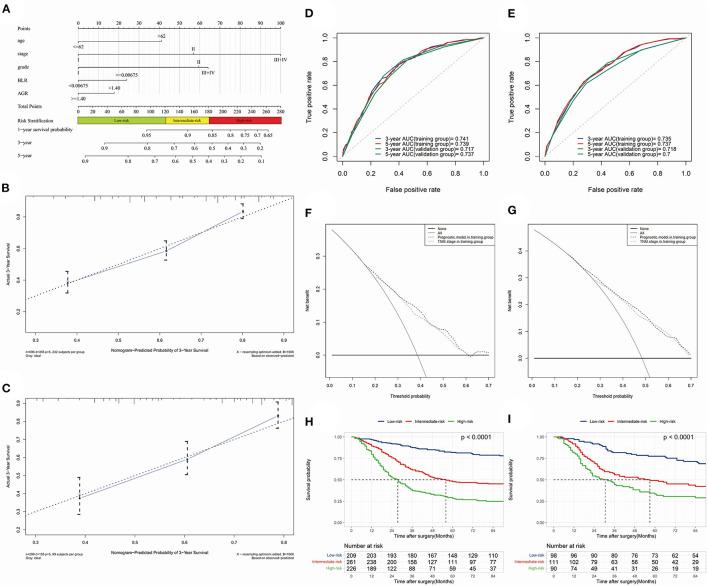
The median overall overall survival (OS) of patients was 74 months. Univariate Cox analysis indicated that fifteen inflammatory biomarkers were significantly correlated with OS ( < 0.100). Multivariate Cox analysis revealed that the model incorporating grade, age, stage, basophil-to-lymphocyte ratio (BLR, ≥0.00675 vs. < 0.00675) and albumin-to-globulin ratio (AGR, ≥1.40 vs. <1.40) showed the maximum area under the curve (AUC, 0.744). The C-index in the training and validation group was 0.690 and 0.683, respectively. The 3-year integrated discrimination improvement (IDI) compared to TNM (Tumor Node Metastasis) stage was 0.035 vs. 0.011 in the training and validation group, respectively.
CONCLUSIONS
Lower AGR, ANRI, and higher BLR were associated with a worse outcome for patients with NSCLC. We constructed a prognostic nomogram with risk stratification based on inflammatory and nutrient biomarkers. The discrimination and calibration abilities of the model were evaluated to confirm its validity, indicating the potential utility of this prognostic model for clinical guidance.
引言
患者术前的炎症和营养状况与非小细胞肺癌(NSCLC)手术治疗的结果密切相关。我们旨在通过构建预后预测模型来研究炎症和营养生物标志物在术前非小细胞肺癌(NSCLC)患者中的预后价值。
方法
我们回顾性研究了995例在山东省立医院接受手术的NSCLC患者,并将他们以7:3的比例随机分为训练组和验证组。然后我们比较了它们的预后表现,并对几个临床病理变量进行了单因素Cox分析。基于受试者工作特征(ROC)曲线和决策曲线分析(DCA)的表现,对预后模型进行了优化和验证。
结果
患者的中位总生存期(OS)为74个月。单因素Cox分析表明,15种炎症生物标志物与OS显著相关(P<0.100)。多因素Cox分析显示,包含分级、年龄、分期、嗜碱性粒细胞与淋巴细胞比值(BLR,≥0.00675 vs. <0.00675)和白蛋白与球蛋白比值(AGR,≥1.40 vs. <1.40)的模型显示出最大曲线下面积(AUC,0.744)。训练组和验证组的C指数分别为0.690和0.683。与TNM(肿瘤淋巴结转移)分期相比,训练组和验证组的3年综合鉴别改善(IDI)分别为0.035和0.011。
结论
较低的AGR、ANRI以及较高的BLR与NSCLC患者的较差预后相关。我们基于炎症和营养生物标志物构建了一个具有风险分层的预后列线图。对该模型的鉴别和校准能力进行了评估以确认其有效性,表明该预后模型在临床指导方面具有潜在效用。



 Zotero 插件