
变构作用发生在动态辅激活因子结构域 KIX 的次要构象微态中。
Allostery in the dynamic coactivator domain KIX occurs through minor conformational micro-states.
机构信息
Life Sciences Institute, University of Michigan, Ann Arbor, Michigan, United States of America.
Program in Chemical Biology, University of Michigan, Ann Arbor, Michigan, United States of America.
出版信息
PLoS Comput Biol. 2022 Apr 22;18(4):e1009977. doi: 10.1371/journal.pcbi.1009977. eCollection 2022 Apr.
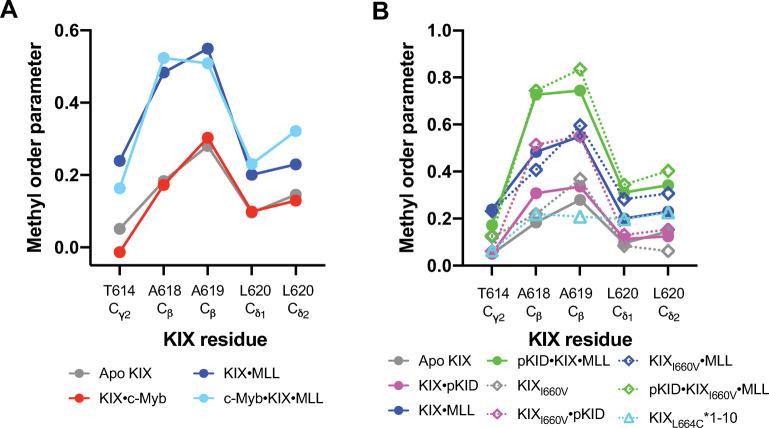
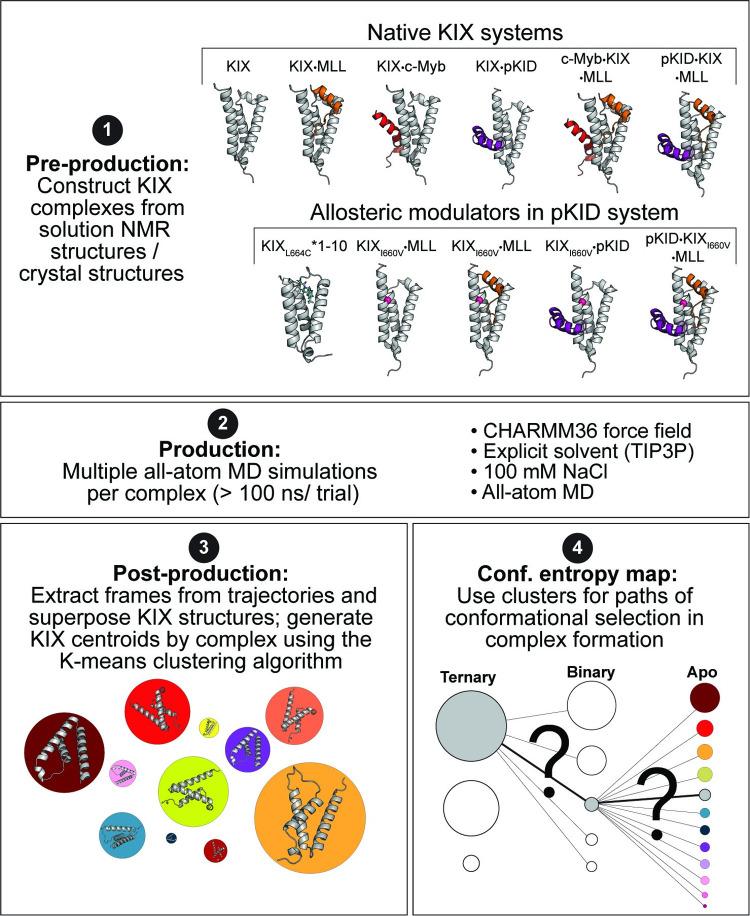
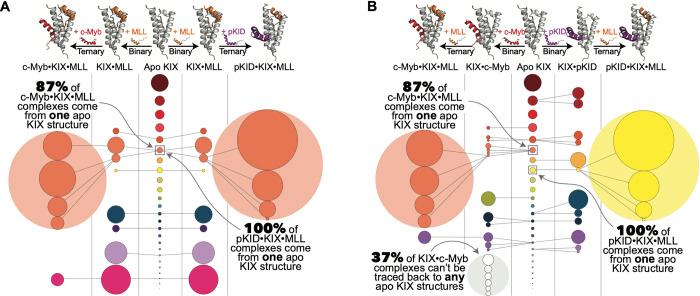
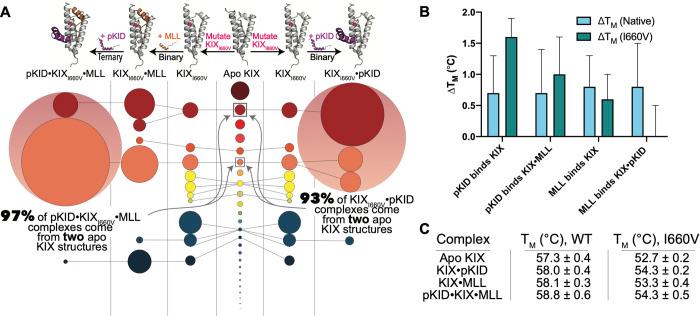
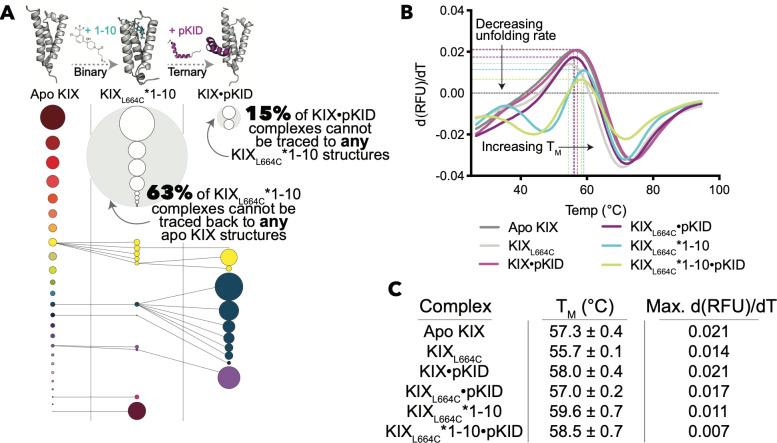
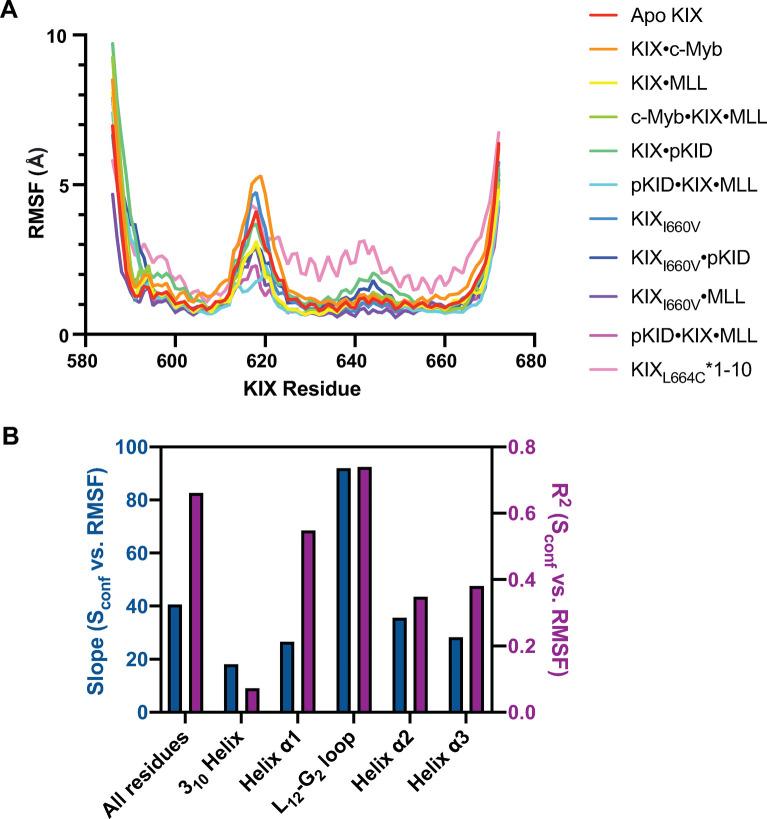
The coactivator KIX of CBP uses two binding surfaces to recognize multiple activators and exhibits allostery in ternary complex formation. Activator•coactivator interactions are central to transcriptional regulation, yet the microscopic origins of allostery in dynamic proteins like KIX are largely unknown. Here, we investigate the molecular recognition and allosteric manifestations involved in two KIX ternary systems c-Myb•KIX•MLL and pKID•KIX•MLL. Exploring the hypothesis that binary complex formation prepays an entropic cost for positive cooperativity, we utilize molecular dynamics simulations, side chain methyl order parameters, and differential scanning fluorimetry (DSF) to explore conformational entropy changes in KIX. The protein's configurational micro-states from structural clustering highlight the utility of protein plasticity in molecular recognition and allostery. We find that apo KIX occupies a wide distribution of lowly-populated configurational states. Each binding partner has its own suite of KIX states that it selects, building a model of molecular recognition fingerprints. Allostery is maximized with MLL pre-binding, which corresponds to the observation of a significant reduction in KIX micro-states observed when MLL binds. With all binding partners, the changes in KIX conformational entropy arise predominantly from changes in the most flexible loop. Likewise, we find that a small molecule and mutations allosterically inhibit/enhance activator binding by tuning loop dynamics, suggesting that loop-targeting chemical probes could be developed to alter KIX•activator interactions. Experimentally capturing KIX stabilization is challenging, particularly because of the disordered nature of particular activators. However, DSF melting curves allow for inference of relative entropic changes that occur across complexes, which we compare to our computed entropy changes using simulation methyl order parameters.
CBP 的共激活因子 KIX 使用两个结合表面来识别多种激活因子,并在三元复合物形成中表现出变构作用。激活剂-共激活剂相互作用是转录调控的核心,但像 KIX 这样的动态蛋白中变构作用的微观起源在很大程度上仍是未知的。在这里,我们研究了涉及两个 KIX 三元系统 c-Myb•KIX•MLL 和 pKID•KIX•MLL 的分子识别和变构表现。我们探索了这样一个假设,即二元复合物的形成预先为正协同作用支付了熵成本,我们利用分子动力学模拟、侧链甲基有序参数和差示扫描荧光法(DSF)来探索 KIX 中的构象熵变化。从结构聚类中,蛋白质的构象微态突出了蛋白质可塑性在分子识别和变构中的作用。我们发现,apo KIX 占据了广泛分布的低 populate 构象状态。每个结合伴侣都有自己的一套 KIX 状态,这些状态构成了分子识别指纹的模型。MLL 预结合会最大限度地发挥变构作用,这与观察到 MLL 结合时 KIX 微态显著减少的观察结果相对应。对于所有的结合伴侣,KIX 构象熵的变化主要来自于最灵活的环的变化。同样,我们发现小分子和突变通过调节环动力学在变构上抑制/增强激活剂的结合,这表明可以开发针对环的化学探针来改变 KIX-激活剂相互作用。实验上捕获 KIX 的稳定化是具有挑战性的,特别是因为特定激活剂的无序性质。然而,DSF 熔点曲线允许推断复合物之间发生的相对熵变化,我们将这些变化与我们使用模拟甲基有序参数计算的熵变化进行比较。


 Zotero 插件