
利用地面和便携式高效空气过滤器对学校环境中的 SARS-CoV-2 进行监测的挑战:新鲜的还是陈旧的 RNA?
The challenge of SARS-CoV-2 environmental monitoring in schools using floors and portable HEPA filtration units: Fresh or relic RNA?
机构信息
Department of Civil and Environmental Engineering, One Shields Avenue, University of California, Davis, California, United States of America.
Genome Center, University of California, Davis, California, United States of America.
出版信息
PLoS One. 2022 Apr 22;17(4):e0267212. doi: 10.1371/journal.pone.0267212. eCollection 2022.
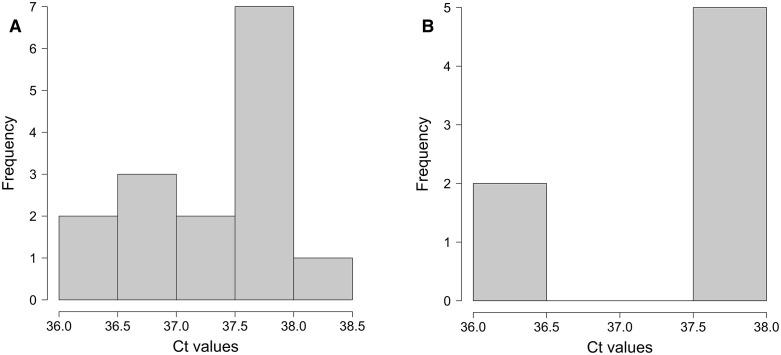
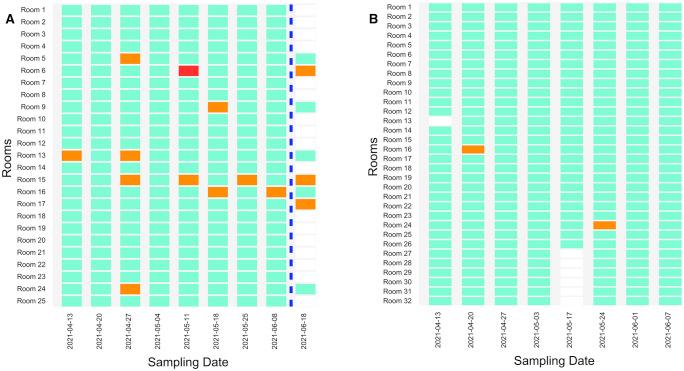
Testing surfaces in school classrooms for the presence of SARS-CoV-2, the virus that causes COVID-19, can provide public-health information that complements clinical testing. We monitored the presence of SARS-CoV-2 RNA in five schools (96 classrooms) in Davis, California (USA) by collecting weekly surface-swab samples from classroom floors and/or portable high-efficiency particulate air (HEPA) units (n = 2,341 swabs). Twenty-two surfaces tested positive, with qPCR cycle threshold (Ct) values ranging from 36.07-38.01. Intermittent repeated positives in a single room were observed for both floor and HEPA filter samples for up to 52 days, even following regular cleaning and HEPA filter replacement after a positive result. We compared the two environmental sampling strategies by testing one floor and two HEPA filter samples in 57 classrooms at Schools D and E. HEPA filter sampling yielded 3.02% and 0.41% positivity rates per filter sample collected for Schools D and E, respectively, while floor sampling yielded 0.48% and 0% positivity rates. Our results indicate that HEPA filter swabs are more sensitive than floor swabs at detecting SARS-CoV-2 RNA in interior spaces. During the study, all schools were offered weekly free COVID-19 clinical testing through Healthy Davis Together (HDT). HDT also offered on-site clinical testing in Schools D and E, and upticks in testing participation were observed following a confirmed positive environmental sample. However, no confirmed COVID-19 cases were identified among students associated with classrooms yielding positive environmental samples. The positive samples detected in this study appeared to contain relic viral RNA from individuals infected before the monitoring program started and/or RNA transported into classrooms via fomites. High-Ct positive results from environmental swabs detected in the absence of known active infections supports this conclusion. Additional research is needed to differentiate between fresh and relic SARS-CoV-2 RNA in environmental samples and to determine what types of results should trigger interventions.
对学校教室中的 SARS-CoV-2 进行检测,以确定其是否存在,这种病毒是导致 COVID-19 的病原体,这可以提供公共卫生信息,与临床检测互为补充。我们从加利福尼亚州戴维斯市的五所学校(96 间教室)中收集每周的表面拭子样本,以监测 SARS-CoV-2 RNA 的存在情况,这些样本取自教室地板和/或便携式高效微粒空气(HEPA)设备(n = 2,341 个拭子)。22 个表面拭子的检测结果为阳性,实时荧光定量 PCR(qPCR)的循环阈值(Ct)值范围为 36.07-38.01。在单个房间中,地板和 HEPA 过滤器样本均出现间歇性重复阳性,最长持续时间达 52 天,甚至在定期清洁和在出现阳性结果后更换 HEPA 过滤器后也是如此。我们通过在学校 D 和 E 的 57 间教室中测试一个地板样本和两个 HEPA 过滤器样本,比较了这两种环境采样策略。对于学校 D 和 E,每采集一个 HEPA 过滤器样本的阳性率分别为 3.02%和 0.41%,而地板样本的阳性率分别为 0.48%和 0%。我们的研究结果表明,在检测室内空间中的 SARS-CoV-2 RNA 时,HEPA 过滤器拭子比地板拭子更敏感。在研究期间,通过 Healthy Davis Together(HDT)为所有学校提供每周免费的 COVID-19 临床检测。HDT 还在学校 D 和 E 提供现场临床检测,在确认环境样本呈阳性后,检测参与率有所上升。然而,与产生阳性环境样本的教室相关的学生中未发现确诊的 COVID-19 病例。本研究中检测到的阳性样本似乎包含了在监测计划开始之前感染的个体的遗留病毒 RNA,和/或通过载体进入教室的 RNA。从环境拭子中检测到的高 Ct 值阳性结果支持这一结论。需要进一步的研究来区分环境样本中新鲜和遗留的 SARS-CoV-2 RNA,并确定哪些类型的结果应触发干预措施。

 Zotero 插件