
移民背景如何影响 COVID-19 疫苗接种意愿?一般态度、宗教信仰、文化适应和对感染的恐惧之间的复杂关系。
How Does Migration Background Affect COVID-19 Vaccination Intentions? A Complex Relationship Between General Attitudes, Religiosity, Acculturation and Fears of Infection.
机构信息
Chemnitz University of Technology, Chemnitz, Germany.
出版信息
Front Public Health. 2022 Apr 6;10:854146. doi: 10.3389/fpubh.2022.854146. eCollection 2022.
OBJECTIVES
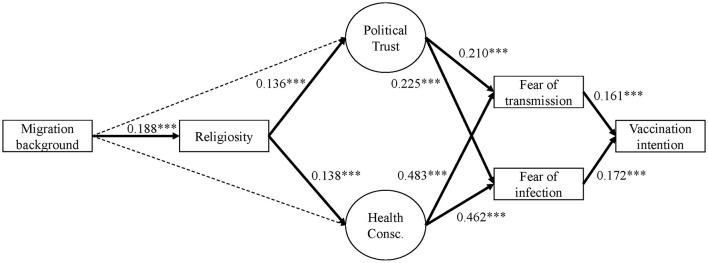
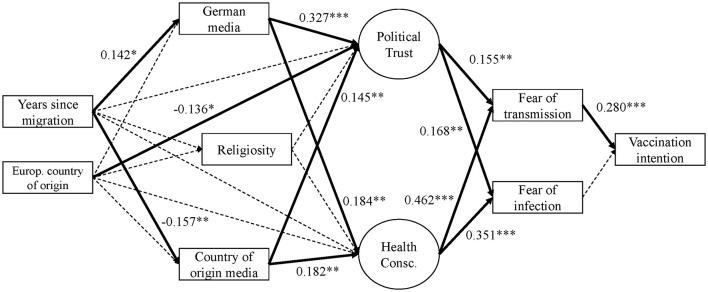
The aim of the study is to investigate the relationship between migration background and COVID-19 vaccine intentions, exploring multiple mediation paths. We argue that the migrational and sociocultural background influences general attitudes toward health and political/public institutions. The effects of these general attitudes on vaccination intentions are mediated by fears of infection. Additionally, we analyze a migrant-only model including acculturation variables (years since migration, foreign and host country media consumption) and region of origin (European vs. Non-European). Design: The data (n = 1027) stem from an online access panel collected between March 15 and March 25, 2021. Quotas for gender and age were set according the online population of Germany. The use of an oversampling framework for first generation migrants resulted in a sample with 50% first generation migrants and 50% native Germans without migration background. Models were calculated using a Structural Equation Modeling approach.
RESULTS
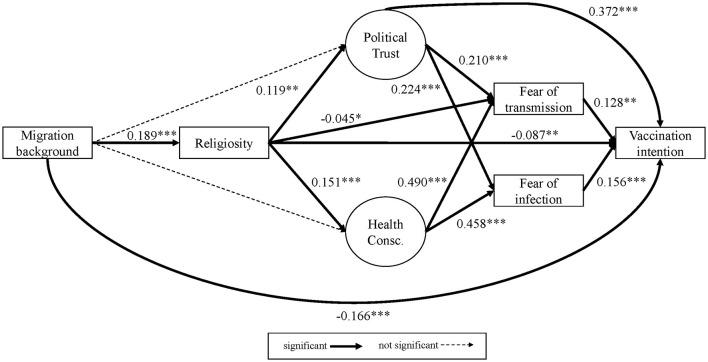
Migration background both increases and decreases antecedents of vaccination intentions. Being a migrant increases positive antecedents like religiosity, which in turn positively influence general attitudes and thus fears of infection and vaccination intentions. But being a migrant has also a significant direct negative association with vaccination intentions, implying missing mediators. Increasing years since migration increase host country (German) media consumption and decrease consumption of media from the country of origin. Both media variables are positively associated with political trust and health consciousness. Additionally, European compared to Non-European migrants have less political trust, fear of personal infection and lower vaccination intentions on the whole.
CONCLUSIONS
The study found that vaccination intentions can be understood by applying the proposed hypothetical structure. We found complex associations of the migration and sociocultural background and COVID-19 vaccination intentions, where antecedents of vaccination intentions are both increased and decreased by migration background and migration specific factors.
目的
本研究旨在探讨移民背景与 COVID-19 疫苗接种意愿之间的关系,并探索多种中介途径。我们认为,移民和社会文化背景会影响人们对健康和政治/公共机构的总体态度。这些总体态度对疫苗接种意愿的影响是通过对感染的恐惧来介导的。此外,我们还分析了一个仅针对移民的模型,其中包括文化适应变量(移民时间、外国和本国媒体消费)和原籍地区(欧洲与非欧洲)。设计:数据(n=1027)来自于 2021 年 3 月 15 日至 3 月 25 日期间通过在线访问面板收集的。性别和年龄的配额是根据德国在线人口设置的。通过使用第一代移民的超采样框架,我们的样本中有 50%的第一代移民和 50%的没有移民背景的德国本地人。模型是使用结构方程建模方法计算的。
结果
移民背景既增加也减少了疫苗接种意愿的前因变量。作为移民,会增加宗教信仰等积极的前因变量,而宗教信仰又会积极影响总体态度,从而影响对感染和疫苗接种的恐惧以及疫苗接种意愿。但作为移民也与疫苗接种意愿有显著的直接负相关,这意味着存在缺失的中介变量。移民时间的增加会增加对本国(德国)媒体的消费,减少对原籍国媒体的消费。这两个媒体变量与政治信任和健康意识呈正相关。此外,与非欧洲移民相比,欧洲移民的政治信任度、对个人感染的恐惧程度和整体疫苗接种意愿较低。
结论
本研究发现,通过应用提出的假设结构,可以理解疫苗接种意愿。我们发现,移民和社会文化背景与 COVID-19 疫苗接种意愿之间存在复杂的关联,其中疫苗接种意愿的前因变量既因移民背景而增加,也因移民背景而减少,同时还受到移民特定因素的影响。


 Zotero 插件