
预测普通外科急诊跨院转诊患者的预后
Predicting Outcomes for Interhospital Transferred Patients of Emergency General Surgery.
作者信息
Cave Brandon, Najafali Daniel, Gilliam William, Barr Jackson F, Cain Christian, Yum Chris, Palmer Jamie, Tanveer Safura, Esposito Emily, Tran Quincy K
机构信息
University of Maryland School of Medicine, Baltimore, MD, USA.
The Research Associate Program in Emergency Medicine and Critical Care, Department of Emergency Medicine, University of Maryland School of Medicine, Baltimore, MD, USA.
出版信息
Crit Care Res Pract. 2022 Apr 15;2022:8137735. doi: 10.1155/2022/8137735. eCollection 2022.
BACKGROUND
Interhospital transferred (IHT) emergency general surgery (EGS) patients are associated with high care intensity and mortality. However, prior studies do not focus on patient-level data. Our study, using each IHT patient's data, aimed to understand the underlying cause for IHT EGS patients' outcomes. We hypothesized that transfer origin of EGS patients impacts outcomes due to critical illness as indicated by higher Sequential Organ Failure Assessment (SOFA) score and disease severity.
MATERIALS AND METHODS
We conducted a retrospective analysis of all adult patients transferred to our quaternary academic center's EGS service from 01/2014 to 12/2016. Only patients transferred to our hospital with EGS service as the primary service were eligible. We used multivariable logistic regression and probit analysis to measure the association of patients' clinical factors and their outcomes (mortality and survivors' hospital length of stay [HLOS]).
RESULTS
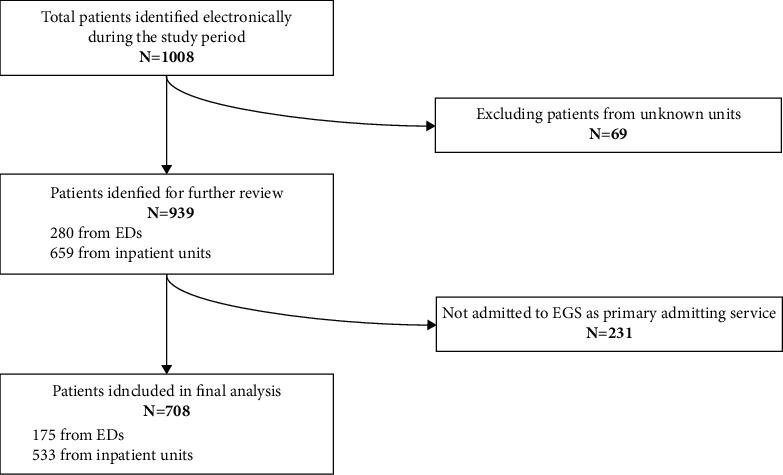
We analyzed 708 patients, 280 (39%) from an ICU, 175 (25%) from an ED, and 253 (36%) from a surgical ward. Compared to ED patients, patients transferred from the ICU had higher mean (SD) SOFA score (5.7 (4.5) vs. 2.39 (2), < 0.001), longer HLOS, and higher mortality. Transferring from ICU (OR 2.95, 95% CI 1.36-6.41, =0.006), requiring laparotomy (OR 1.96, 95% CI 1.04-3.70, =0.039), and SOFA score (OR 1.22, 95% CI 1.13-1.32, < 0.001) were associated with higher mortality.
CONCLUSIONS
At our academic center, patients transferred from an ICU were more critically ill and had longer HLOS and higher mortality. We identified SOFA score and a few conditions and diagnoses as associated with patients' outcomes. Further studies are needed to confirm our observation.
背景
院际转运(IHT)的急诊普通外科(EGS)患者护理强度高且死亡率高。然而,既往研究未关注患者层面的数据。我们的研究利用每位IHT患者的数据,旨在了解IHT EGS患者预后的潜在原因。我们假设,EGS患者的转运来源会因病情严重程度(如序贯器官衰竭评估(SOFA)评分升高所示)和疾病严重程度而影响预后。
材料与方法
我们对2014年1月至2016年12月期间转至我们四级学术中心EGS科室的所有成年患者进行了回顾性分析。仅那些以EGS科室作为主要科室转至我院的患者符合条件。我们使用多变量逻辑回归和概率分析来衡量患者临床因素与其预后(死亡率和幸存者的住院时间[HLOS])之间的关联。
结果
我们分析了708例患者,其中280例(39%)来自重症监护病房(ICU),175例(25%)来自急诊科(ED),253例(36%)来自外科病房。与ED患者相比,从ICU转出的患者平均(标准差)SOFA评分更高(5.7(4.5)对2.39(2),<0.001),HLOS更长,死亡率更高。从ICU转出(比值比2.95,95%置信区间1.36 - 6.41,P = 0.006)、需要剖腹手术(比值比1.96,95%置信区间1.04 - 3.70,P = 0.039)以及SOFA评分(比值比1.22,95%置信区间1.13 - 1.32,<0.001)与更高的死亡率相关。
结论
在我们的学术中心,从ICU转出的患者病情更严重,HLOS更长,死亡率更高。我们确定SOFA评分以及一些病情和诊断与患者预后相关联。需要进一步研究来证实我们的观察结果。

 Zotero 插件