
不良童年经历(包括低收入家庭和同伴孤立)与日本青少年肥胖的关联:A-CHILD 研究结果。
Association of Adverse Childhood Experiences Including Low Household Income and Peer Isolation With Obesity Among Japanese Adolescents: Results From A-CHILD Study.
机构信息
Department of Global Health Promotion, Tokyo Medical and Dental University (TMDU), Tokyo, Japan.
Research Fellow of Japan Society for the Promotion of Science, Tokyo, Japan.
出版信息
Front Public Health. 2022 Apr 5;10:754765. doi: 10.3389/fpubh.2022.754765. eCollection 2022.
BACKGROUND
Adverse childhood experience (ACE) is a major risk factor for obesity in both adults and adolescents. Although, arguably, peer isolation and low household income could be conceived as of ACEs, few studies have included these experiences as ACEs.
OBJECTIVES
This study aims to examine whether ACEs, including peer isolation and low household income, are associated with obesity in adolescents.
METHODS
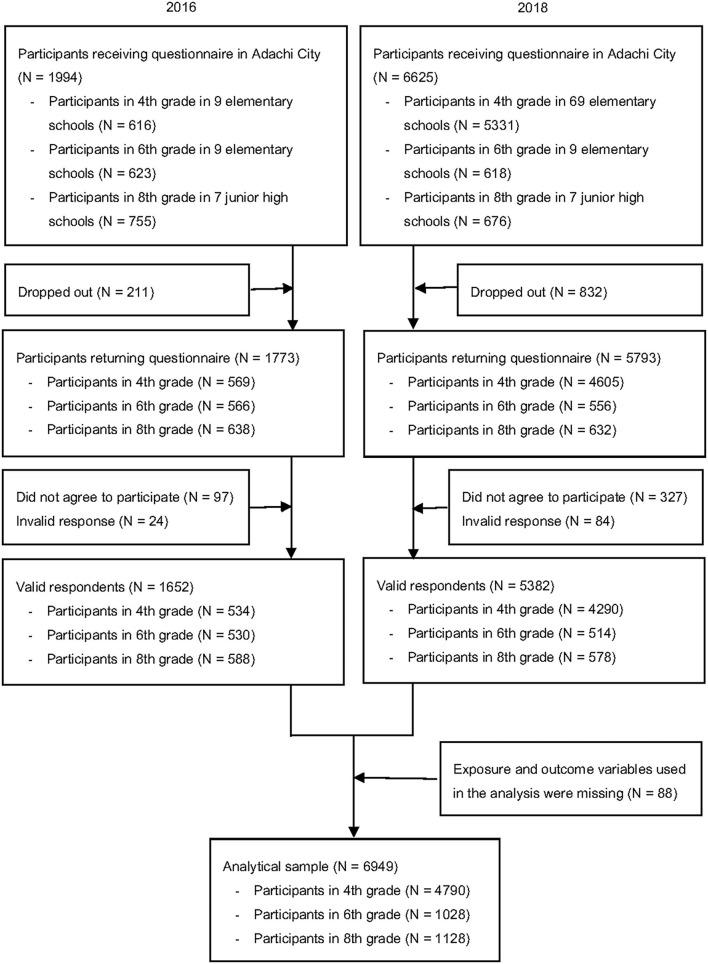
We used pooled data from the Adachi Child Health Impact of Living Difficulty (A-CHILD) study in 2016 and 2018, which is a school-based cross-sectional study in Adachi City, Tokyo, Japan, = 6,946, 4th (9-10 years old), 6th (11-12 years old), and 8th (13-14 years old) grades. Among the eight items of ACEs, adolescents assessed one item, including peer isolation, and their caregivers assessed seven other items using questionnaires. The adolescents' body mass index (BMI) was measured in school health checkups and calculated to fit the World Health Organization (WHO) standards. Multinomial logistic regression was applied to investigate the association of the cumulative ACEs and each type of ACE with BMI, in which the study was conducted in 2020.
RESULTS
The number of ACEs was not associated with overweight or obesity among adolescents after adjusting for covariates. As for each type of ACE, single parenthood and low household income showed a significant independent association with obesity.
CONCLUSIONS
The number of ACEs was not associated with overweight or obesity in Japanese adolescents, while single parenthood and low household income showed a significant positive association with obesity. Further longitudinal studies are needed to replicate this association among adolescents.
背景
不良的童年经历(ACE)是成年人和青少年肥胖的主要危险因素。尽管同伴孤立和低家庭收入可以被认为是 ACE,但很少有研究将这些经历包括在内。
目的
本研究旨在探讨 ACE(包括同伴孤立和低家庭收入)是否与青少年肥胖有关。
方法
我们使用了 2016 年和 2018 年在日本东京足立区进行的基于学校的横断面研究——足立儿童生活困难对健康的影响(A-CHILD)的汇总数据,共有 6946 名 4 年级(9-10 岁)、6 年级(11-12 岁)和 8 年级(13-14 岁)的学生参与。在八项 ACE 中,青少年通过问卷评估了其中一项,包括同伴孤立,而他们的照顾者则评估了另外七项。青少年的体重指数(BMI)在学校体检中进行测量,并按照世界卫生组织(WHO)标准进行计算。我们采用多分类逻辑回归分析了累积 ACE 与每种 ACE 与 BMI 的关系,该研究于 2020 年进行。
结果
在调整了协变量后,ACE 的数量与青少年超重或肥胖无关。就每种 ACE 而言,单亲家庭和低家庭收入与肥胖有显著的独立关联。
结论
ACE 的数量与日本青少年的超重或肥胖无关,而单亲家庭和低家庭收入与肥胖有显著的正相关。需要进一步的纵向研究来验证青少年中这种关联。
 Zotero 插件