
非洲全民健康保险:对机构模式文献的叙述性综述。
Universal health insurance in Africa: a narrative review of the literature on institutional models.
机构信息
Institut Santé et Développement (ISED), Cheikh Anta Diop University, Dakar, Senegal
Institut Santé et Développement (ISED), Cheikh Anta Diop University, Dakar, Senegal.
出版信息
BMJ Glob Health. 2022 Apr;7(4). doi: 10.1136/bmjgh-2021-008219.
INTRODUCTION
Several African countries have introduced universal health insurance (UHI) programmes. These programmes aim to extend health insurance to groups that are usually excluded, namely informal workers and the indigent. Countries use different approaches. The purpose of this article is to study their institutional characteristics and their contribution to the achievement of universal health coverage (UHC) goals.
METHOD
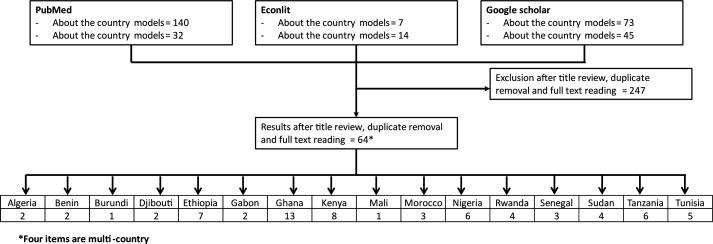
This study is a narrative review. It focused on African countries with a UHI programme for at least 4 years. We identified 16 countries. We then compared how these UHI schemes mobilise, pool and use funds to purchase healthcare. Finally, we synthesised how all these aspects contribute to achieving the main objectives of UHC (access to care and financial protection).
RESULTS
Ninety-two studies were selected. They found that government-run health insurance was the dominant model in Africa and that it produced better results than community-based health insurance (CBHI). They also showed that private health insurance was marginal. In a context with a large informal sector and a substantial number of people with low contributory capacity, the review also confirmed the limitations of contribution-based financing and the need to strengthen tax-based financing. It also showed that high fragmentation and voluntary enrolment, which are considered irreconcilable with universal insurance, characterise most UHI systems in Africa.
CONCLUSION
Public health insurance is more likely to contribute to the achievement of UHC goals than CBHI, as it ensures better management and promotes the pooling of resources on a larger scale.
简介
一些非洲国家已经引入了全民健康保险(UHI)计划。这些计划旨在将健康保险扩大到通常被排除在外的群体,即非正式工人和贫困人群。各国采用了不同的方法。本文的目的是研究它们的制度特征及其对实现全民健康覆盖(UHC)目标的贡献。
方法
本研究是一项叙述性综述。它侧重于至少有 4 年 UHI 计划的非洲国家。我们确定了 16 个国家。然后,我们比较了这些 UHI 计划如何筹集、汇集和使用资金来购买医疗保健。最后,我们综合分析了所有这些方面如何有助于实现 UHC 的主要目标(获得医疗保健和财务保护)。
结果
共选择了 92 项研究。研究结果表明,政府运营的健康保险是非洲的主要模式,其效果优于社区健康保险(CBHI)。研究还表明,私人健康保险的作用微不足道。在一个非正式部门庞大、缴费能力低的人数众多的背景下,该综述还证实了基于缴费的融资的局限性,以及加强基于税收的融资的必要性。它还表明,大多数非洲 UHI 系统的特点是高度碎片化和自愿参保,这被认为与全民保险是不可调和的。
结论
公共健康保险更有可能有助于实现 UHC 目标,因为它可以确保更好的管理,并促进资源在更大规模上的汇集。
 Zotero 插件