
羧甲基壳聚糖分子量和浓度对胶原蛋白仿生矿化的影响。
Influence of molecular weight and concentration of carboxymethyl chitosan on biomimetic mineralization of collagen.
作者信息
Wang Ruoxun, Guo Jiaxin, Lin Xiaoxuan, Chen Sipeng, Mai Sui
机构信息
Department of Operative Dentistry and Endodontics, Guanghua Hospital of Stomatology, School of Stomatology, Sun Yat-sen University Guangzhou China
Guangdong Provincial Key Laboratory of Stomatology Guangzhou China.
出版信息
RSC Adv. 2020 Mar 31;10(22):12970-12981. doi: 10.1039/d0ra00999g. eCollection 2020 Mar 30.
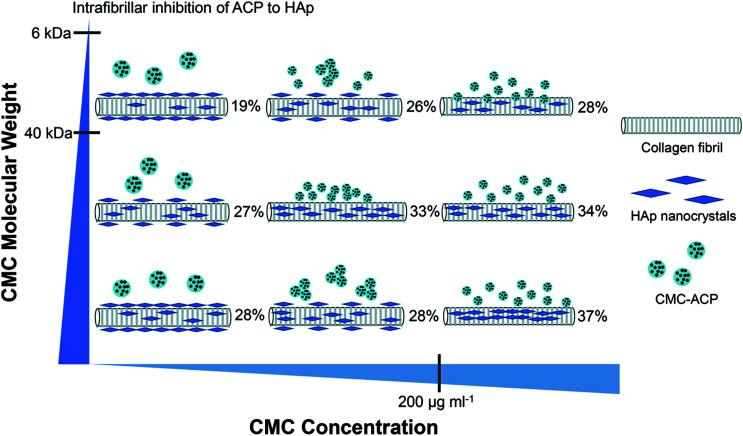
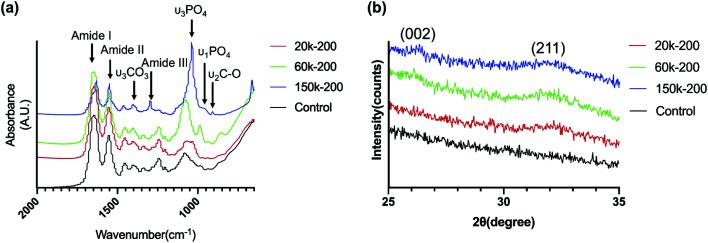
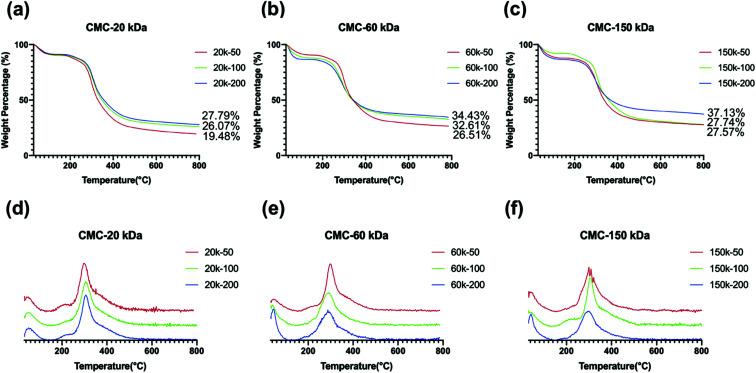
The objective of the present study was to systematically investigate the influence of molecular weight (MW) and concentration of carboxymethyl chitosan (CMC), which served as non-collagenous protein (NCP) surrogates, on biomimetic mineralization of type I collagen. Supersaturated CMC-stabilized amorphous calcium-phosphate (CMC-ACP) dispersions containing different MWs (20 kDa, 60 kDa, 150 kDa) and concentrations (25, 50, 100, 200, 400 μg ml) of CMC were prepared. After mineralization in the aforementioned dispersions for 7 days, the pattern and extent of biomimetic mineralization of collagen scaffolds were investigated. Our study showed that increasing CMC concentration resulted in increasing stability and decreasing particle size of CMC-ACP dispersions. Images from scanning and transmission electron microscopy revealed that intrafibrillar mineralization of collagen was obtained with 20k-200, 60k-100, 60k-200 and 150k-200 CMC-ACP dispersions, with hydroxyapatite (HAp) formation confirmed by Fourier transform infrared spectroscopy and X-ray diffraction measurements, whereas HAp formed extrafibrillar clusters in other collagen scaffolds. Thermogravimetric analysis showed that the combined effect of MW and concentration of CMC contributed to different extents of biomimetic mineralization, and was correlated with the stability and particle size of CMC-ACP dispersions, and the size-exclusion characteristics of type I collagen. The results of this work support the effective function of CMC as NCP analogs, and provide parameters of MWs and concentrations of CMC for applications in hard tissue engineering as well as insights into intersections of mechanisms in biomimetic mineralization.
本研究的目的是系统地研究作为非胶原蛋白(NCP)替代物的羧甲基壳聚糖(CMC)的分子量(MW)和浓度对I型胶原蛋白仿生矿化的影响。制备了含有不同分子量(20 kDa、60 kDa、150 kDa)和浓度(25、50、100、200、400 μg/ml)CMC的过饱和CMC稳定的无定形磷酸钙(CMC-ACP)分散体。在上述分散体中矿化7天后,研究了胶原支架仿生矿化的模式和程度。我们的研究表明,增加CMC浓度会导致CMC-ACP分散体的稳定性增加和粒径减小。扫描电子显微镜和透射电子显微镜图像显示,使用20k-200、60k-100、60k-200和150k-200 CMC-ACP分散体可实现胶原的原纤维内矿化,傅里叶变换红外光谱和X射线衍射测量证实了羟基磷灰石(HAp)的形成,而在其他胶原支架中HAp形成了原纤维外簇。热重分析表明,CMC的分子量和浓度的综合作用导致了不同程度的仿生矿化,并且与CMC-ACP分散体的稳定性和粒径以及I型胶原蛋白的尺寸排阻特性相关。这项工作的结果支持了CMC作为NCP类似物的有效功能,并提供了CMC的分子量和浓度参数,用于硬组织工程应用以及对仿生矿化机制交叉点的见解。


 Zotero 插件