
聚苯胺包覆的三氧化钨作为从水介质中去除橙色G染料的有效吸附剂。
Polyaniline coated tungsten trioxide as an effective adsorbent for the removal of orange G dye from aqueous media.
作者信息
Hsini Abdelghani, Naciri Yassine, Bouziani Asmae, Aarab Nouh, Essekri Abdelilah, Imgharn Abdelaziz, Laabd Mohamed, Navío J A, Puga F, Lakhmiri Rajae, Albourine Abdallah
机构信息
Laboratory of Materials and Environment, Faculty of Sciences, Ibn Zohr University Agadir Morocco
Chemical Engineering Department, Middle East Technical University Ankara Turkey.
出版信息
RSC Adv. 2021 Nov 9;11(50):31272-31283. doi: 10.1039/d1ra04135e. eCollection 2021 Sep 21.
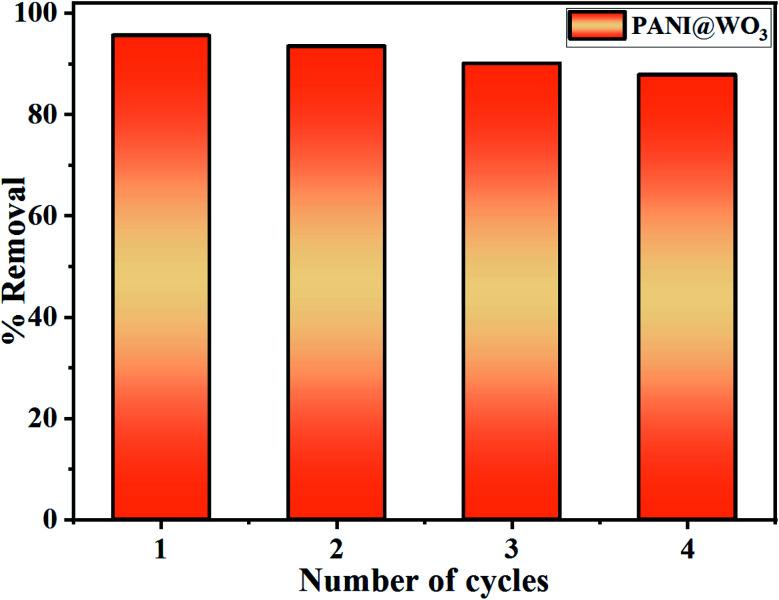
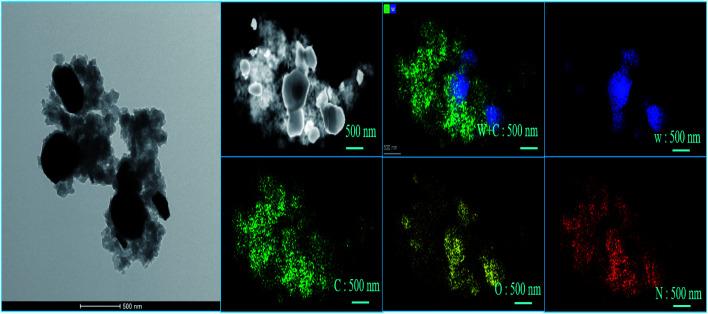
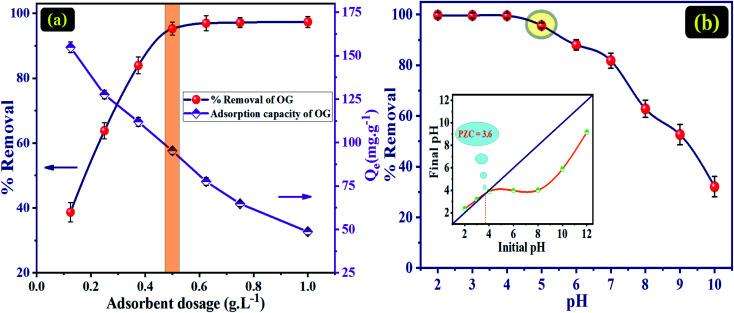
In this work, the core-shell PANI@WO composite was obtained from the reaction of aniline monomer polymerization with WO particles; sodium persulfate was used as an oxidant. Various analytical techniques such as scanning electron microscopy (SEM-EDS), X-ray diffraction (XRD), Fourier transform infrared spectroscopy (FTIR), Brunauer-Emmett-Teller (BET), and X-ray photoelectron spectroscopy (XPS) were used to characterize the as-prepared PANI@WO adsorbent, which well confirmed that the WO particles were coated by polyaniline polymer. The PANI@WO composite was tested as an adsorbent to remove reactive orange G (OG) for the first time. pH, adsorbent dose, contact time, initial dye concentration, and temperature were systematically investigated in order to study their effect on the adsorption process. The experimental findings showed that the PANI@WO composite has considerable potential to remove an aqueous OG dye. Langmuir and Freundlich's models were used to analyze the equilibrium isotherms of OG dye adsorption on the PANI@WO composite. As a result, the best correlation of the experimental data was provided by the Langmuir model, and the maximum capacity of adsorption was 226.50 mg g. From a thermodynamic point of view, the OG dye adsorption process occurred spontaneously and endothermically. Importantly, PANI@WO still exhibited an excellent adsorption capability after four regeneration cycles, indicating the potential reusability of the PANI@WO composite. These results indicate that the as prepared PANI@WO composite could be employed as an efficient adsorbent and was much better than the parent material adsorption of OG dye.
在本工作中,核壳结构的聚苯胺@WO复合材料是通过苯胺单体与WO颗粒聚合反应得到的;过硫酸钠用作氧化剂。采用扫描电子显微镜(SEM-EDS)、X射线衍射(XRD)、傅里叶变换红外光谱(FTIR)、布鲁诺尔-埃米特-泰勒(BET)和X射线光电子能谱(XPS)等多种分析技术对制备的聚苯胺@WO吸附剂进行表征,充分证实了WO颗粒被聚苯胺聚合物包覆。首次将聚苯胺@WO复合材料作为吸附剂用于去除活性橙G(OG)。系统研究了pH值、吸附剂用量、接触时间、初始染料浓度和温度对吸附过程的影响。实验结果表明,聚苯胺@WO复合材料具有去除水中OG染料的巨大潜力。采用朗缪尔和弗伦德利希模型分析了OG染料在聚苯胺@WO复合材料上的吸附平衡等温线。结果表明,朗缪尔模型对实验数据的拟合效果最佳,最大吸附量为226.50 mg/g。从热力学角度来看,OG染料的吸附过程是自发的且吸热的。重要的是,聚苯胺@WO在四个再生循环后仍表现出优异的吸附能力,表明聚苯胺@WO复合材料具有潜在的可重复使用性。这些结果表明,所制备的聚苯胺@WO复合材料可作为一种高效吸附剂,对OG染料的吸附性能远优于母体材料。




 Zotero 插件