
501Y.V2 型严重急性呼吸综合征冠状病毒 2 变体抗体抗性中的热力学和动力学
Thermodynamics and kinetics in antibody resistance of the 501Y.V2 SARS-CoV-2 variant.
作者信息
Ngo Son Tung, Nguyen Trung Hai, Pham Duc-Hung, Tung Nguyen Thanh, Nam Pham Cam
机构信息
Laboratory of Theoretical and Computational Biophysics, Ton Duc Thang University Ho Chi Minh City Vietnam
Faculty of Applied Sciences, Ton Duc Thang University Ho Chi Minh City Vietnam.
出版信息
RSC Adv. 2021 Oct 13;11(53):33438-33446. doi: 10.1039/d1ra04134g. eCollection 2021 Oct 8.
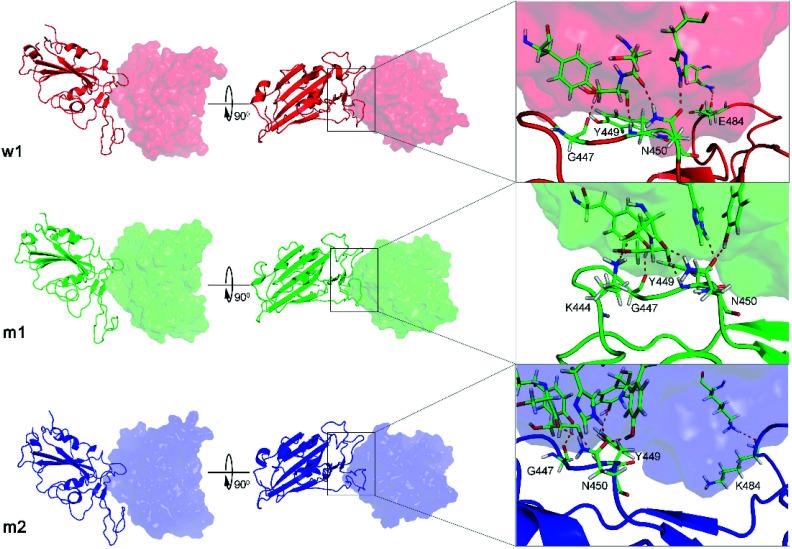
Understanding the thermodynamics and kinetics of the binding process of an antibody to the SARS-CoV-2 receptor-binding domain (RBD) of the spike protein is very important for the development of COVID-19 vaccines. In particular, it is essential to understand how the binding mechanism may change under the effects of RBD mutations. In this context, we have demonstrated that the South African variant (B1.351 or 501Y.V2) can resist the neutralizing antibody (NAb). Three substitutions in the RBD including K417N, E484K, and N501Y alter the free energy landscape, binding pose, binding free energy, binding kinetics, hydrogen bonding, nonbonded contacts, and unbinding pathway of RBD + NAb complexes. The low binding affinity of NAb to 501Y.V2 RBD confirms the antibody resistance of the South African variant. Moreover, the fragment of NAb + RBD can be used as an affordable model to investigate changes in the binding process between the mutated RBD and antibodies.
了解抗体与新冠病毒刺突蛋白的受体结合域(RBD)结合过程的热力学和动力学,对于新冠疫苗的研发非常重要。特别是,了解在RBD突变的影响下结合机制如何变化至关重要。在此背景下,我们已经证明南非变体(B1.351或501Y.V2)能够抵抗中和抗体(NAb)。RBD中的三个取代,包括K417N、E484K和N501Y,改变了RBD + NAb复合物的自由能态势、结合姿势、结合自由能、结合动力学、氢键、非键接触和解离途径。NAb对501Y.V2 RBD的低结合亲和力证实了南非变体的抗体抗性。此外,NAb + RBD片段可作为一种经济实惠的模型,用于研究突变RBD与抗体之间结合过程的变化。



 Zotero 插件