
基于碳点和铜纳米簇的铜和生物硫醇比率荧光探针。
Ratiometric fluorescence probe of Cu and biothiols by using carbon dots and copper nanoclusters.
作者信息
Zhao Ning, Song Jianqiang, Huang Zheng, Yang Xiuying, Wang Yousheng, Zhao Longshan
机构信息
School of Pharmacy, Shenyang Pharmaceutical University 103 Wenhua Road Shenhe District Shenyang Liaoning 110016 P. R. China
Hainan Vocational University of Science and Technology, Key Laboratory of Medicinal and Edible Plants Resources of Hainan Province Haikou Hainan 571126 China.
出版信息
RSC Adv. 2021 Oct 15;11(53):33662-33674. doi: 10.1039/d1ra05854a. eCollection 2021 Oct 8.
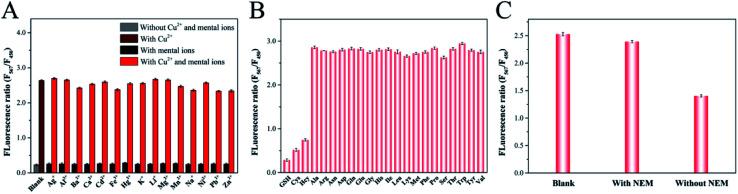
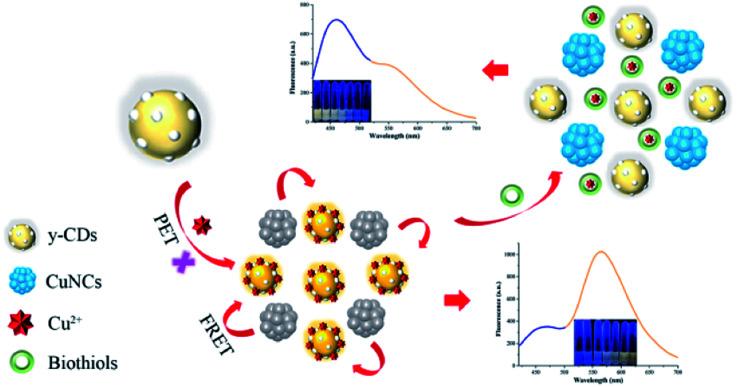
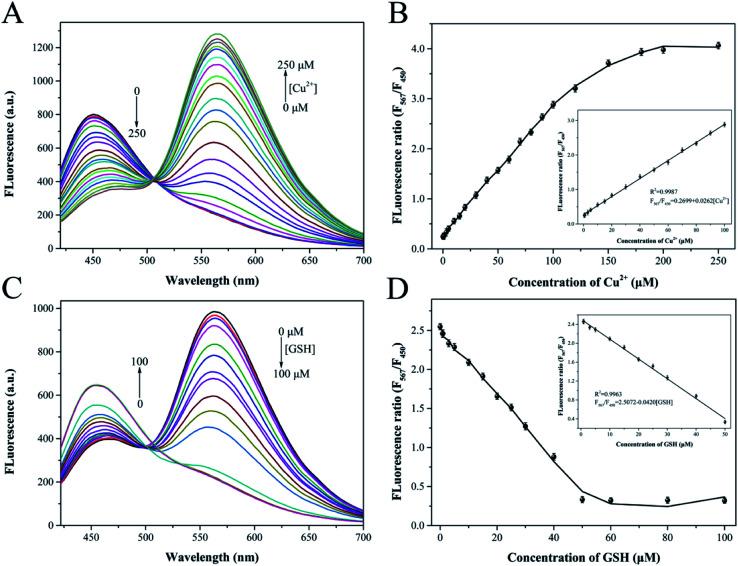
A novel dual-emission ratiometric fluorescent probe based on N-doped yellow fluorescent carbon dots (y-CDs) and blue fluorescent copper nanoclusters (CuNCs) was established for quantitative determination of Cu and biothiols. In this work, the Cu-(y-CDs) complexes formed by the chelation of y-CDs with Cu, showed an absorption peak at 430 nm that not only enhanced the fluorescence of y-CDs through inhibiting photoinduced electron transfer (PET) but also effectively quenched the fluorescence of CuNCs due to Förster resonance energy transfer (FRET). In addition, the chelation of y-CDs with Cu could be inhibited by biothiols that prevented the fluorescence of y-CDs from being enhanced and the fluorescence of CuNCs from being quenched. On account of the changes of ratiometric signal, a dual-emission fluorescence probe for Cu and biothiols determination was achieved. The proposed method exhibited high sensitivity for Cu and biothiols in the ranges of 0.5-100 μM and 0.8-50 μM and the limits of detection (LODs) of Cu, glutathione (GSH), cysteine (Cys) and homocysteine (Hcy) were 0.21 μM, 0.33 μM, 0.39 μM and 0.46 μM, respectively. Subsequently, the established strategy presented an application prospect for the detection of Cu and biothiols in real samples.
基于氮掺杂黄色荧光碳点(y-CDs)和蓝色荧光铜纳米簇(CuNCs)构建了一种新型双发射比率荧光探针,用于定量测定铜和生物硫醇。在本研究中,y-CDs与铜螯合形成的Cu-(y-CDs)配合物在430nm处有一个吸收峰,该峰不仅通过抑制光诱导电子转移(PET)增强了y-CDs的荧光,还由于福斯特共振能量转移(FRET)有效地猝灭了CuNCs的荧光。此外,生物硫醇可以抑制y-CDs与铜的螯合,从而阻止y-CDs荧光增强以及CuNCs荧光猝灭。基于比率信号的变化,实现了一种用于测定铜和生物硫醇的双发射荧光探针。该方法对铜和生物硫醇在0.5 - 100μM和0.8 - 50μM范围内表现出高灵敏度,铜、谷胱甘肽(GSH)、半胱氨酸(Cys)和同型半胱氨酸(Hcy)的检测限(LOD)分别为0.21μM、0.33μM、0.39μM和0.46μM。随后,所建立的策略在实际样品中铜和生物硫醇的检测方面展现出应用前景。


 Zotero 插件