
IgA肾病中肾淋巴管密度与临床结局相关。
The Density of Renal Lymphatics Correlates With Clinical Outcomes in IgA Nephropathy.
作者信息
Rodas Lida, Barnadas Esther, Pereira Arturo, Castrejon Natalia, Saurina Anna, Calls Jordi, Calzada Yolanda, Madrid Álvaro, Blasco Miquel, Poch Esteban, García-Herrera Adriana, Quintana Luis F
机构信息
Department of Nephrology and Renal Transplantation, Hospital Clínic, Department of Medicine, University of Barcelona, IDIBAPS and Centro de Referencia en Enfermedad Glomerular Compleja del Sistema Nacional de Salud de España (CSUR), Barcelona, Spain.
Department of Pathology, Hospital Clínic, University of Barcelona, IDIBAPS and Centro de Referencia en Enfermedad Glomerular Compleja del Sistema Nacional de Salud de España (CSUR), Barcelona, Spain.
出版信息
Kidney Int Rep. 2022 Jan 11;7(4):823-830. doi: 10.1016/j.ekir.2021.12.029. eCollection 2022 Apr.
INTRODUCTION
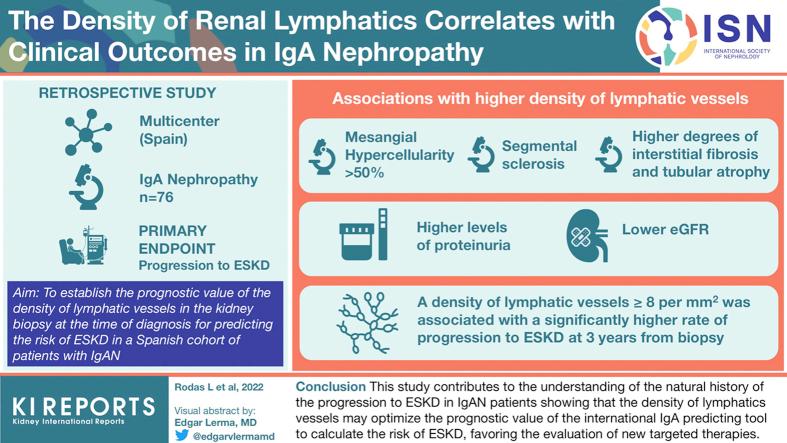
IgA nephropathy (IgAN) is the most common primary glomerulonephritis (GN) worldwide. The disease course fluctuates, and the most important challenge is the considerable variation in the time lag between diagnosis and the development of a hard clinical end point, such as end-stage kidney disease (ESKD). The reaction of renal tissue to damage resembles the common wound-healing response. One part of this repair in IgAN is the expansion of lymphatic vessels known as lymphangiogenesis. The aim of this work was to establish the prognostic value of the density of lymphatic vessels in the renal biopsy at the time of diagnosis, for predicting the risk of ESKD in a Spanish cohort of patients with IgAN.
METHODS
We performed a retrospective multicenter study of 76 patients with IgAN. The end point of the study was progression to ESKD. The morphometric analysis of lymphatic vessels was performed on tissue sections stained with antipodoplanin antibody.
RESULTS
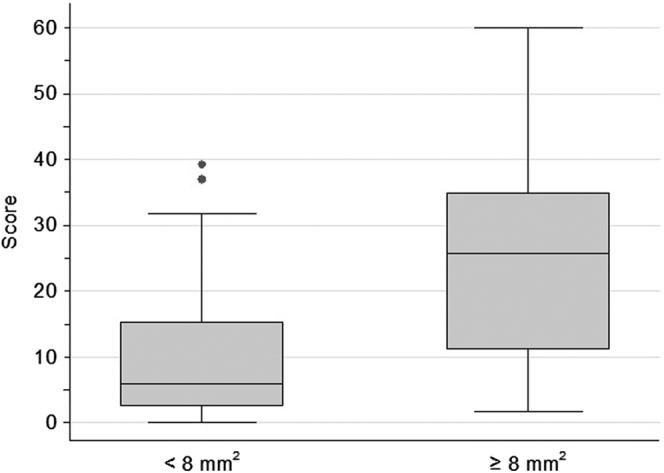
Density of lymphatic vessels was significantly higher in patients with IgAN with mesangial hypercellularity >50%, segmental sclerosis, higher degrees of interstitial fibrosis, and tubular atrophy. Patients with more lymphatic vessels had significantly higher values of proteinuria and lower estimated glomerular filtration rate (eGFR). A density of lymphatic vessels ≥8 per mm was associated with a significantly higher rate of progression to ESKD at 3 years from biopsy. After adjustment for the International IgAN prediction score, at the multivariate logistic regression, high density of lymphatic vessels (≥8 per mm) remained significantly associated with a higher rate of early progression to ESKD.
CONCLUSION
This study contributes to the understanding of the natural history of the progression to ESKD in patients with IgAN revealing the density of lymphatics vessels may optimize the prognostic value of the International IgA predicting tool to calculate the risk of ESKD, favoring the evaluation of new targeted therapies.
引言
IgA肾病(IgAN)是全球最常见的原发性肾小球肾炎(GN)。该病病程波动,最重要的挑战是从诊断到出现严重临床终点(如终末期肾病(ESKD))之间的时间间隔存在显著差异。肾组织对损伤的反应类似于常见的伤口愈合反应。IgAN修复过程的一部分是淋巴管扩张,即淋巴管生成。本研究的目的是确定诊断时肾活检中淋巴管密度的预后价值,以预测西班牙IgAN患者队列中发生ESKD的风险。
方法
我们对76例IgAN患者进行了一项回顾性多中心研究。研究的终点是进展为ESKD。使用抗足突蛋白抗体染色的组织切片对淋巴管进行形态计量分析。
结果
系膜细胞增生>50%、节段性硬化、间质纤维化程度较高和肾小管萎缩的IgAN患者淋巴管密度显著更高。淋巴管较多的患者蛋白尿值显著更高,估计肾小球滤过率(eGFR)更低。每毫米≥8条的淋巴管密度与活检后3年进展为ESKD的显著更高发生率相关。在根据国际IgAN预测评分进行调整后,在多变量逻辑回归中,高密度淋巴管(每毫米≥8条)仍与早期进展为ESKD的更高发生率显著相关。
结论
本研究有助于理解IgAN患者进展为ESKD的自然病程,揭示淋巴管密度可能优化国际IgA预测工具对ESKD风险的预后价值,有利于评估新的靶向治疗方法。


 Zotero 插件