
共价功能化的聚醚醚酮植入物与成骨生长肽(OGP)结合以提高成骨活性。
Covalently functionalized poly(etheretherketone) implants with osteogenic growth peptide (OGP) to improve osteogenesis activity.
作者信息
Yakufu Maihemuti, Wang Zongliang, Wang Yu, Jiao Zixue, Guo Min, Liu Jianguo, Zhang Peibiao
机构信息
Department of Orthopaedics, The First Hospital of Jilin University Changchun Jilin 130021 China
Key Laboratory of Polymer Ecomaterials, Changchun Institute of Applied Chemistry, Chinese Academy of Sciences Changchun 130022 China
出版信息
RSC Adv. 2020 Mar 6;10(17):9777-9785. doi: 10.1039/d0ra00103a.
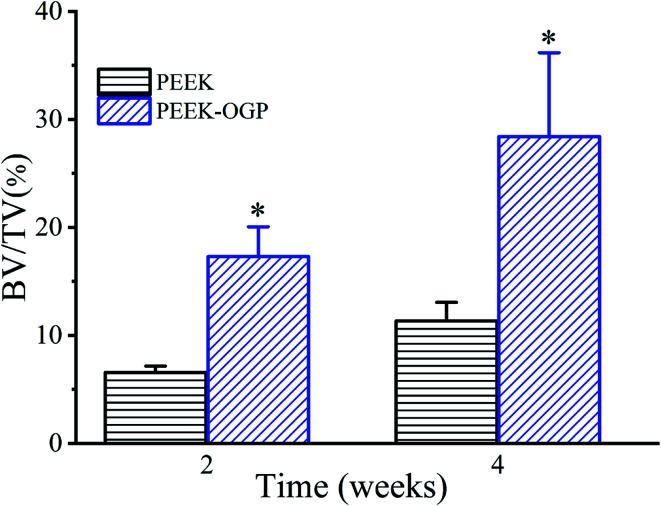
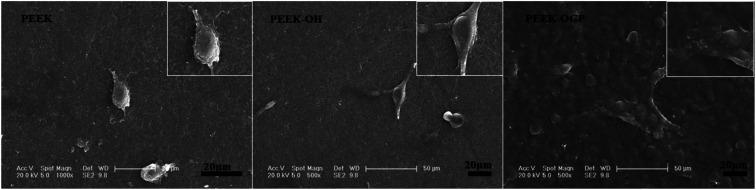
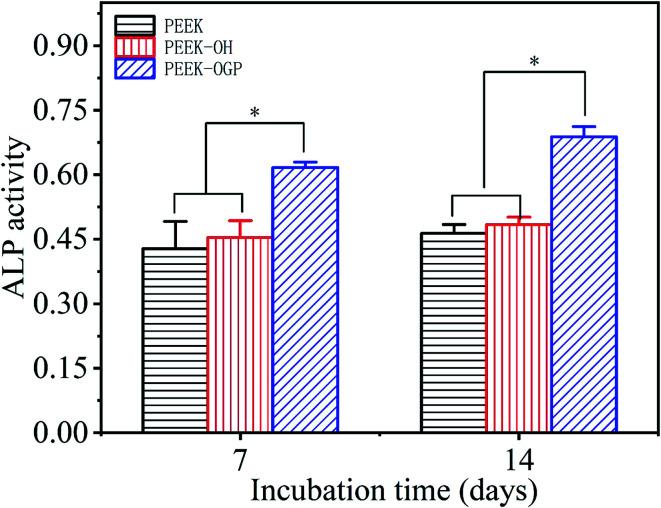
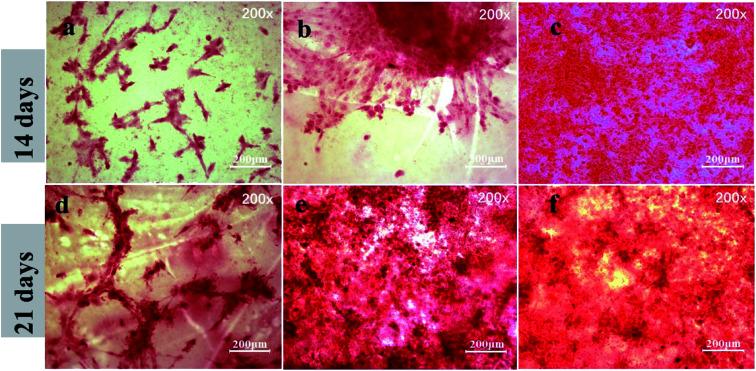
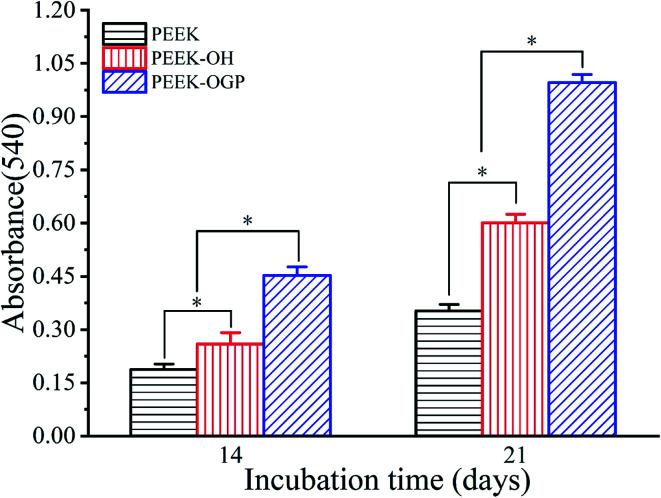
Polyetheretherketone (PEEK), as the most promising implant material for orthopedics and dental applications, has bone-like stiffness, excellent fatigue resistance, X-ray transparency, and near absence of immune toxicity. However, due to biological inertness, its bone conduction and bone ingrowth performance is limited. The surface modification of PEEK is an option to overcome these shortcomings and retain most of its favorable properties, especially when excellent osseointegration is desired. In this study, a simple reaction procedure was employed to bind the osteogenic growth peptide (OGP) on the surface of PEEK materials by covalent chemical grafting to construct a bioactive interface. The PEEK surface was activated by ,'-disuccinimidyl carbonate (DSC) after hydroxylation, and then OGP was covalently grafted with amino groups. The functionalized surface of PEEK samples were characterized by X-ray photoelectron spectroscopy (XPS), Fourier-transform infrared spectroscopy (FT-IR), water contact angle measurement and biological evaluation . OGP-functionalized PEEK surface significantly promoted the attachment, proliferation, alkaline phosphatase (ALP) activity and mineralization of pre-osteoblast cells (MC3T3-E1). The rat tibia implantation model is adopted and micro-CT analyses demonstrated that the OGP coating significantly promoted new bone formation around the samples. The and results reveal that the modification by covalent chemical functionalization with OGP on PEEK surface can augment new bone formation surrounding implants compared to bare PEEK and PEEK implant modified by covalently attached OGP is promising in orthopedic and dental applications.
聚醚醚酮(PEEK)作为骨科和牙科应用中最具前景的植入材料,具有类似骨的硬度、出色的抗疲劳性、X射线透过性以及几乎不存在免疫毒性。然而,由于其生物惰性,其骨传导和骨长入性能有限。PEEK的表面改性是克服这些缺点并保留其大部分优良性能的一种选择,特别是在需要优异的骨整合时。在本研究中,采用一种简单的反应程序,通过共价化学接枝将成骨生长肽(OGP)结合到PEEK材料表面,以构建生物活性界面。PEEK表面在羟基化后用碳酸二琥珀酰亚胺酯(DSC)活化,然后OGP与氨基共价接枝。通过X射线光电子能谱(XPS)、傅里叶变换红外光谱(FT-IR)、水接触角测量和生物学评价对PEEK样品的功能化表面进行了表征。OGP功能化的PEEK表面显著促进了前成骨细胞(MC3T3-E1)的附着、增殖、碱性磷酸酶(ALP)活性和矿化。采用大鼠胫骨植入模型,显微CT分析表明OGP涂层显著促进了样品周围的新骨形成。和结果表明,与裸PEEK相比,通过OGP共价化学功能化对PEEK表面进行改性可增强植入物周围的新骨形成,并且共价连接OGP改性的PEEK植入物在骨科和牙科应用中具有前景。




 Zotero 插件