
探索反向激动剂与雌激素相关受体α的结合模式及热力学。
Exploring the binding mode and thermodynamics of inverse agonists against estrogen-related receptor alpha.
作者信息
Karnati Konda Reddy, Wang Yixuan, Du Yongli
机构信息
Department of Chemistry and Forensic Science, Albany State University Albany GA 31705 USA
School of Chemical and Pharmaceutical Engineering, Qilu University of Technology (Shandong Academy of Sciences) Jinan Shandong 250353 China.
出版信息
RSC Adv. 2020 Apr 28;10(28):16659-16668. doi: 10.1039/c9ra10697a. eCollection 2020 Apr 23.
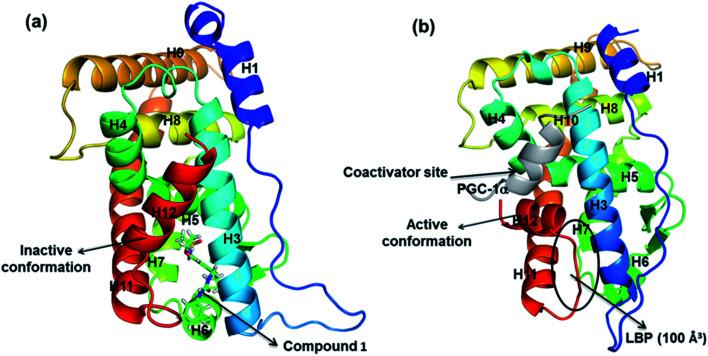
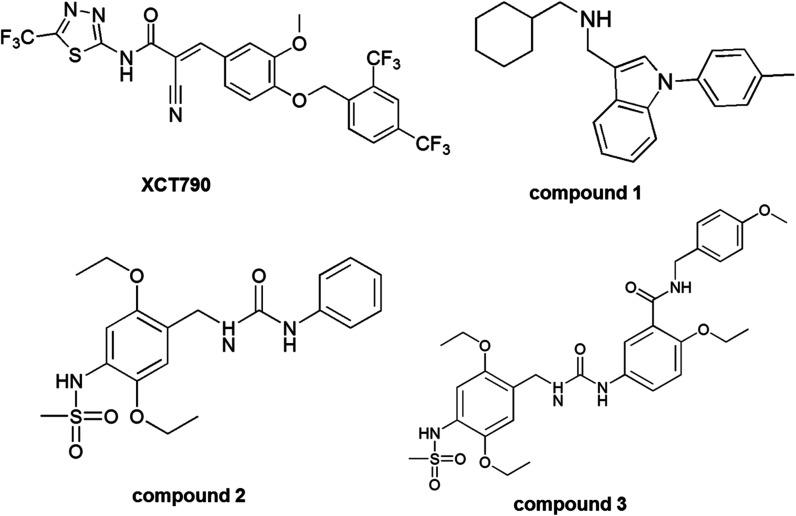
Since estrogen-related receptor alpha (ERRα), one of three estrogen-related receptors, displays constitutively active transcriptional activities and important implications in both physiological and pathological processes of breast cancers, ERRα was recently recognized as a new target to fight breast cancers, and regulating the activity of ERRα with inverse agonists has thus become a promising new therapeutic strategy. A few inverse agonists cyclohexylmethyl-(1--tolyl-1-indol-3-ylmethyl)-amine (compound 1), thiadiazoacrylamide (XCT790), and 1-(2,5-diethoxy-benzyl)-3-phenyl-area analogues (compounds 2 and 3) were reported to be capable of targeting ERRα. However, the detailed mechanism by which the inverse agonists deactivate ERRα remains unclear, especially in the aspects of quantitative binding and hot spot residues. Therefore, to gain insights into the interaction modes between inverse agonists and ERRα ligand binding domain, all-atom molecular dynamics (MD) simulations were firstly carried out for the complexes of inverse agonists and ERRα. The binding free energies were then calculated with MM-PBSA method to quantitatively discuss the binding of the inverse agonists with ERRα. The binding affinities were finally decomposed to per-residue contributions to identify the hot spot residues as well as assess their role in the binding mechanism. MD simulations show that the inverse agonists stretch downwards into the ERRα ligand binding pocket (LBP) formed by H3 and H11 helices, and upon the binding H12 adopts a well-defined position in the coactivator groove, where PGC-1α binds to ERRα. Binding energy analysis indicates that compound 3 and XCT790 bind more tightly to ERRα than compounds 1 and 2, and the energy difference mainly results from the contribution of van der Waals interaction. Both binding mode analysis and affinity decomposition per-residue indicate that compound 1, XCT790, and compound 3 have similar binding spectra to ERRα, primarily interacting with the residues of H3, H5, H6/H7 loop, and H11 helix, while compound 2 lacks a significant interaction with the H5 region. The hot spot residues significantly binding to the three inverse agonists in common include Leu324, Phe328, Phe382, Leu398, Phe495, and Leu500. It is essential for an effective inverse agonist to strongly bind with the aromatic ring cluster consisting of Phe328(H3), Phe495(H11), and Phe382(H5/H6 loop) as well as Leu500.
由于雌激素相关受体α(ERRα)是三种雌激素相关受体之一,具有组成型活性转录活性,且在乳腺癌的生理和病理过程中具有重要意义,ERRα最近被认为是对抗乳腺癌的新靶点,因此用反向激动剂调节ERRα的活性已成为一种有前景的新治疗策略。据报道,一些反向激动剂环己基甲基 -(1 - 对甲苯基 - 1 - 吲哚 - 3 - 基甲基)-胺(化合物1)、噻二唑丙烯酰胺(XCT790)和1 -(2,5 - 二乙氧基 - 苄基)-3 - 苯基 - 区域类似物(化合物2和3)能够靶向ERRα。然而,反向激动剂使ERRα失活的详细机制仍不清楚,尤其是在定量结合和热点残基方面。因此,为了深入了解反向激动剂与ERRα配体结合域之间的相互作用模式,首先对反向激动剂与ERRα的复合物进行了全原子分子动力学(MD)模拟。然后用MM - PBSA方法计算结合自由能,以定量讨论反向激动剂与ERRα的结合。最后将结合亲和力分解为每个残基的贡献,以识别热点残基并评估它们在结合机制中的作用。MD模拟表明,反向激动剂向下延伸到由H3和H11螺旋形成的ERRα配体结合口袋(LBP)中,并且在结合时H12在共激活剂凹槽中采取明确的位置,PGC - 1α在此处与ERRα结合。结合能分析表明,化合物3和XCT790比化合物1和2与ERRα结合更紧密,能量差异主要来自范德华相互作用的贡献。结合模式分析和每个残基的亲和力分解均表明,化合物1、XCT790和化合物3与ERRα具有相似的结合谱,主要与H3、H5、H6/H7环和H11螺旋的残基相互作用,而化合物2与H5区域缺乏显著相互作用。与这三种反向激动剂均有显著结合的热点残基包括Leu324、Phe328、Phe382、Leu398、Phe495和Leu500。一种有效的反向激动剂必须与由Phe328(H3)、Phe495(H11)和Phe382(H5/H6环)以及Leu500组成的芳香环簇紧密结合。



 Zotero 插件