
评价尼日尔农村地区孕妇补充多种微量营养素和中剂量基于脂质的营养补充剂对儿童发育的影响:一项集群随机对照试验的二次分析。
Evaluation of multiple micronutrient supplementation and medium-quantity lipid-based nutrient supplementation in pregnancy on child development in rural Niger: A secondary analysis of a cluster randomized controlled trial.
机构信息
Department of Global Health and Population, Harvard T.H. Chan School of Public Health, Boston, Massachusetts, United States of America.
Department of Nutrition, Harvard T.H. Chan School of Public Health, Boston, Massachusetts, United States of America.
出版信息
PLoS Med. 2022 May 2;19(5):e1003984. doi: 10.1371/journal.pmed.1003984. eCollection 2022 May.
BACKGROUND
It is estimated that over 250 million children under 5 years of age in low- and middle-income countries (LMICs) do not reach their full developmental potential. Poor maternal diet, anemia, and micronutrient deficiencies during pregnancy are associated with suboptimal neurodevelopmental outcomes in children. However, the effect of prenatal macronutrient and micronutrient supplementation on child development in LMIC settings remains unclear due to limited evidence from randomized trials.
METHODS AND FINDINGS
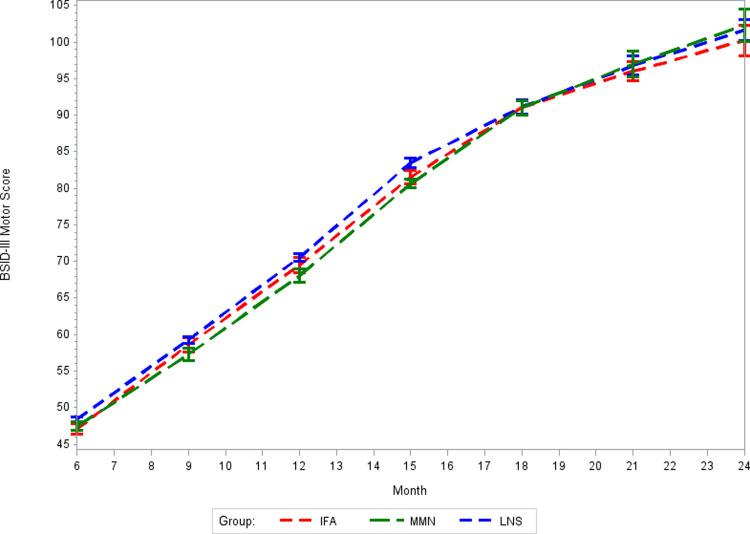
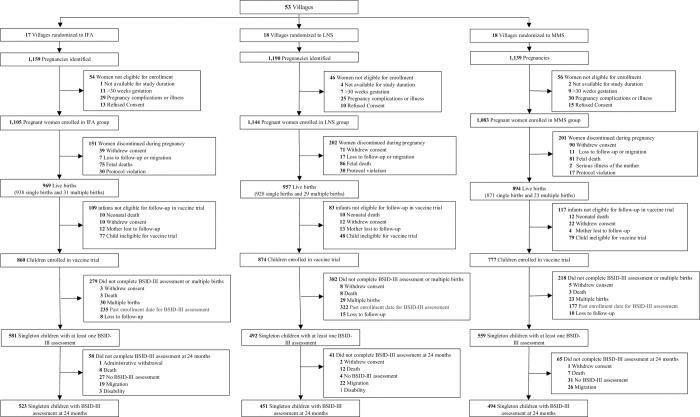
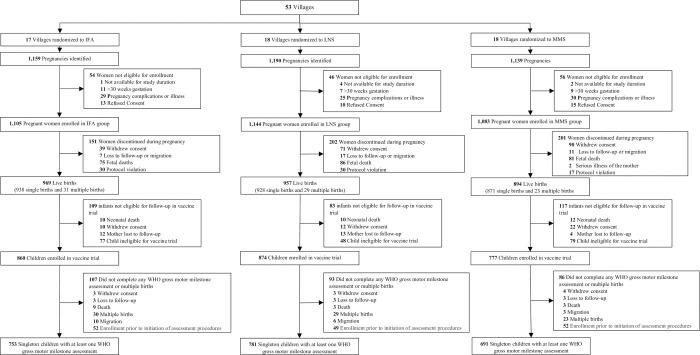
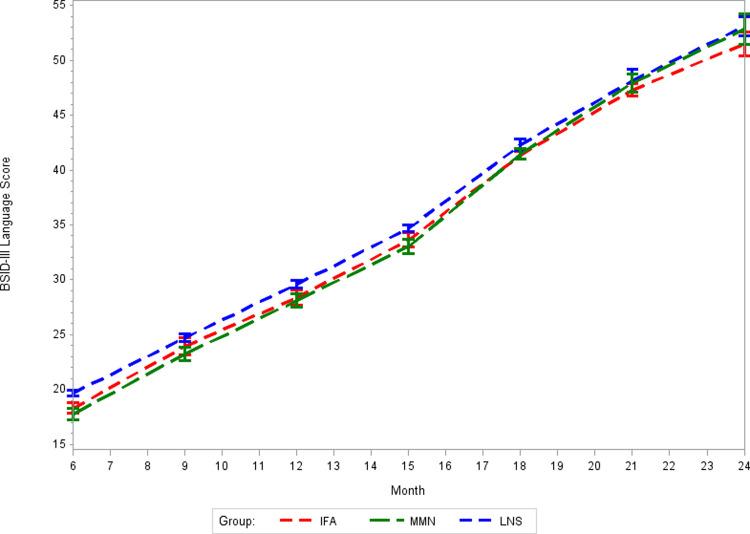
We conducted a 3-arm cluster-randomized trial (n = 53 clusters) that evaluated the efficacy of (1) prenatal multiple micronutrient supplementation (MMS; n = 18 clusters) and (2) lipid-based nutrient supplementation (LNS; n = 18 clusters) as compared to (3) routine iron-folic acid (IFA) supplementation (n = 17 clusters) among pregnant women in the rural district of Madarounfa, Niger, from March 2015 to August 2019 (ClinicalTrials.gov identifier NCT02145000). Children were followed until 2 years of age, and the Bayley Scales of Infant and Toddler Development III (BSID-III) were administered to children every 3 months from 6 to 24 months of age. Maternal report of WHO gross motor milestone achievement was assessed monthly from 3 to 24 months of age. An intention-to-treat analysis was followed. Child BSID-III data were available for 559, 492, and 581 singleton children in the MMS, LNS, and IFA groups, respectively. Child WHO motor milestone data were available for 691, 781, and 753 singleton children in the MMS, LNS, and IFA groups, respectively. Prenatal MMS had no effect on child BSID-III cognitive (standardized mean difference [SMD]: 0.21; 95% CI: -0.20, 0.62; p = 0.32), language (SMD: 0.16; 95% CI: -0.30, 0.61; p = 0.50) or motor scores (SMD: 0.18; 95% CI: -0.39, 0.74; p = 0.54) or on time to achievement of the WHO gross motor milestones as compared to IFA. Prenatal LNS had no effect on child BSID-III cognitive (SMD: 0.17; 95% CI: -0.15, 0.49; p = 0.29), language (SMD: 0.11; 95% CI: -0.22, 0.44; p = 0.53) or motor scores (SMD: -0.04; 95% CI: -0.46, 0.37; p = 0.85) at the 24-month endline visit as compared to IFA. However, the trajectory of BSID-III cognitive scores during the first 2 years of life differed between the groups with children in the LNS group having higher cognitive scores at 18 and 21 months (approximately 0.35 SD) as compared to the IFA group (p-value for difference in trajectory <0.001). Children whose mothers received LNS also had earlier achievement of sitting alone (hazard ratio [HR]: 1.57; 95% CI: 1.10 to 2.24; p = 0.01) and walking alone (1.52; 95% CI: 1.14 to 2.03; p = 0.004) as compared to IFA, but there was no effect on time to achievement of other motor milestones. A limitation of our study is that we assessed child development up to 2 years of age, and, therefore, we may have not captured effects that are easier to detect or emerge at older ages.
CONCLUSIONS
There was no benefit of prenatal MMS on child development outcomes up to 2 years of age as compared to IFA. There was evidence of an apparent positive effect of prenatal LNS on cognitive development trajectory and time to achievement of selected gross motor milestones.
TRIAL REGISTRATION
ClinicalTrials.gov NCT02145000.
背景
据估计,在中低收入国家(LMICs),有超过 2.5 亿 5 岁以下儿童没有充分发挥其发展潜力。孕妇饮食不良、贫血和微量营养素缺乏与儿童神经发育不良结局有关。然而,由于随机试验证据有限,产前宏量营养素和微量营养素补充对 LMIC 环境中儿童发育的影响仍不清楚。
方法和发现
我们进行了一项 3 臂聚类随机试验(n = 53 个聚类),评估了(1)产前多种微量营养素补充(MMS;n = 18 个聚类)和(2)脂质营养素补充(LNS;n = 18 个聚类)与(3)常规铁叶酸(IFA)补充(n = 17 个聚类)相比,在尼日尔马杜罗纳夫农村地区孕妇中的疗效,从 2015 年 3 月至 2019 年 8 月(ClinicalTrials.gov 标识符 NCT02145000)。对儿童进行了 2 年的随访,并在 6 至 24 个月时每 3 个月对儿童进行贝利婴幼儿发育量表第三版(BSID-III)评估。从 3 至 24 个月,每月评估世卫组织大运动里程碑达成情况。遵循意向治疗分析。MMS、LNS 和 IFA 组的儿童 BSID-III 数据分别为 559、492 和 581 名单胎儿童,儿童 WHO 运动里程碑数据分别为 691、781 和 753 名单胎儿童。与 IFA 相比,产前 MMS 对儿童 BSID-III 认知(标准化均数差 [SMD]:0.21;95%CI:-0.20,0.62;p = 0.32)、语言(SMD:0.16;95%CI:-0.30,0.61;p = 0.50)或运动评分(SMD:0.18;95%CI:-0.39,0.74;p = 0.54)或实现世卫组织大运动里程碑的时间没有影响。产前 LNS 对儿童 BSID-III 认知(SMD:0.17;95%CI:-0.15,0.49;p = 0.29)、语言(SMD:0.11;95%CI:-0.22,0.44;p = 0.53)或运动评分(SMD:-0.04;95%CI:-0.46,0.37;p = 0.85)与 IFA 相比,在 24 个月的最终访问时没有影响。然而,两组儿童的 BSID-III 认知评分在生命的头 2 年的轨迹不同,与 IFA 组相比,LNS 组儿童在 18 和 21 个月时的认知评分更高(约 0.35 标准差)(p 值<0.001)。接受 LNS 的母亲的孩子也更早地实现独坐(风险比 [HR]:1.57;95%CI:1.10 至 2.24;p = 0.01)和独走(1.52;95%CI:1.14 至 2.03;p = 0.004),而对其他运动里程碑的实现时间没有影响。我们研究的一个局限性是我们评估了儿童的发育情况,直到 2 岁,因此我们可能没有捕捉到更容易在年龄较大时发现或出现的影响。
结论
与 IFA 相比,产前 MMS 对儿童发育结果没有益处,直到 2 岁。有证据表明,产前 LNS 对认知发育轨迹和实现特定大运动里程碑的时间有明显的积极影响。
试验注册
ClinicalTrials.gov NCT02145000。

 Zotero 插件