
金和银与氨基酸及核碱基相互作用的比较研究。
Comparative study of gold and silver interactions with amino acids and nucleobases.
作者信息
Buglak Andrey A, Kononov Alexei I
机构信息
St. Petersburg State University 199034 Saint-Petersburg Russia
出版信息
RSC Adv. 2020 Sep 15;10(56):34149-34160. doi: 10.1039/d0ra06486f. eCollection 2020 Sep 10.
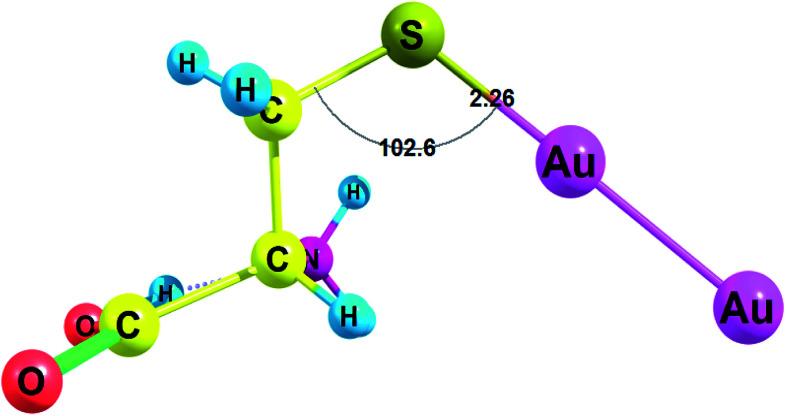
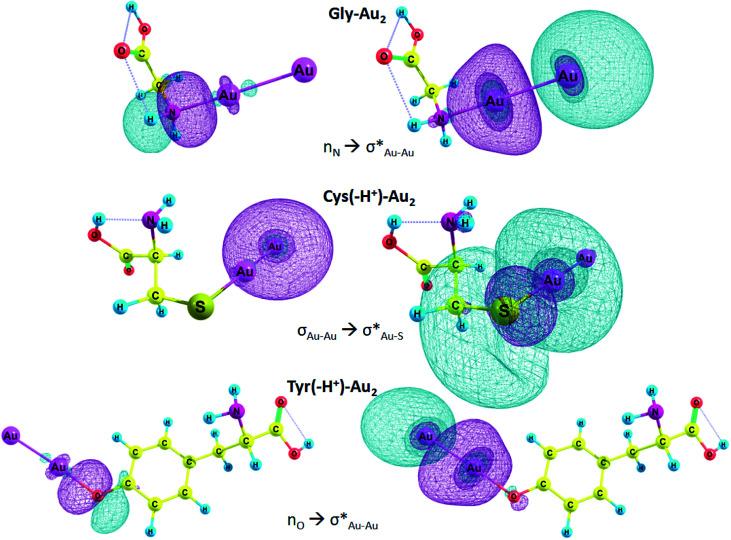
Metal nanoclusters (NCs) have gained much attention in the last decade. In solution, metal nanoclusters can be stabilized by proteins, and, thus, exhibit many advantages in biocatalysis, biosensing, and bioimaging. In spite of much progress in the synthesis of polypeptide-stabilized gold (Au) clusters, their structure, as well as amino acid-cluster and amino acid-Au interactions, remain poorly understood. It is not entirely clear which amino acid (AA) residues and sites in the protein are preferred for binding. The understanding of NC-protein interactions and how they evolve in the polypeptide templates is the key to designing Au NCs. In this work, binding of gold ion Au and diatomic neutral gold nanocluster Au with a full set of α-proteinogenic amino acids is studied using Density Functional Theory (DFT) and the RI-MP2 method in order to find the preferred sites of gold interaction in proteins. We demonstrated that the interaction of gold cations and clusters with protonated and deprotonated amino acid residues do not differ greatly. The binding affinity of AAs to the Au cluster increases in the following order: Cys(-H) > Asp(-H) > Tyr(-H) > Glu(-H) > Arg > Gln, His, Met ≫ Asn, Pro, Trp > Lys, Tyr, Phe > His(+H) > Asp > Lys(+H) > Glu, Leu > Arg(+H) > Ile, Val, Ala > Thr, Ser > Gly, Cys, which agrees with the available experimental data that gold cluster synthesis occurs in a wide range of pH - amino acid residues with different protonation states are involved in this process. The significant difference in the binding energy of metal atoms with nucleobases and amino acids apparently means that unlike on DNA templates, neutral metal atoms are strongly bound to amino acid residues and can't freely diffuse in a polypeptide globula. This fact allows one to conclude that formation of metal NCs in proteins occurs through the nucleation of reduced Au atoms bound to the neighboring amino acid residues, and the flexibility of the amino acid residue side-chains and protein chain as a whole plays a significant role in this process.
在过去十年中,金属纳米团簇(NCs)备受关注。在溶液中,金属纳米团簇可通过蛋白质实现稳定,因此在生物催化、生物传感和生物成像方面展现出诸多优势。尽管在合成多肽稳定的金(Au)团簇方面取得了很大进展,但其结构以及氨基酸 - 团簇和氨基酸 - 金的相互作用仍知之甚少。目前尚不完全清楚蛋白质中哪些氨基酸(AA)残基和位点更有利于结合。理解NC - 蛋白质相互作用以及它们在多肽模板中的演变方式是设计金纳米团簇的关键。在这项工作中,使用密度泛函理论(DFT)和RI - MP2方法研究了金离子Au和双原子中性金纳米团簇Au与全套α - 蛋白质原氨基酸的结合,以寻找蛋白质中金相互作用的优先位点。我们证明,金阳离子和团簇与质子化和去质子化氨基酸残基的相互作用差异不大。氨基酸与金团簇的结合亲和力按以下顺序增加:半胱氨酸(-H)>天冬氨酸(-H)>酪氨酸(-H)>谷氨酸(-H)>精氨酸>谷氨酰胺、组氨酸、蛋氨酸≫天冬酰胺、脯氨酸、色氨酸>赖氨酸、酪氨酸、苯丙氨酸>组氨酸(+H)>天冬氨酸>赖氨酸(+H)>谷氨酸、亮氨酸>精氨酸(+H)>异亮氨酸、缬氨酸、丙氨酸>苏氨酸、丝氨酸>甘氨酸、半胱氨酸,这与现有的实验数据一致,即在广泛的pH范围内会发生金团簇合成——不同质子化状态的氨基酸残基参与了这一过程。金属原子与核碱基和氨基酸结合能的显著差异显然意味着,与在DNA模板上不同,中性金属原子与氨基酸残基紧密结合,无法在多肽球中自由扩散。这一事实使人们可以得出结论,蛋白质中金属纳米团簇的形成是通过与相邻氨基酸残基结合的还原金原子的成核过程实现的,并且氨基酸残基侧链和整个蛋白质链的灵活性在这一过程中起着重要作用。


 Zotero 插件