
激素治疗是否能提高非梗阻性无精子症患者的精子获取率:系统评价和荟萃分析。
Does hormonal therapy improve sperm retrieval rates in men with non-obstructive azoospermia: a systematic review and meta-analysis.
机构信息
Department of Urology, Imperial Healthcare NHS Trust, Charing Cross Hospital, London, UK.
Department of Metabolism, Digestion and Reproduction, Imperial College London, London, UK.
出版信息
Hum Reprod Update. 2022 Aug 25;28(5):609-628. doi: 10.1093/humupd/dmac016.
BACKGROUND
The beneficial effects of hormonal therapy in stimulating spermatogenesis in patients with non-obstructive azoospermia (NOA) and either normal gonadotrophins or hypergonadotropic hypogonadism prior to surgical sperm retrieval (SSR) is controversial. Although the European Association of Urology guidelines state that hormone stimulation is not recommended in routine clinical practice, a significant number of patients undergo empiric therapy prior to SSR. The success rate for SSR from microdissection testicular sperm extraction is only 40-60%, thus hormonal therapy could prove to be an effective adjunctive therapy to increase SSR rates.
OBJECTIVE AND RATIONALE
The primary aim of this systematic review and meta-analysis was to compare the SSR rates in men with NOA (excluding those with hypogonadotropic hypogonadism) receiving hormone therapy compared to placebo or no treatment. The secondary objective was to compare the effects of hormonal therapy in normogonadotropic and hypergonadotropic NOA men.
SEARCH METHODS
A literature search was performed using the Medline, Embase, Web of Science and Clinicaltrials.gov databases from 01 January 1946 to 17 September 2020. We included all studies where hormone status was confirmed. We excluded non-English language and animal studies. Heterogeneity was calculated using I2 statistics and risk of bias was assessed using Cochrane tools. We performed a meta-analysis on all the eligible controlled trials to determine whether hormone stimulation (irrespective of class) improved SSR rates and also whether this was affected by baseline hormone status (hypergonadotropic versus normogonadotropic NOA men). Sensitivity analyses were performed when indicated.
OUTCOMES
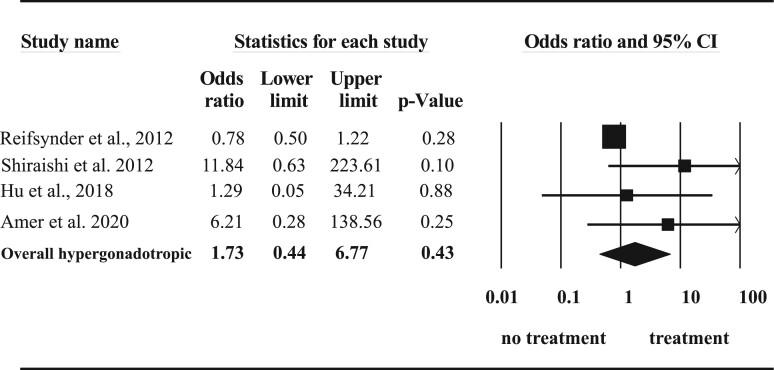
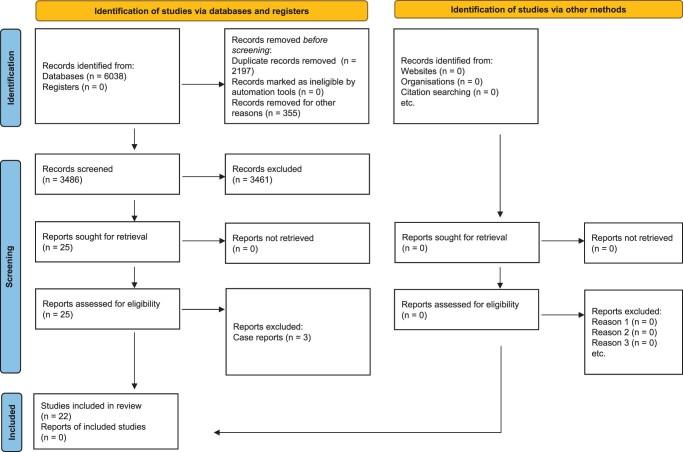
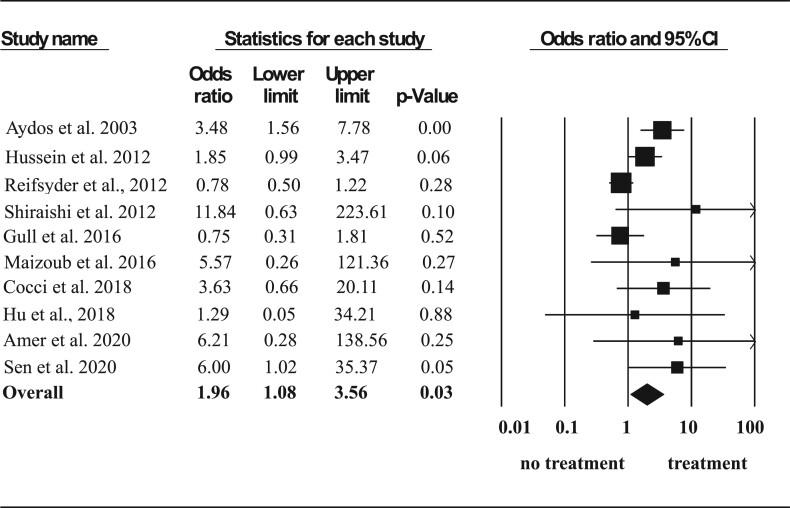
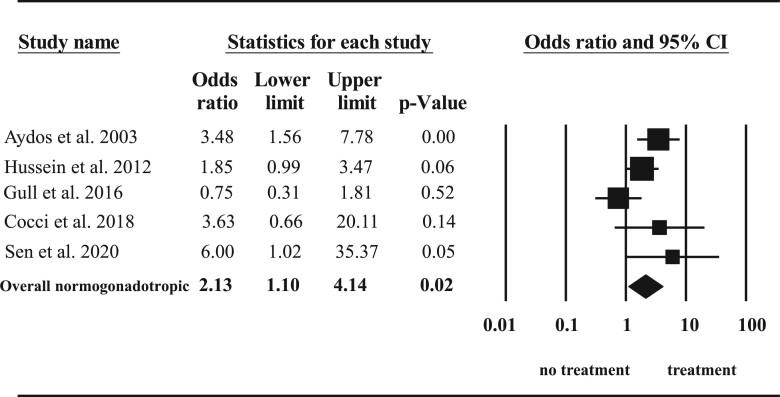
A total of 3846 studies were screened and 22 studies were included with 1706 participants. A higher SSR rate in subjects pre-treated with hormonal therapy was observed (odds ratio (OR) 1.96, 95% CI: 1.08-3.56, P = 0.03) and this trend persisted when excluding a study containing only men with Klinefelter syndrome (OR 1.90, 95% CI: 1.03-3.51, P = 0.04). However, the subgroup analysis of baseline hormone status demonstrated a significant improvement only in normogonadotropic men (OR 2.13, 95% CI: 1.10-4.14, P = 0.02) and not in hypergonadotropic patients (OR 1.73, 95% CI: 0.44-6.77, P = 0.43). The literature was at moderate or severe risk of bias.
WIDER IMPLICATIONS
This meta-analysis demonstrates that hormone therapy is not associated with improved SSR rates in hypergonadotropic hypogonadism. While hormone therapy improved SSR rates in eugonadal men with NOA, the quality of evidence was low with a moderate to high risk of bias. Therefore, hormone therapy should not be routinely used in men with NOA prior to SSR and large scale, prospective randomized controlled trials are needed to validate the meta-analysis findings.
背景
在接受手术精子提取(SSR)之前,荷尔蒙疗法对刺激非阻塞性无精子症(NOA)患者的精子发生具有有益作用,这些患者的促性腺激素正常或高促性腺激素性腺功能减退。尽管欧洲泌尿外科学会指南指出,不建议在常规临床实践中进行激素刺激,但仍有大量患者在 SSR 前接受经验性治疗。微观解剖睾丸精子提取的 SSR 成功率仅为 40-60%,因此荷尔蒙疗法可能被证明是增加 SSR 率的有效辅助疗法。
目的和理由
本系统评价和荟萃分析的主要目的是比较接受激素治疗的 NOA 男性(不包括低促性腺激素性腺功能减退症患者)与安慰剂或不治疗的 SSR 率。次要目的是比较在正常促性腺激素和高促性腺激素 NOA 男性中激素治疗的效果。
检索方法
使用 Medline、Embase、Web of Science 和 Clinicaltrials.gov 数据库从 1946 年 1 月 1 日至 2020 年 9 月 17 日进行文献检索。我们纳入了所有确认激素状态的研究。我们排除了非英语语言和动物研究。使用 I2 统计量计算异质性,并使用 Cochrane 工具评估偏倚风险。我们对所有合格的对照试验进行荟萃分析,以确定激素刺激(无论类别如何)是否提高了 SSR 率,以及这是否受到基线激素状态(高促性腺激素与正常促性腺激素 NOA 男性)的影响。在需要时进行敏感性分析。
结果
共筛选了 3846 项研究,纳入了 22 项研究,共纳入 1706 名参与者。接受荷尔蒙治疗的受试者 SSR 率较高(比值比(OR)1.96,95%CI:1.08-3.56,P=0.03),当排除仅包含 Klinefelter 综合征男性的研究时,这一趋势仍然存在(OR 1.90,95%CI:1.03-3.51,P=0.04)。然而,基线激素状态的亚组分析仅显示在正常促性腺激素男性中,SSR 率显著提高(OR 2.13,95%CI:1.10-4.14,P=0.02),而在高促性腺激素患者中没有(OR 1.73,95%CI:0.44-6.77,P=0.43)。文献存在中度或高度偏倚风险。
更广泛的影响
这项荟萃分析表明,荷尔蒙疗法与改善高促性腺激素性腺功能减退症患者的 SSR 率无关。虽然荷尔蒙疗法提高了正常促性腺激素 NOA 男性的 SSR 率,但证据质量较低,存在中度至高度偏倚风险。因此,SSR 前不应该常规在 NOA 男性中使用荷尔蒙治疗,需要进行大规模、前瞻性随机对照试验来验证荟萃分析结果。

 Zotero 插件