
对亚甲基蓝和铬(III)从水溶液吸附到柚子皮上的吸附机制的洞察。
Insight into the adsorption mechanisms of methylene blue and chromium(iii) from aqueous solution onto pomelo fruit peel.
作者信息
Dinh Van-Phuc, Huynh Thuy-Diem-Thuy, Le Hung M, Nguyen Van-Dong, Dao Vinh-Ai, Hung N Quang, Tuyen L Anh, Lee Sunhwa, Yi Junsin, Nguyen Trinh Duy, Tan L V
机构信息
Institute of Fundamental and Applied Sciences, Duy Tan University 10C Tran Nhat Duat Street, District 1 Ho Chi Minh City 700000 Vietnam
Industrial University of Ho Chi Minh City 12 Nguyen Van Bao, Ward 4, Go Vap Disc. HCM City Vietnam.
出版信息
RSC Adv. 2019 Aug 19;9(44):25847-25860. doi: 10.1039/c9ra04296b. eCollection 2019 Aug 13.
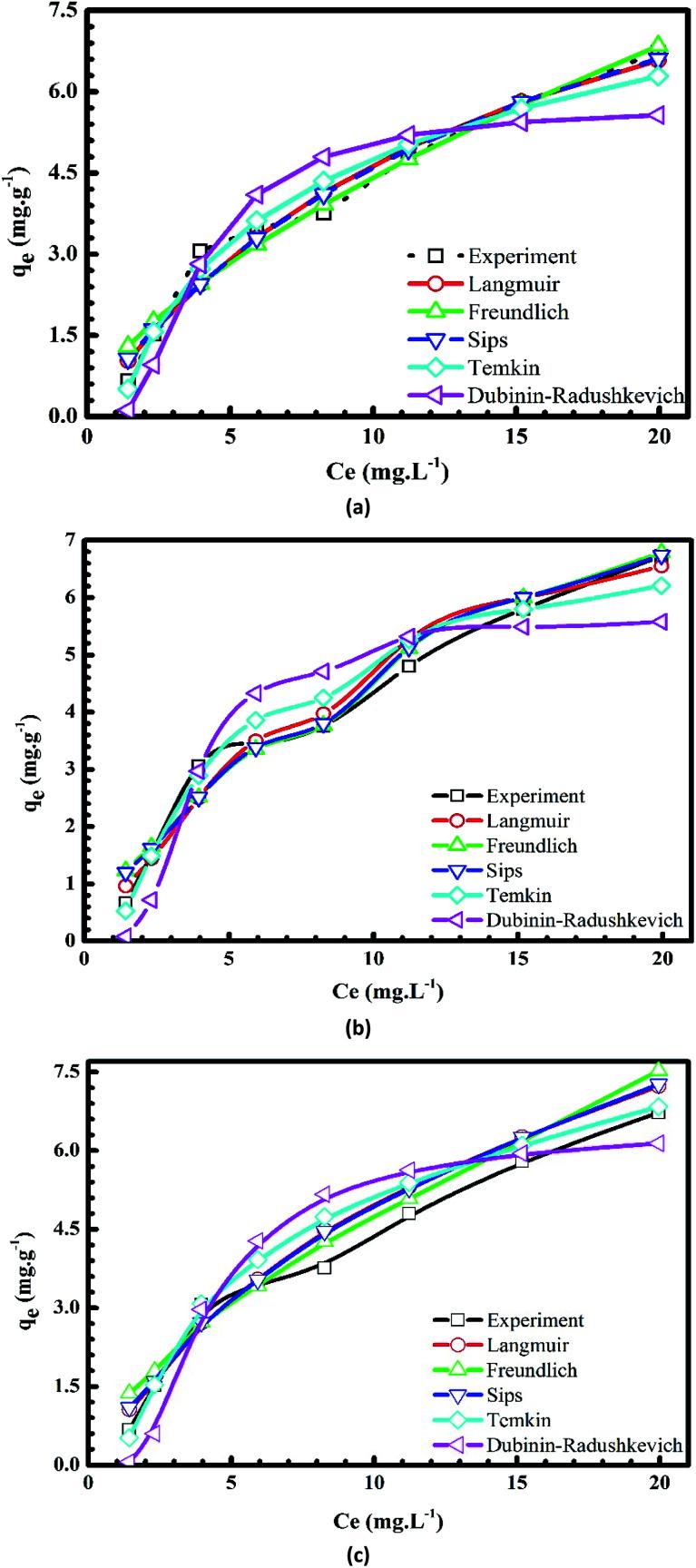
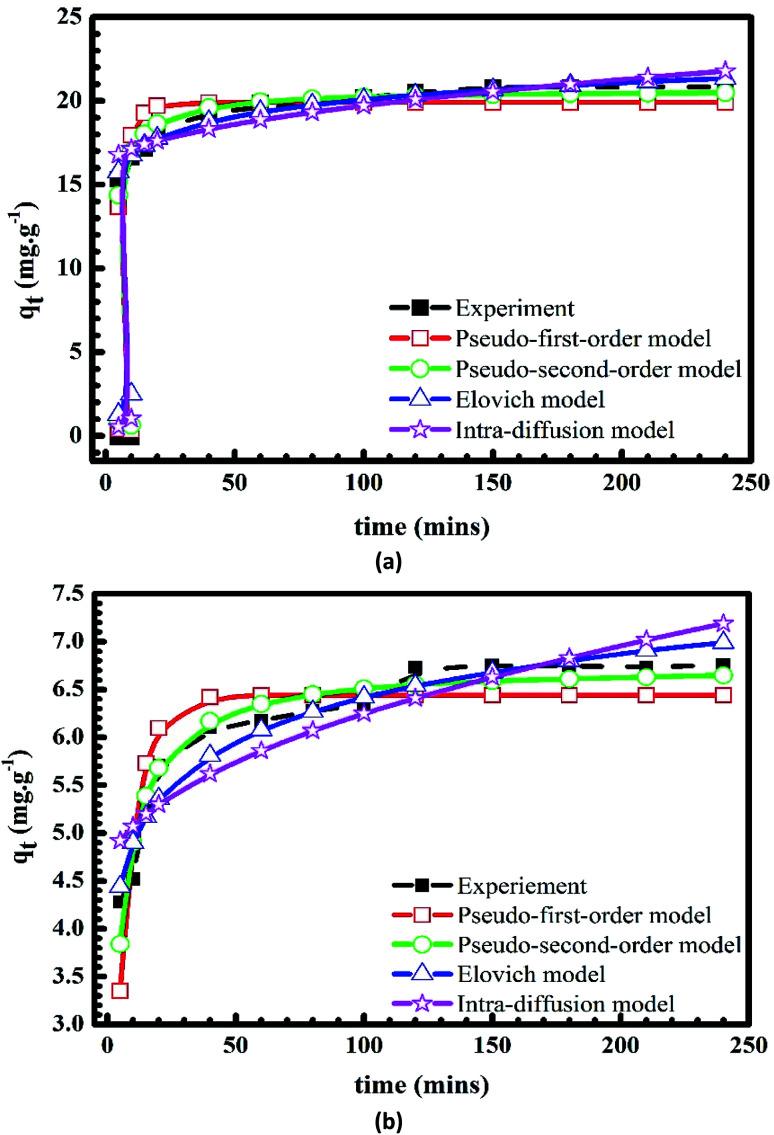
In this study, the biosorption mechanisms of methylene blue (MB) and Cr(iii) onto pomelo peel collected from our local fruits are investigated by combining experimental analysis with simulations. Factors that affect the adsorption such as pH, adsorption time, adsorbent dosage and initial adsorbate concentration, are fully considered. Five isotherm models-Langmuir, Freundlich, Sips, Temkin, and Dubinin-Radushkevich-are employed to estimate the capacity of pomelo peel adsorption, whereas four kinetic models-pseudo-first-order, pseudo-second-order, Elovich and intra-diffusion models-are also used to investigate the mechanisms of the uptake of MB and Cr(iii) onto the pomelo fruit peel. The maximum biosorption capacities calculated from the Langmuir models for MB and Cr(iii) at 303 K are, 218.5 mg g and 11.3 mg g, respectively. In particular, by combining, for the first time, the experimental FT-IR spectra with those obtained from calculations, we are able to demonstrate that the primary adsorption mechanisms of the uptake of MB onto pomelo fruit peel are electrostatic attraction and hydrogen-bond formations, whereas the adsorption mechanisms for Cr(iii) are electrostatic attraction and n-d interactions.
在本研究中,通过实验分析与模拟相结合的方法,研究了亚甲基蓝(MB)和Cr(iii)对从当地水果中收集的柚子皮的生物吸附机制。充分考虑了影响吸附的因素,如pH值、吸附时间、吸附剂用量和初始吸附质浓度。采用了五种等温线模型——朗缪尔模型、弗伦德里希模型、西普斯模型、坦金模型和杜宾宁-拉杜舍维奇模型——来估计柚子皮的吸附容量,同时还使用了四种动力学模型——伪一级模型、伪二级模型、埃洛维奇模型和内扩散模型——来研究MB和Cr(iii)在柚子果皮上的吸附机制。在303 K下,由朗缪尔模型计算得出的MB和Cr(iii)的最大生物吸附容量分别为218.5 mg/g和11.3 mg/g。特别是,通过首次将实验得到的傅里叶变换红外光谱(FT-IR)与计算得到的光谱相结合,我们能够证明MB在柚子果皮上的主要吸附机制是静电吸引和氢键形成,而Cr(iii)的吸附机制是静电吸引和n-d相互作用。









 Zotero 插件