
儿童体重指数与多发性硬化症风险的年龄特异性效应。
Age-specific effects of childhood body mass index on multiple sclerosis risk.
机构信息
Preventive Neurology Unit, Wolfson Institute of Population Health, Queen Mary University London, Charterhouse Square, London, EC1M 6BQ, UK.
Department of Neurology, Royal London Hospital, London, UK.
出版信息
J Neurol. 2022 Sep;269(9):5052-5060. doi: 10.1007/s00415-022-11161-4. Epub 2022 May 9.
OBJECTIVE
Higher body mass index (BMI) during early life is thought to be a causal risk factor for multiple sclerosis (MS). We used longitudinal Mendelian randomisation (MR) to determine whether there is a critical window during which BMI influences MS risk.
METHODS
Summary statistics for childhood BMI (n ~ 28,000 children) and for MS susceptibility were obtained from recent large genome-wide association studies (GWAS) (n = 14,802 MS, 26,703 controls). We generated exposure instruments for BMI during four non-overlapping age epochs (< 3 months, 3 months-1.5 years, 2-5 years, and 7-8 years) and performed MR using the inverse variance weighted method with standard sensitivity analyses. Multivariable MR was used to account for effects mediated via later-life BMI.
RESULTS
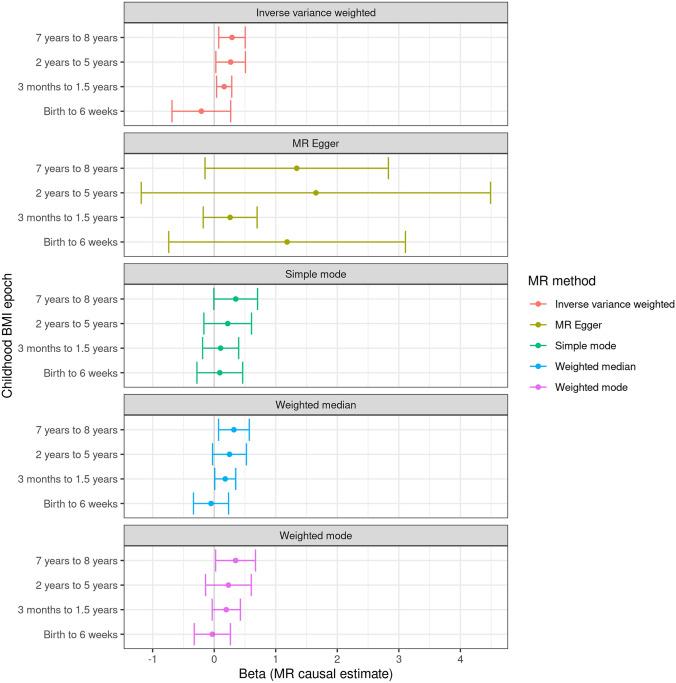
For all age epochs other than birth, genetically determined higher BMI was associated with an increased liability to MS: Birth [Odds Ratio (OR) 0.81, 95% Confidence Interval (CI) 0.50-1.31, Number of Single-Nucleotide Polymorphisms (N) = 7, p = 0.39], Infancy (OR 1.18, 95% CI 1.04-1.33, N = 18, p = 0.01), Early childhood (OR 1.31, 95% CI 1.03-1.66, N = 4, p = 0.03), Later childhood (OR 1.34, 95% CI 1.08-1.66, N = 4, p = 0.01). Multivariable MR suggested that these effects may be mediated by effects on adult BMI.
CONCLUSION
We provide evidence using MR that genetically determined higher BMI during early life is associated with increased MS risk. This effect may be driven by shared genetic architecture with later-life BMI.
目的
人们认为生命早期的体重指数(BMI)较高是多发性硬化症(MS)的一个因果风险因素。我们使用纵向孟德尔随机化(MR)来确定 BMI 是否在某个关键窗口期影响 MS 风险。
方法
从最近的大型全基因组关联研究(GWAS)中获得儿童期 BMI(n≈28000 名儿童)和 MS 易感性的汇总统计数据(n=14802 例 MS,26703 例对照)。我们生成了四个不重叠的年龄时期(<3 个月、3 个月至 1.5 岁、2 至 5 岁和 7 至 8 岁)内 BMI 的暴露工具,并使用逆方差加权法进行了 MR 分析,同时进行了标准敏感性分析。多变量 MR 用于解释通过成年后 BMI 介导的影响。
结果
除出生外,所有年龄时期的遗传决定的较高 BMI 与 MS 的易感性增加相关:出生时[比值比(OR)0.81,95%置信区间(CI)0.50-1.31,单核苷酸多态性(N)数为 7,p=0.39],婴儿期(OR 1.18,95%CI 1.04-1.33,N=18,p=0.01),幼儿期(OR 1.31,95%CI 1.03-1.66,N=4,p=0.03),儿童后期(OR 1.34,95%CI 1.08-1.66,N=4,p=0.01)。多变量 MR 表明,这些影响可能是通过与成年 BMI 的影响介导的。
结论
我们使用 MR 提供了证据,表明生命早期遗传决定的较高 BMI 与 MS 风险增加相关。这种影响可能是由与成年 BMI 共享的遗传结构驱动的。
 Zotero 插件