
年轻人和老年人对咸味强度的动态感知差异。
Differences in dynamic perception of salty taste intensity between young and older adults.
机构信息
Department of Oral and Maxillofacial Radiology, Tokyo Dental College, 2-9-18 Kandamisaki-cho, Chiyoda-ku, Tokyo, 101-0061, Japan.
Tokyo Dental College Research Branding Project, Tokyo Dental College, 2-9-18, Kanda-Misakicho, Chiyoda-ku, Tokyo, 101-0061, Japan.
出版信息
Sci Rep. 2022 May 9;12(1):7558. doi: 10.1038/s41598-022-11442-y.
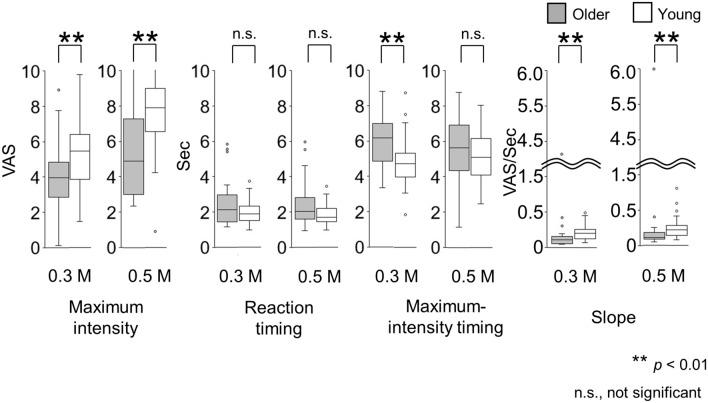
In super-aged societies, high salt intake substantially increases the risk of stroke and cardiovascular disease. Perceived low salty taste often prompts the addition of table salt to food. However, it remains unclear how older adults perceive the nature and intensity of salty taste in the mouth and brain. We compared the perceptions of salty taste intensities of older adults with those of young adults. Participants were 74 healthy adults: 31 older (age, 60-81 years [65.0 ± 5.5 SD]) and 43 young (age, 21-39 years [25.0 ± 3.6 SD]). Our research project comprises three sequential experiments. This article reports on the first two, which were (1) static and (2) dynamic sensory evaluations of taste perceptions in the mouth. Participants assessed the taste of 0.3 M and 0.5 M sodium chloride solutions in two types of sensory evaluations: (1) a cup tasting test, in which they sipped the solution from cups, spat it out, and rated static salty taste intensity, and (2) a time-intensity sensory evaluation, in which the solutions were delivered to participants' tongues through a custom-made delivery system while they recorded dynamic taste intensities on a hand-held meter. Older adults perceived significantly lower taste intensities than young adults (p = 0.004 and p < 0.001 for 0.3 M and 0.5 M, respectively). Reaction timings for both solutions did not differ, but the slopes for both concentrations were significantly lower for older adults than for young adults (p < 0.001). Using a standardized system allowed us to evaluate and directly compare real-time feedback on taste intensities according to age. This study is the first to characterize the time-intensity profiles of salty taste intensity in older adults. Our findings show that older adults do not take longer to recognize a salty taste, but their perception of taste intensity slowly increases, and yet remains lower than that of young adults. This suggests that older adults should be aware of the tendency to add more salt to their food to compensate for their low perceptions of salty taste. We would like to suggest them to savor and chew sufficiently during eating to optimize the perceived salty taste. Furthermore, our results offer a reference for ordinary citizens' taste-intensity perceptions; our standardized system could be usefully integrated into clinical follow-up examinations and treatments.
在超级老龄化社会中,高盐摄入量大大增加了中风和心血管疾病的风险。人们通常认为盐味淡,因此会往食物中添加食盐。然而,老年人如何感知口中和大脑中的咸味本质和强度仍不清楚。我们比较了老年人和年轻人对咸味强度的感知。参与者为 74 名健康成年人:31 名老年人(年龄 60-81 岁[65.0±5.5 标准差])和 43 名年轻人(年龄 21-39 岁[25.0±3.6 标准差])。我们的研究项目包括三个连续的实验。本文报告了前两个实验,即(1)口腔中味觉的静态和(2)动态感官评估。参与者在两种感官评估中评估了 0.3 M 和 0.5 M 氯化钠溶液的味道:(1)在杯测试验中,他们从杯中啜饮溶液,吐出并评估静态咸味强度,以及(2)通过定制的输送系统将溶液输送到参与者的舌头上,同时他们在手持计上记录动态味觉强度。与年轻人相比,老年人感知到的味道强度明显较低(0.3 M 和 0.5 M 时分别为 p=0.004 和 p<0.001)。两种溶液的反应时间没有差异,但对于老年人来说,两种浓度的斜率都明显低于年轻人(p<0.001)。使用标准化系统,我们可以根据年龄评估和直接比较实时反馈的味觉强度。这项研究首次描述了老年人对咸味强度的时间强度曲线。我们的研究结果表明,老年人不会花更长时间来识别咸味,而是他们对味觉强度的感知逐渐增加,但仍低于年轻人。这表明,老年人应该意识到自己倾向于在食物中添加更多的盐,以补偿他们对咸味的低感知。我们建议他们在进食时充分品尝和咀嚼,以优化感知到的咸味。此外,我们的结果为普通市民的味觉强度感知提供了参考;我们的标准化系统可以有效地整合到临床随访检查和治疗中。




 Zotero 插件