
在快速魔角旋转下的 H 检测生物分子 NMR。
H-Detected Biomolecular NMR under Fast Magic-Angle Spinning.
机构信息
Centre de RMN à Très Hauts Champs de Lyon, UMR 5082 CNRS/ENS Lyon/Université Claude Bernard Lyon 1, Université de Lyon, 5 rue de la Doua, 69100 Villeurbanne, France.
Department of Biochemistry and Biophysics, Stockholm University, Svante Arrhenius väg 16C SE-106 91, Stockholm, Sweden.
出版信息
Chem Rev. 2022 May 25;122(10):9943-10018. doi: 10.1021/acs.chemrev.1c00918. Epub 2022 May 10.
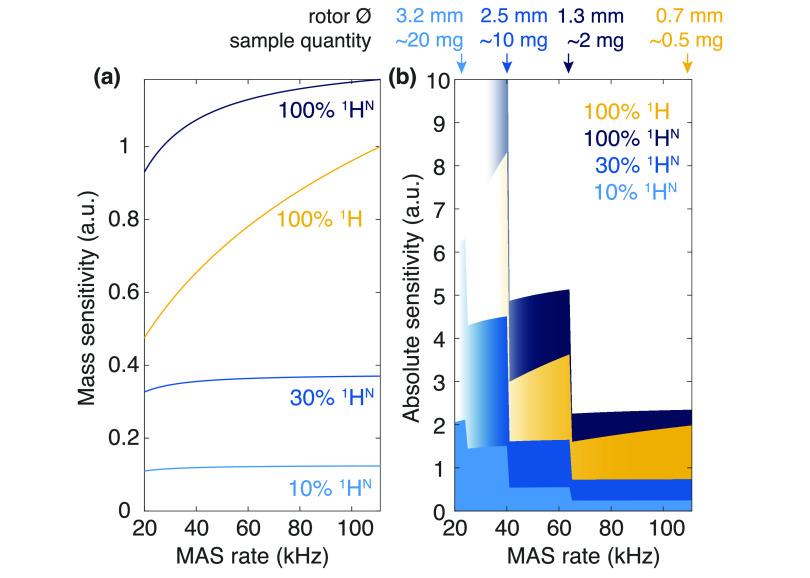
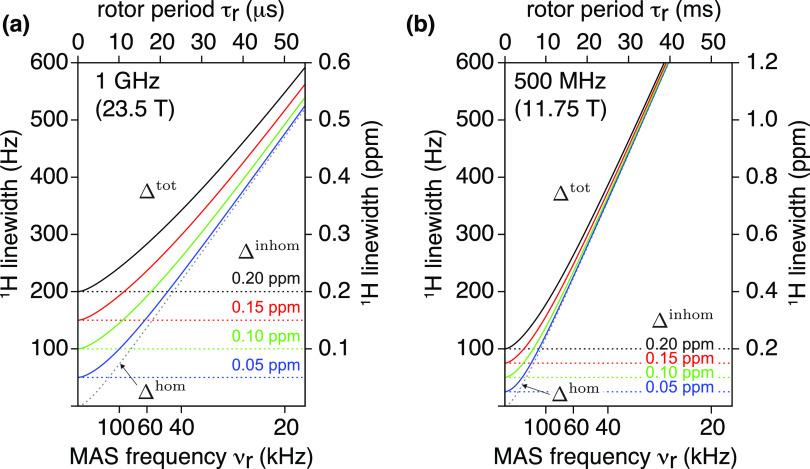
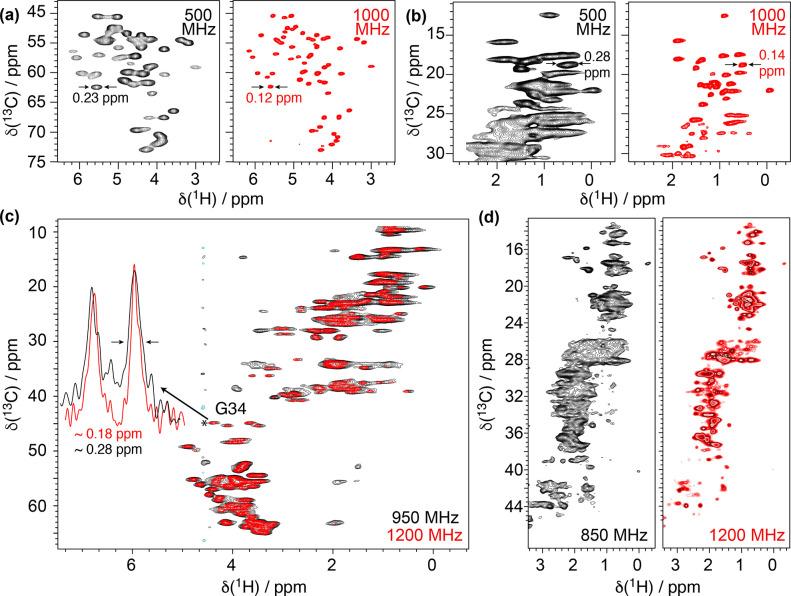
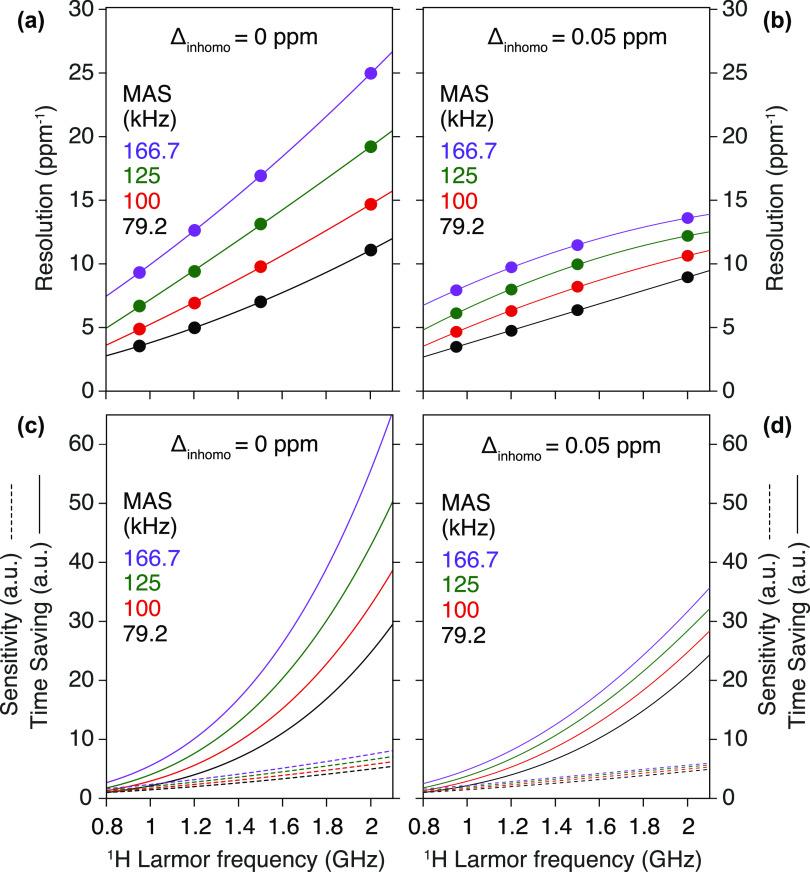
Since the first pioneering studies on small deuterated peptides dating more than 20 years ago, H detection has evolved into the most efficient approach for investigation of biomolecular structure, dynamics, and interactions by solid-state NMR. The development of faster and faster magic-angle spinning (MAS) rates (up to 150 kHz today) at ultrahigh magnetic fields has triggered a real revolution in the field. This new spinning regime reduces the H-H dipolar couplings, so that a direct detection of H signals, for long impossible without proton dilution, has become possible at high resolution. The switch from the traditional MAS NMR approaches with C and N detection to H boosts the signal by more than an order of magnitude, accelerating the site-specific analysis and opening the way to more complex immobilized biological systems of higher molecular weight and available in limited amounts. This paper reviews the concepts underlying this recent leap forward in sensitivity and resolution, presents a detailed description of the experimental aspects of acquisition of multidimensional correlation spectra with fast MAS, and summarizes the most successful strategies for the assignment of the resonances and for the elucidation of protein structure and conformational dynamics. It finally outlines the many examples where H-detected MAS NMR has contributed to the detailed characterization of a variety of crystalline and noncrystalline biomolecular targets involved in biological processes ranging from catalysis through drug binding, viral infectivity, amyloid fibril formation, to transport across lipid membranes.
自 20 多年前首次对小氘代肽进行开拓性研究以来,H 检测已发展成为通过固态 NMR 研究生物分子结构、动态和相互作用最有效的方法。更快、更快的魔角旋转(MAS)速率(目前高达 150 kHz)在超高磁场中的发展引发了该领域的真正革命。这种新的旋转状态降低了 H-H 偶极耦合,因此在没有质子稀释的情况下长期不可能直接检测 H 信号,现在可以在高分辨率下实现。从传统的 C 和 N 检测的 MAS NMR 方法转变为 H 检测,信号强度提高了一个数量级以上,加速了特定部位的分析,并为更复杂的、分子量更高的、数量有限的固定化生物系统开辟了道路。本文综述了这一灵敏度和分辨率近期飞跃背后的概念,详细描述了使用快速 MAS 采集多维相关谱的实验方面,并总结了用于分配共振和阐明蛋白质结构和构象动力学的最成功策略。最后,本文概述了 H 检测 MAS NMR 在详细表征涉及从催化到药物结合、病毒感染性、淀粉样纤维形成,再到跨脂质膜转运等各种生物过程的各种结晶和非结晶生物分子靶标方面所做出的许多贡献。


















 Zotero 插件