
依瑞奈玛预防偏头痛治疗 12 个月的安全性、耐受性和不良事件易感性:一项回顾性真实世界研究。
Twelve-month safety, tolerability and susceptibility to adverse events of prophylactic migraine therapy with erenumab: a retrospective real-world study.
机构信息
Department of Neurology and Center for Translational Neuro- and Behavioral Sciences (C-TNBS), West German Headache Center, University Hospital Essen, University Duisburg-Essen, Hufelandstr. 55, 45147, Essen, Germany.
出版信息
J Headache Pain. 2022 May 11;23(1):55. doi: 10.1186/s10194-022-01426-8.
BACKGROUND
Erenumab is a monoclonal antibody (mAb) against the calcitonin gene related peptide (CGRP) receptor and is commonly used in migraine prophylaxis. Pivotal and open-label studies show a good safety and tolerability. However, little is known about possible predictors, dose dependence and time course of development of adverse events (AEs) during the treatment under real-world conditions.
METHODS
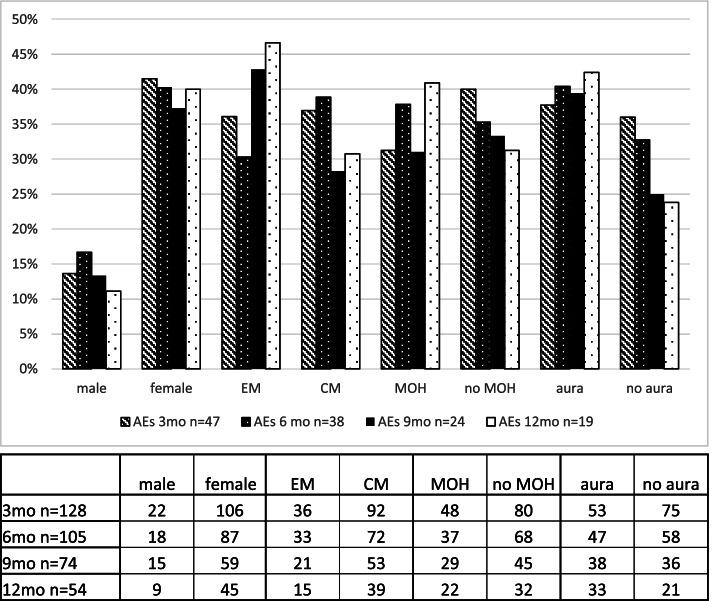
Clinical routine data of 128 patients with migraine treated in the West German Headache Center Essen were analyzed regarding AEs during a treatment interval of up to 12 months (3mo n = 128, 6mo n = 105, 9mo n = 74, 12mo n = 54). Patients obtained subcutaneous erenumab injections with either 70 mg or 140 mg per month. The occurrence and alterations of AEs were evaluated. All reported AEs, regardless of their severity, were included. AEs were graded using the common terminology criteria for adverse events (CTCAE). Possible parameters that could influence the occurrence of AEs (sex, episodic or chronic migraine, medication overuse headache, aura and the dosage of erenumab) were analyzed using the Chi-squared test, alpha adjustment was done using the Bonferroni's correction (6 tests, adjusted alpha = 0.0083).
RESULTS
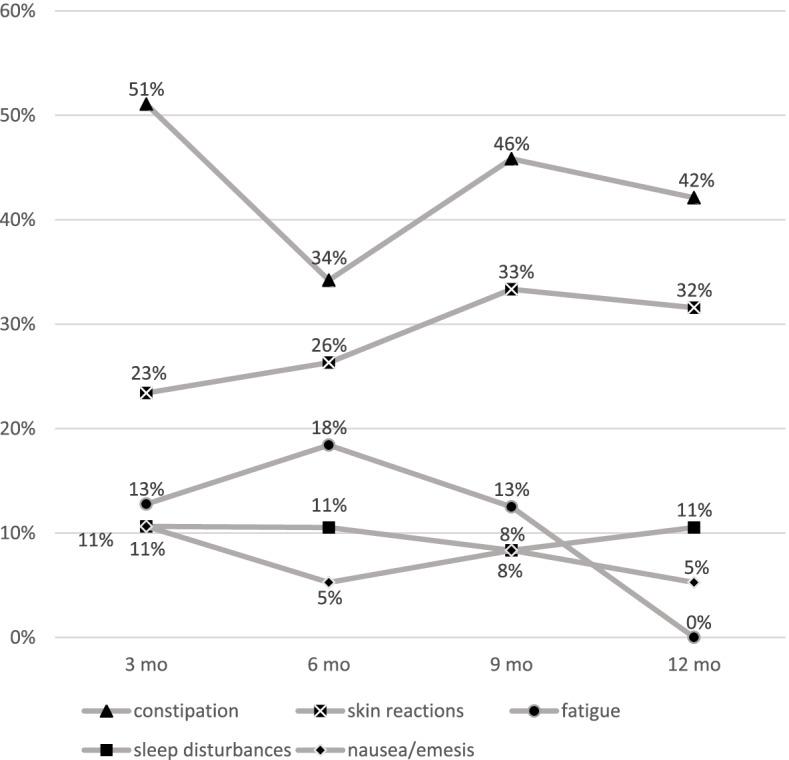
The proportion of patients who reported at least one AE were stable over the course of 12 months (after 3mo = 37%, 6mo = 36%, 9mo = 32%, 12mo = 35%). All reported AEs were grade 1 according to CTCAE with one exception (grade 2). Throughout the interval, five AEs were mostly reported: constipation, skin reactions, fatigue, sleep disturbances and nausea/emesis. Discontinuation of erenumab therapy was rarely caused by AEs (5/49). Increasing the dosage from 70 mg to 140 mg per month caused no higher frequency of AEs (Chi-squared test, p = 0.57). Significant more AEs were reported by females and by patients with aura (Chi-squared test, p < 0.001, respectively).
CONCLUSION
In general, erenumab is well tolerated up to a treatment interval of 12 months and reported AEs rarely lead to discontinuation of therapy. A higher dosage does not increase the patient reported AEs. Furthermore, no habituation of AEs is observed. Nevertheless, females and patients with aura seem to be more prone to have AEs.
TRIAL REGISTRATION
No registration, retrospective analysis.
背景
依瑞奈单抗是一种针对降钙素基因相关肽(CGRP)受体的单克隆抗体(mAb),常用于偏头痛的预防。关键性和开放性研究显示其具有良好的安全性和耐受性。然而,在真实世界环境下治疗期间,关于不良反应(AE)的可能预测因素、剂量依赖性和时间进程知之甚少。
方法
对在德国西部头痛中心埃森接受治疗的 128 例偏头痛患者的临床常规数据进行分析,以评估治疗期间(3 个月 n=128,6 个月 n=105,9 个月 n=74,12 个月 n=54)的 AE。患者每月接受 70mg 或 140mg 的依瑞奈单抗皮下注射。评估 AE 的发生和变化。所有报告的 AE 无论其严重程度如何均包括在内。使用常见术语标准(CTCAE)对 AE 进行分级。使用卡方检验分析可能影响 AE 发生的参数(性别、发作性或慢性偏头痛、药物过度使用性头痛、先兆和依瑞奈单抗的剂量),使用 Bonferroni 校正进行 alpha 调整(6 个测试,调整后的 alpha=0.0083)。
结果
在 12 个月的治疗过程中,报告至少一种 AE 的患者比例保持稳定(3 个月后为 37%,6 个月后为 36%,9 个月后为 32%,12 个月后为 35%)。所有报告的 AE 根据 CTCAE 均为 1 级(1 例外为 2 级)。整个期间,最常报告的 AE 有便秘、皮肤反应、疲劳、睡眠障碍和恶心/呕吐。因 AE 而停止依瑞奈单抗治疗的情况很少见(5/49)。每月从 70mg 增加到 140mg 的剂量不会导致 AE 发生频率增加(卡方检验,p=0.57)。女性和有先兆的患者报告的 AE 更多(卡方检验,p<0.001)。
结论
依瑞奈单抗在长达 12 个月的治疗期间通常具有良好的耐受性,报告的 AE 很少导致治疗中断。更高的剂量不会增加患者报告的 AE。此外,AE 没有出现习惯化。然而,女性和有先兆的患者似乎更容易出现 AE。
试验注册
无注册,回顾性分析。

 Zotero 插件