
人组织和表达的尿苷二磷酸葡萄糖醛酸基转移酶(UGT)对[6]-姜辣素、[8]-姜辣素和[10]-姜辣素的葡萄糖醛酸化作用:确定UGT2B7为主要贡献酶。
Glucuronidation of [6]-shogaol, [8]-shogaol and [10]-shogaol by human tissues and expressed UGT enzymes: identification of UGT2B7 as the major contributor.
作者信息
He Liangliang, Xu Jinjin, Wang Qi, Zhang Yezi, Qin Zifei, Yu Yang, Qian Zhengming, Yao Zhihong, Yao Xinsheng
机构信息
College of Pharmacy, Jinan University Guangzhou 510632 P. R. China
Key Laboratory of State Administration of Traditional Chinese Medicine, Sunshine Lake Pharma Co., LTD Dongguan Guangdong 523850 P. R. China.
出版信息
RSC Adv. 2018 Dec 12;8(72):41368-41375. doi: 10.1039/c8ra08466a. eCollection 2018 Dec 7.
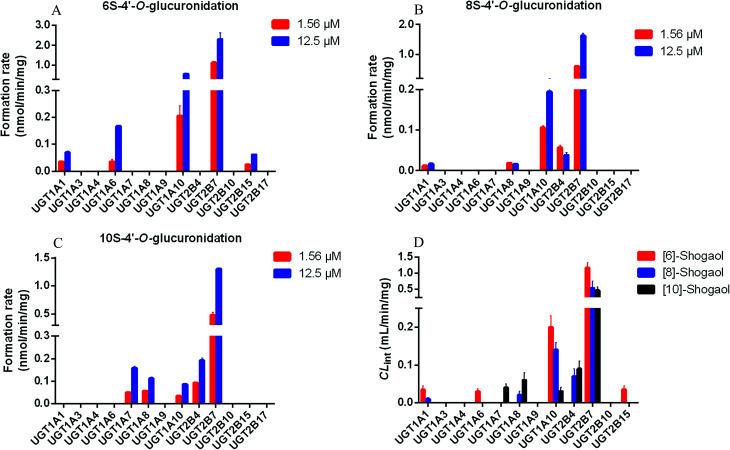
Shogaols, mainly [6]-shogaol (6S), [8]-shogaol (8S) and [10]-shogaol (10S), the predominant and characteristic pungent phytochemicals in ginger, are responsible for most of its beneficial effects. However, poor oral bioavailability owing to extensive glucuronidation limits their application. The present study aimed to characterize the glucuronidation pathways of 6S, 8S and 10S by using pooled human liver microsomes (HLM), human intestine microsomes (HIM) and recombinant human UDP-glucosyltransferases (UGTs). The rates of glucuronidation were determined by incubating shogaols with uridine diphosphate glucuronic acid-supplemented microsomes. Kinetic parameters were derived by appropriate model fitting. Reaction phenotyping assays, activity correlation analyses and relative activity factors were performed to identify the main UGT isoforms. As a result, one mono-4'--glucuronide was detected after incubating each shogaol with HLM and HIM. Enzymes kinetic analysis demonstrated that glucuronidation of shogaols consistently displayed the substrate inhibition profile, and the liver showed higher metabolic activity for shogaols (CL = 1.37-2.87 mL min mg) than the intestine (CL = 0.67-0.85 mL min mg). Besides, reaction phenotyping assays revealed that UGT2B7 displayed the highest catalytic ability (CL = 0.47-1.17 mL min mg) among all tested UGTs. In addition, glucuronidation of shogaols was strongly correlated with AZT glucuronidation ( = 0.886, 0.803 and 0.871 for glucuronidation of 6S, 8S and 10S, respectively; < 0.01) in a bank of individual HLMs ( = 9). Furthermore, UGT2B7 contributed to 40.8%, 34.2% and 36.0% for the glucuronidation of 6S, 8S and 10S in HLM, respectively. Taken altogether, shogaols were efficiently metabolized through the glucuronidation pathway, and UGT2B7 was the main contributor to their glucuronidation.
姜辣素,主要是[6]-姜辣素(6S)、[8]-姜辣素(8S)和[10]-姜辣素(10S),是生姜中主要且具有特征性的辛辣植物化学物质,其大部分有益作用都归因于它们。然而,由于广泛的葡萄糖醛酸化导致口服生物利用度较差,限制了它们的应用。本研究旨在通过使用人肝微粒体(HLM)、人肠微粒体(HIM)和重组人尿苷二磷酸葡萄糖基转移酶(UGT)来表征6S、8S和10S的葡萄糖醛酸化途径。通过将姜辣素与补充了尿苷二磷酸葡萄糖醛酸的微粒体孵育来测定葡萄糖醛酸化速率。通过适当的模型拟合得出动力学参数。进行反应表型分析、活性相关性分析和相对活性因子分析以鉴定主要的UGT同工型。结果,在将每种姜辣素与HLM和HIM孵育后,检测到一种单-4'-葡萄糖醛酸苷。酶动力学分析表明,姜辣素的葡萄糖醛酸化始终呈现底物抑制特征,并且肝脏对姜辣素的代谢活性(CL = 1.37 - 2.87 mL min mg)高于肠道(CL = 0.67 - 0.85 mL min mg)。此外,反应表型分析表明,在所有测试的UGT中,UGT2B7表现出最高的催化能力(CL = 0.47 - 1.17 mL min mg)。此外,在一组个体HLM(n = 9)中,姜辣素的葡萄糖醛酸化与齐多夫定葡萄糖醛酸化(6S、8S和10S葡萄糖醛酸化的r分别为0.886、0.803和0.871;P < 0.01)密切相关。此外,在HLM中,UGT2B7分别对6S、8S和1S的葡萄糖醛酸化贡献了40.8%、34.2%和36.0%。综上所述,姜辣素通过葡萄糖醛酸化途径被有效代谢,UGT2B7是其葡萄糖醛酸化的主要贡献者。

 Zotero 插件