
在具有全民健康覆盖的中上收入国家,制定在新冠疫情期间和之后维持癌症护理质量的指南的建议。
Proposal for development of a guideline in maintaining quality cancer care during and post-covid-19 in an upper middle-income country with universal health coverage.
机构信息
Centre for Epidemiology and Evidence-Based Practice, Department of Social and Preventive Medicine, Faculty of Medicine, Universiti Malaya, Kuala Lumpur, Malaysia.
Department of Radiotherapy and Oncology, Kuala Lumpur Hospital, Malaysia.
出版信息
J Cancer Policy. 2021 Dec;30:100300. doi: 10.1016/j.jcpo.2021.100300. Epub 2021 Aug 20.
BACKGROUND
During periods of high community transmission of COVID-19, the public hospitals in Malaysia, an upper middle-income country, have been forced to scale down elective surgeries, prioritize cancer treatments based on treatment benefits, and postpone non-emergency imaging procedures. These inevitably led to disruptions in cancer care delivery within the public health care system. This study aims to explore the facilitators and barriers faced by healthcare providers and cancer survivors in cancer care, and to co-design a guideline to maintain the delivery of cancer care amid the disaster situations.
METHOD
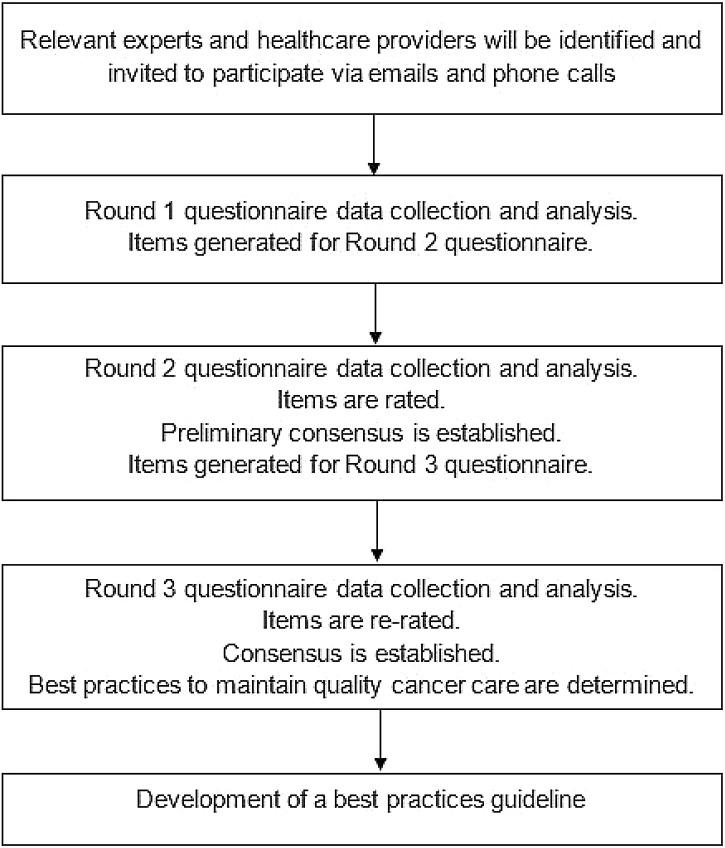
In-depth interviews (IDIs) will be conducted with Malaysian healthcare providers and cancer survivors and findings will be analysed thematically. The insights will be used in a subsequent phase to co-design a guideline to maintain the delivery of quality cancer care in Malaysia via a three-round modified Delphi survey with a broad range of cancer stakeholders.
EXPECTED RESULTS
Findings derived from IDIs and existing literature will be included for rating across three rounds by the expert panel. Feedback provided will be refined until consensus on the best practises for cancer care continuity during crises is achieved.
CONCLUSION
The output of the present study is not only expected to ensure the continuity of delivery of high-quality cancer care in Malaysia during the ongoing pandemic but also to be adapted during unforeseen crises in the near future.
POLICY SUMMARY STATEMENT
Collaborative work between policy makers, public health physicians, members of the multidisciplinary oncology team as well as cancer survivors is vital in developing an evidenced- based contingency plan for maintaining access to cancer care.
背景
在 COVID-19 社区传播高峰期,马来西亚的公立医院被迫缩减择期手术,根据治疗获益情况优先安排癌症治疗,并推迟非紧急影像检查。这些措施不可避免地导致公共医疗体系中的癌症护理服务中断。本研究旨在探讨医疗保健提供者和癌症幸存者在癌症护理方面面临的促进因素和障碍,并共同设计一份指南,以维持灾难情况下的癌症护理服务。
方法
将对马来西亚的医疗保健提供者和癌症幸存者进行深入访谈(IDIs),并对研究结果进行主题分析。这些见解将用于后续阶段,通过与广泛的癌症利益相关者进行三轮改良 Delphi 调查,共同设计一份指南,以维持马来西亚高质量癌症护理的提供。
预期结果
IDIs 和现有文献中得出的结果将在三轮中由专家小组进行评分。提供的反馈将不断完善,直到就危机期间癌症护理连续性的最佳实践达成共识。
结论
本研究的结果不仅有望确保马来西亚在当前大流行期间高质量癌症护理服务的持续提供,而且还将在不久的将来适应不可预见的危机。
政策总结陈述
政策制定者、公共卫生医生、肿瘤多学科团队成员以及癌症幸存者之间的协作工作对于制定维持癌症护理机会的循证应急计划至关重要。

 Zotero 插件