
面向职业暴露的基于健康的纳米参考值 (HNRVs):专家小组的建议。
Towards health-based nano reference values (HNRVs) for occupational exposure: Recommendations from an expert panel.
机构信息
National Institute for Public Health and the Environment, Bilthoven, the Netherlands.
National Institute for Public Health and the Environment, Bilthoven, the Netherlands.
出版信息
NanoImpact. 2022 Apr;26:100396. doi: 10.1016/j.impact.2022.100396. Epub 2022 Mar 17.
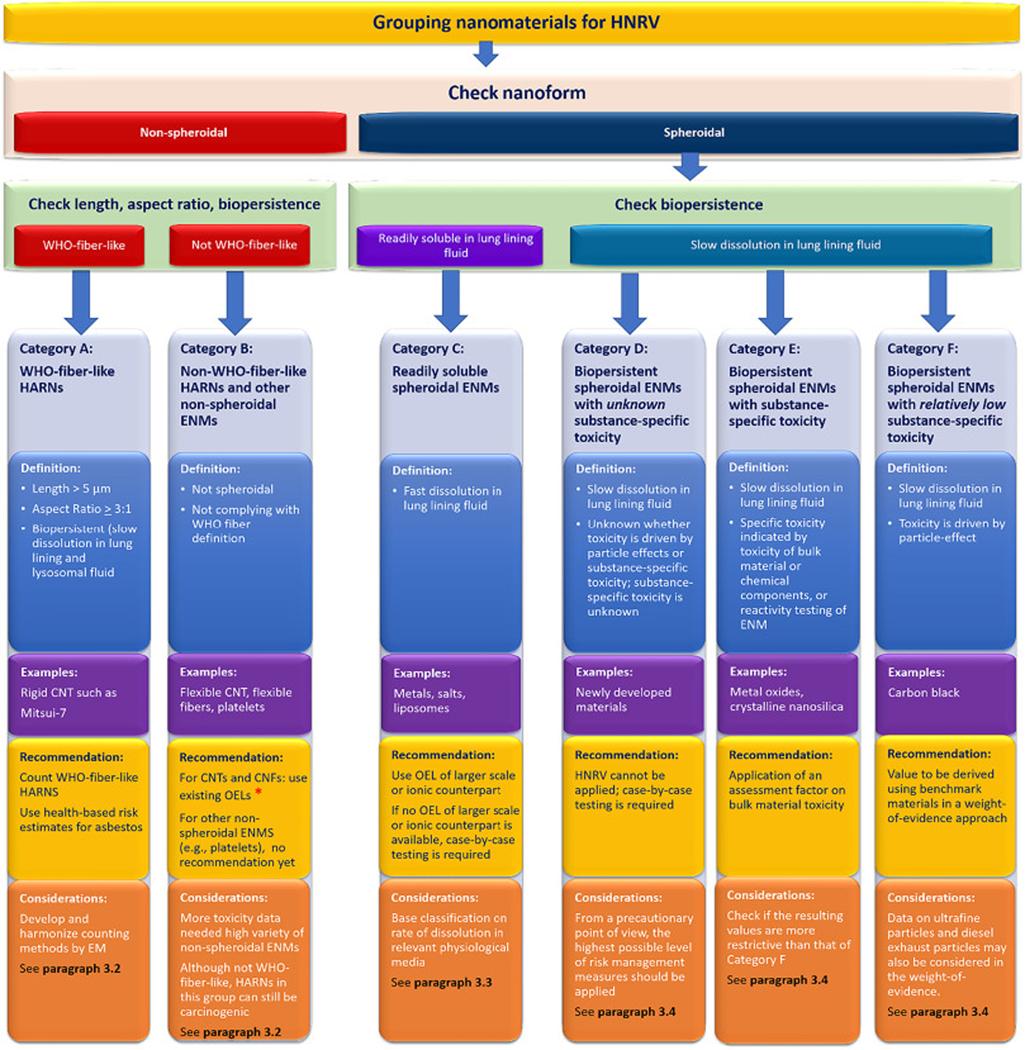
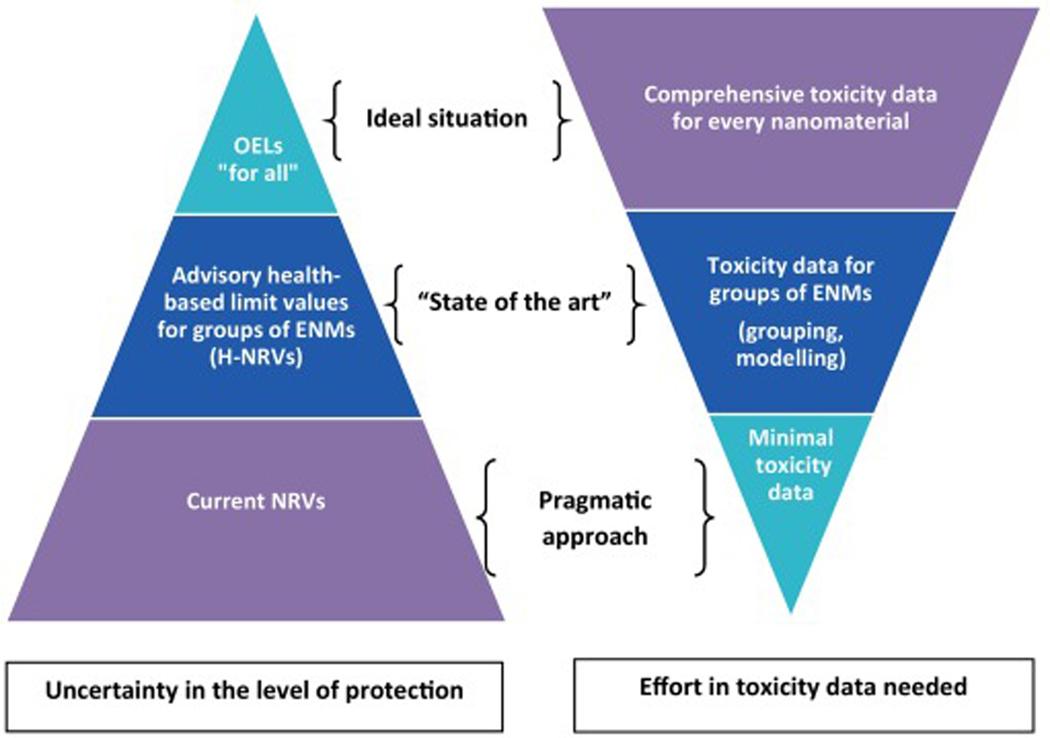
Unique physicochemical characteristics of engineered nanomaterials (ENMs) suggest the need for nanomaterial-specific occupational exposure limits (OELs). Setting these limits remains a challenge. Therefore, the aim of this study was to set out a framework to evaluate the feasibility of deriving advisory health-based occupational limit values for groups of ENMs, based on scientific knowledge. We have used an expert panel approach to address three questions: 1) What ENM-categories should be distinguished to derive advisory health-based occupational limit values (or health-based Nano Reference Values, HNRVs) for groups of ENMs? 2) What evidence would be needed to define values for these categories? And 3) How much effort would it take to achieve this? The panel experts distinguished six possible categories of HNRVs: A) WHO-fiber-like high aspect ratio ENMs (HARNs), B) Non-WHO-fiber-like HARNs and other non-spheroidal ENMs, C) readily soluble spheroidal ENMs, D) biopersistent spheroidal ENMs with unknown toxicity, E) biopersistent spheroidal ENMs with substance-specific toxicity and F) biopersistent spheroidal ENMs with relatively low substance-specific toxicity. For category A, the WHO-fiber-like HARNs, agreement was reached on criteria defining this category and the approach of using health-based risk estimates for asbestos to derive the HNRV. For category B, a quite heterogeneous category, more toxicity data are needed to set an HNRV. For category C, readily soluble spheroidal ENMs, using the OEL of their molecular or ionic counterpart would be a good starting point. For the biopersistent ENMs with unknown toxicity, HNRVs cannot be applied as case-by-case testing is required. For the other biopersistent ENMs in category E and F, we make several recommendations that can facilitate the derivation of these HNRVs. The proposed categories and recommendations as outlined by this expert panel can serve as a reference point for derivation of HNRVs when health-based OELs for ENMs are not yet available.
工程纳米材料 (ENMs) 的独特物理化学特性表明需要制定针对纳米材料的特定职业暴露限值 (OEL)。制定这些限值仍然是一个挑战。因此,本研究的目的是制定一个框架,根据科学知识评估为 ENM 组衍生基于健康的咨询职业限值的可行性。我们使用专家小组的方法来解决三个问题:1)应该区分哪些 ENM 类别,以便为 ENM 组衍生基于健康的咨询职业限值(或基于健康的纳米参考值,HNRVs)?2)需要哪些证据来定义这些类别的值?3)实现这一目标需要多少努力?小组专家区分了六个可能的 HNRV 类别:A)世界卫生组织纤维状高纵横比 ENMs (HARNs),B)非世界卫生组织纤维状 HARNs 和其他非球形 ENMs,C)易溶性球形 ENMs,D)具有未知毒性的生物持久性球形 ENMs,E)具有物质特异性毒性的生物持久性球形 ENMs 和 F)具有相对较低物质特异性毒性的生物持久性球形 ENMs。对于类别 A,即世界卫生组织纤维状 HARNs,专家们就定义该类别的标准和使用基于健康的风险估计来衍生 HNRV 的方法达成了一致。对于类别 B,一个相当异质的类别,需要更多的毒性数据来设定 HNRV。对于类别 C,易溶性球形 ENMs,使用其分子或离子对应物的 OEL 作为起始点将是一个很好的起点。对于具有未知毒性的生物持久性 ENMs,不能应用 HNRV,因为需要进行个案测试。对于类别 E 和 F 中的其他生物持久性 ENMs,我们提出了一些建议,这些建议可以促进这些 HNRV 的推导。该专家小组概述的建议类别可以作为在没有针对 ENMs 的基于健康的 OEL 时推导 HNRV 的参考点。

 Zotero 插件