
不同生物流体中检测到的细胞外囊泡在 COPD 中的新兴作用。
The Emerging Role of Extracellular Vesicles Detected in Different Biological Fluids in COPD.
机构信息
Centro Dipartimentale di Biologia Cellulare Cardiorespiratoria, Dipartimento di Patologia Chirurgica, Medica, Molecolare e dell'Area Critica, Università degli Studi di Pisa, 56124 Pisa, Italy.
Department of Cardiac, Thoracic, Vascular Sciences and Public Health, University of Padova, 35128 Padova, Italy.
出版信息
Int J Mol Sci. 2022 May 5;23(9):5136. doi: 10.3390/ijms23095136.
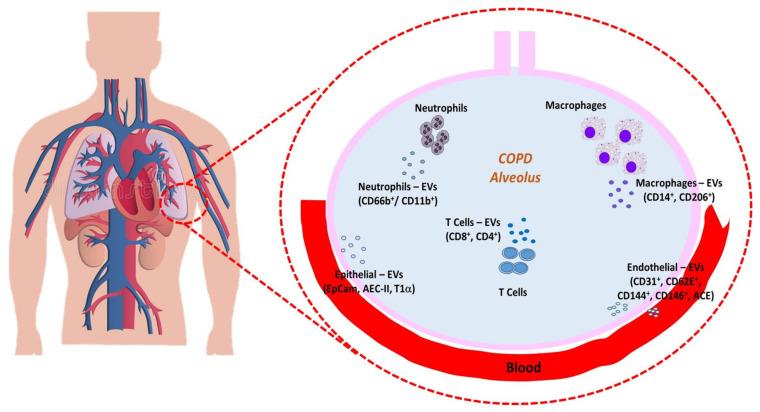
The pathogenesis of chronic obstructive pulmonary disease (COPD) is characterized by complex cellular and molecular mechanisms, not fully elucidated so far. It involves inflammatory cells (monocytes/macrophages, neutrophils, lymphocytes), cytokines, chemokines and, probably, new players yet to be clearly identified and described. Chronic local and systemic inflammation, lung aging and cellular senescence are key pathological events in COPD development and progression over time. Extracellular vesicles (EVs), released by virtually all cells both as microvesicles and exosomes into different biological fluids, are involved in intercellular communication and, therefore, represent intriguing players in pathobiological mechanisms (including those characterizing aging and chronic diseases); moreover, the role of EVs as biomarkers in different diseases, including COPD, is rapidly gaining recognition. In this review, after recalling the essential steps of COPD pathogenesis, we summarize the current evidence on the roles of EVs collected in different biological mediums as biomarkers in COPD and as potential players in the specific mechanisms leading to disease development. We will also briefly review the data on EV as potential therapeutic targets and potential therapeutic agents.
慢性阻塞性肺疾病(COPD)的发病机制以复杂的细胞和分子机制为特征,目前尚未完全阐明。它涉及炎症细胞(单核细胞/巨噬细胞、中性粒细胞、淋巴细胞)、细胞因子、趋化因子,可能还有尚未明确和描述的新参与者。慢性局部和全身炎症、肺老化和细胞衰老,是 COPD 发展和随时间进展的关键病理事件。细胞外囊泡(EVs),几乎所有细胞都通过微泡和外泌体释放到不同的生物流体中,参与细胞间通讯,因此是病理生物学机制(包括那些表征衰老和慢性疾病的机制)中的有趣参与者;此外,EV 作为不同疾病(包括 COPD)生物标志物的作用正在迅速得到认可。在这篇综述中,在回顾 COPD 发病机制的基本步骤后,我们总结了目前在不同生物介质中收集的 EV 作为 COPD 生物标志物的作用以及作为导致疾病发展的特定机制的潜在参与者的证据。我们还将简要回顾关于 EV 作为潜在治疗靶点和潜在治疗剂的数据。
 Zotero 插件