
回顾 COVID-19 大流行期间五个西方国家对母乳喂养支持的破坏情况及其在临床实践中的应用。
A review of the disruption of breastfeeding supports in response to the COVID-19 pandemic in five Western countries and applications for clinical practice.
机构信息
Manitoba Interdisciplinary Lactation Center (MILC), University of Manitoba, Winnipeg, Canada.
Children's Hospital Research Institute of Manitoba, University of Manitoba, Winnipeg, Canada.
出版信息
Int Breastfeed J. 2022 May 15;17(1):38. doi: 10.1186/s13006-022-00478-5.
BACKGROUND
The COVID-19 pandemic has significantly altered how breastfeeding support is provided, resulting in mixed breastfeeding outcomes and experiences for mothers. The World Health Organization has consistently supported breastfeeding from the beginning of the pandemic. However, recommendations from obstetrical and gynaecological societies within individual countries have varied in their alignment with this guidance, resulting in inconsistent recommendations. It is unknown how breastfeeding guidelines, maternal breastfeeding experiences, and breastfeeding initiation and duration compared across five Western countries. The current study is comprised of two parts, each with a different objective. Part One objective: to review pandemic-related changes in professional society guidelines on breastfeeding support in Australia, New Zealand, Canada, the United Kingdom, and the United States; and Part Two objective: to conduct a narrative review to summarize the evidence of how the pandemic has changed breastfeeding initiation, duration, and mothers' breastfeeding experiences during the pandemic in these five countries and provide recommendations for clinical lactation support.
METHODS
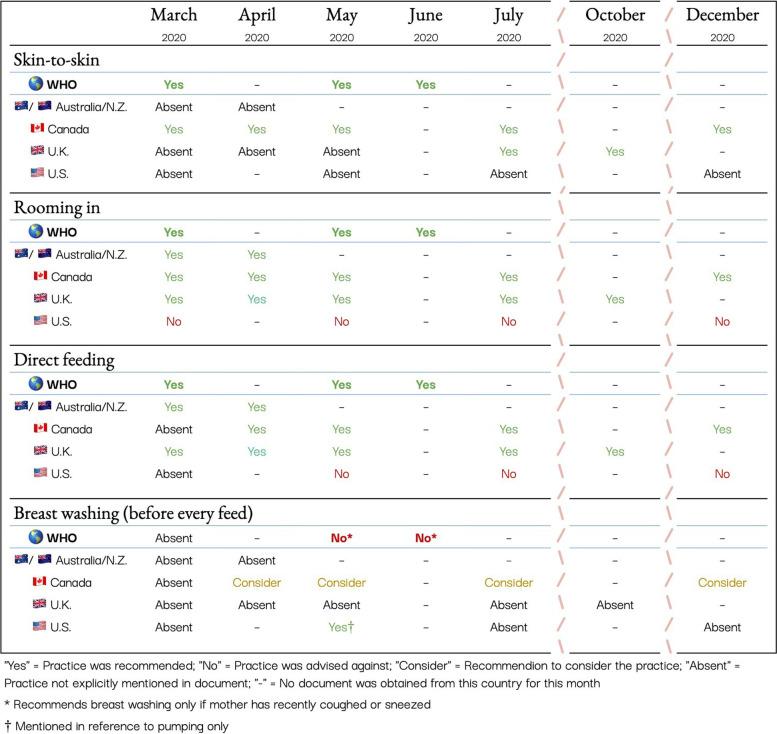
We searched for indicators that are impactful on breastfeeding outcomes: skin-to-skin contact, rooming in, direct breastfeeding and breast washing, in the five countries mentioned above and compared these to the recommendations from the World Health Organization. Next, we conducted a narrative review of the literature from these five countries to explore how the pandemic altered breastfeeding outcomes and used this information to provide suggestions for clinical practice moving forward.
RESULTS
Recommendations on the four practices above differed by country and were not always in alignment with the World Health Organization recommendations. Mother-infant separation after birth in the United States was associated with a lower prevalence of breastfeeding initiation and duration. While some mothers reported positive breastfeeding experiences during the pandemic, many mothers indicated negative experiences related to decreased social and professional support.
CONCLUSIONS
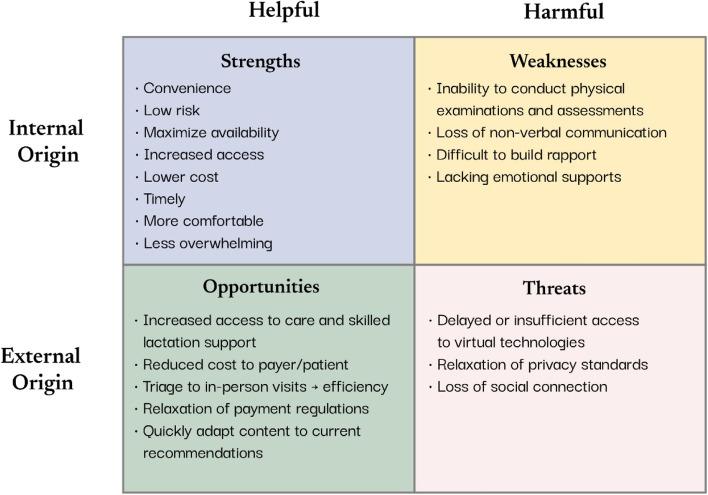
The pandemic can inform practice recommendations and can be viewed as an opportunity to permanently modify existing methods to support breastfeeding families. The use of virtual care increased during the pandemic and should continue with specific considerations for prioritizing in-person care. This will help to provide more timely and accessible support for breastfeeding mothers.
背景
COVID-19 大流行显著改变了母乳喂养支持的方式,导致母亲的混合母乳喂养结果和体验参差不齐。世界卫生组织从大流行一开始就一直支持母乳喂养。然而,个别国家的妇产科协会的建议在与这一指导方针的一致性上存在差异,导致建议不一致。目前尚不清楚在五个西方国家,母乳喂养指南、产妇母乳喂养体验以及母乳喂养开始和持续时间的比较情况。本研究由两部分组成,每部分都有不同的目标。第一部分目标:审查澳大利亚、新西兰、加拿大、英国和美国专业协会关于母乳喂养支持的大流行相关指南的变化;第二部分目标:进行叙述性综述,总结大流行如何改变这五个国家母乳喂养开始、持续时间和母亲在大流行期间的母乳喂养体验的证据,并为临床哺乳支持提供建议。
方法
我们搜索了对母乳喂养结果有影响的指标:皮肤接触、母婴同室、直接母乳喂养和乳房清洗,在上述五个国家进行了比较,并将这些与世界卫生组织的建议进行了比较。接下来,我们对这五个国家的文献进行了叙述性综述,探讨了大流行如何改变母乳喂养结果,并利用这些信息为今后的临床实践提供建议。
结果
上述四项实践的建议因国家而异,并不总是与世界卫生组织的建议一致。美国产后母婴分离与母乳喂养开始和持续时间较低的流行率相关。虽然一些母亲报告在大流行期间有积极的母乳喂养体验,但许多母亲表示,由于社会和专业支持减少,她们的体验不佳。
结论
大流行可以为实践建议提供信息,并可以视为永久修改现有方法以支持母乳喂养家庭的机会。大流行期间虚拟护理的使用增加,应继续使用特别考虑优先提供面对面护理的方法。这将有助于为母乳喂养的母亲提供更及时和更方便的支持。
 Zotero 插件