
细菌群体感应允许细胞对种群密度变化进行分级和双峰响应。
Bacterial Quorum Sensing Allows Graded and Bimodal Cellular Responses to Variations in Population Density.
机构信息
School of Biological Sciences, Georgia Institute of Technologygrid.213917.f, Atlanta, Georgia, USA.
Center for Microbial Dynamics and Infection, Georgia Institute of Technologygrid.213917.f, Atlanta, Georgia, USA.
出版信息
mBio. 2022 Jun 28;13(3):e0074522. doi: 10.1128/mbio.00745-22. Epub 2022 May 18.
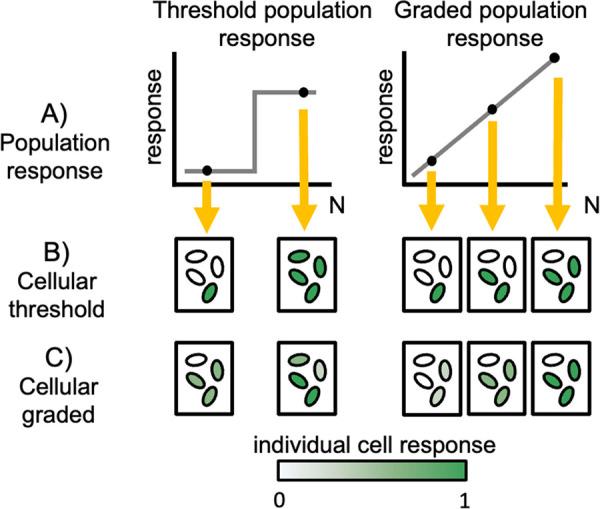
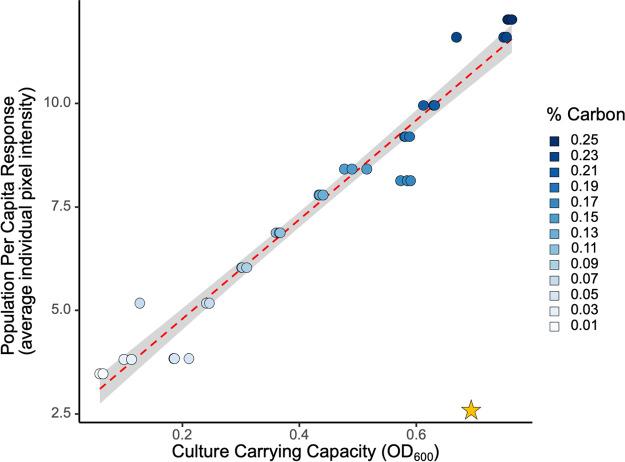
Quorum sensing (QS) is a mechanism of cell-cell communication that connects gene expression to environmental conditions (e.g., cell density) in many bacterial species, mediated by diffusible signal molecules. Current functional studies focus on qualitatively distinct QS ON/OFF states. In the context of density sensing, this view led to the adoption of a "quorum" analogy in which populations sense when they are above a sufficient density (i.e., "quorate") to efficiently turn on cooperative behaviors. This framework overlooks the potential for intermediate, graded responses to shifts in the environment. In this study, we tracked QS-regulated protease () expression and showed that Pseudomonas aeruginosa can deliver a graded behavioral response to fine-scale variation in population density, on both the population and single-cell scales. On the population scale, we saw a graded response to variation in population density (controlled by culture carrying capacity). On the single-cell scale, we saw significant bimodality at higher densities, with separate OFF and ON subpopulations that responded differentially to changes in density: a static OFF population of cells and increasing intensity of expression among the ON population of cells. Together, these results indicate that QS can tune gene expression to graded environmental change, with no critical cell mass or "quorum" at which behavioral responses are activated on either the individual-cell or population scale. In an infection context, our results indicate there is not a hard threshold separating a quorate "attack" mode from a subquorate "stealth" mode. Bacteria can be highly social, controlling collective behaviors via cell-cell communication mechanisms known as quorum sensing (QS). QS is now a large research field, yet a basic question remains unanswered: what is the environmental resolution of QS? The notion of a threshold, or "quorum," separating coordinated ON and OFF states is a central dogma in QS, but recent studies have shown heterogeneous responses at a single cell scale. Using Pseudomonas aeruginosa, we showed that populations generate graded responses to environmental variation through shifts in the proportion of cells responding and the intensity of responses. In an infection context, our results indicate that there is not a hard threshold separating a quorate "attack" mode and a subquorate "stealth" mode.
群体感应 (QS) 是一种细胞间通讯机制,通过可扩散的信号分子将基因表达与许多细菌物种的环境条件(例如细胞密度)联系起来。目前的功能研究侧重于定性不同的 QS ON/OFF 状态。在密度感应的背景下,这种观点导致了采用“群体感应”类比的情况,其中群体感应在它们的密度高于足够高的密度(即“群体感应”)时感知到可以有效地开启合作行为。这个框架忽略了环境变化的中间、分级响应的可能性。在这项研究中,我们跟踪了 QS 调节的蛋白酶 () 表达,并表明铜绿假单胞菌可以对种群密度的细微变化做出分级行为反应,无论是在种群水平还是单细胞水平上。在种群水平上,我们看到了种群密度变化的分级反应(由培养物承载能力控制)。在单细胞水平上,我们在较高密度下看到了显著的双峰性,具有不同密度的单独的 OFF 和 ON 亚群:细胞的静态 OFF 群体和细胞的 ON 群体中表达强度的增加。这些结果表明,QS 可以将基因表达调谐到环境变化的分级上,无论是在单细胞还是种群水平上,都没有关键的细胞质量或“群体感应”来激活行为反应。在感染背景下,我们的结果表明,不存在将群体感应的“攻击”模式与亚群体感应的“隐身”模式区分开来的硬性阈值。细菌可以是高度社会化的,通过称为群体感应 (QS) 的细胞间通讯机制来控制集体行为。QS 现在是一个大型研究领域,但一个基本问题仍然没有答案:QS 的环境分辨率是什么?分离协调的 ON 和 OFF 状态的阈值或“群体感应”的概念是 QS 的一个核心教条,但最近的研究表明,单细胞尺度存在异质响应。使用铜绿假单胞菌,我们表明,通过响应细胞比例和响应强度的变化,种群对环境变化产生分级响应。在感染背景下,我们的结果表明,不存在将群体感应的“攻击”模式与亚群体感应的“隐身”模式区分开来的硬性阈值。


 Zotero 插件