
卤化锌(II)的环状(烷基)(氨基)卡宾配合物中的超长寿命发光三重激发态
Ultra-Long Lived Luminescent Triplet Excited States in Cyclic (Alkyl)(amino)carbene Complexes of Zn(II) Halides.
作者信息
Mrózek Ondřej, Gernert Markus, Belyaev Andrey, Mitra Mousree, Janiak Lars, Marian Christel M, Steffen Andreas
机构信息
Faculty of Chemistry and Chemical Biology, TU Dortmund University, Otto-Hahn-Str. 6, 44227, Dortmund, Germany.
Institute of Theoretical and Computational Chemistry, Heinrich Heine University Düsseldorf, 40225, Düsseldorf, Germany.
出版信息
Chemistry. 2022 Aug 10;28(45):e202201114. doi: 10.1002/chem.202201114. Epub 2022 Jun 21.
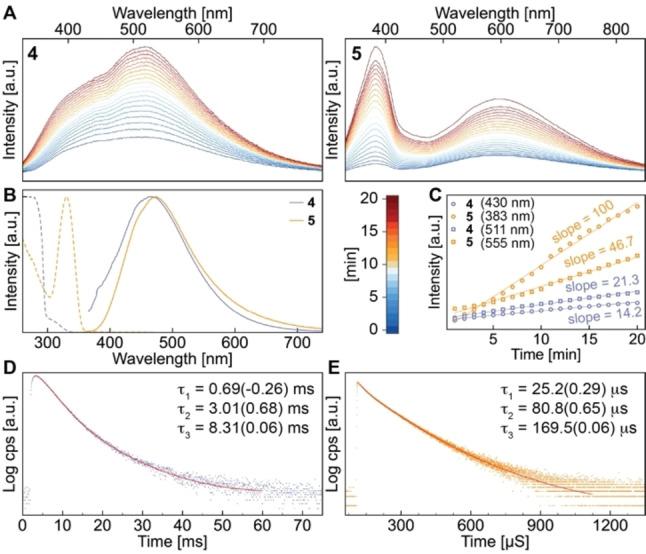
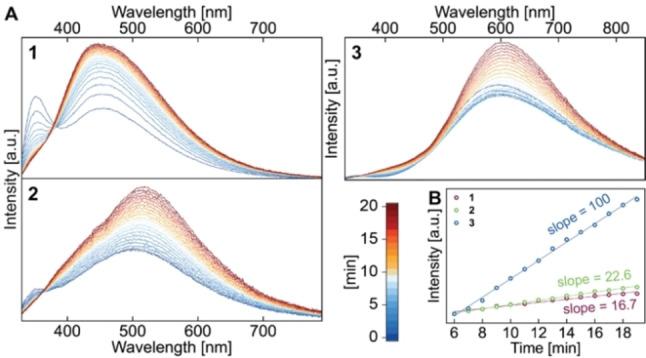
The high element abundance and d electron configuration make Zn -based compounds attractive candidates for the development of novel photoactive molecules. Although a large library of purely fluorescent compounds exists, emission involving triplet excited states is a rare phenomenon for zinc complexes. We have investigated the photophysical and -chemical properties of a series of dimeric and monomeric Zn halide complexes bearing a cyclic (alkyl)(amino)carbene (cAAC) as chromophore unit. Specifically, [(cAAC)XZn(μ-X) ZnX(cAAC)] (X=Cl (1), Br (2), I (3)) and [ZnX (cAAC)(NCMe)] (X=Br (4), I (5)) were isolated and fully characterized, showing intense visible light photoluminescence under UV irradiation at 297 K and fast photo-induced transformation. At 77 K, the compounds exhibit improved stability allowing to record ultra-long lifetimes in the millisecond regime. DFT/MRCI calculations confirm that the emission stems from XCT/LE states and indicate the phototransformation to be related to asymmetric distortion of the complexes by cAAC ligand rotation. This study enhances our understanding of the excited state properties for future development and application of new classes of Zn phosphorescent complexes.
高元素丰度和d电子构型使锌基化合物成为开发新型光活性分子的有吸引力的候选物。尽管存在大量纯荧光化合物库,但涉及三重激发态的发射对于锌配合物来说是一种罕见的现象。我们研究了一系列以环状(烷基)(氨基)卡宾(cAAC)作为发色团单元的二聚体和单体卤化锌配合物的光物理和化学性质。具体而言,分离并充分表征了[(cAAC)XZn(μ-X)ZnX(cAAC)](X = Cl(1),Br(2),I(3))和[ZnX(cAAC)(NCMe)](X = Br(4),I(5)),它们在297 K的紫外光照射下显示出强烈的可见光光致发光以及快速的光诱导转变。在77 K时,这些化合物表现出更高的稳定性,能够记录毫秒级的超长寿命。DFT/MRCI计算证实发射源于XCT/LE态,并表明光转变与cAAC配体旋转导致的配合物不对称畸变有关。这项研究增进了我们对激发态性质的理解,有助于未来新型锌磷光配合物的开发和应用。




 Zotero 插件