
观点:微量营养素和 ω-3 长链多不饱和脂肪酸对老年人感染相关免疫结局的作用——叙述性综述及行动呼吁。
Perspective: Role of Micronutrients and Omega-3 Long-Chain Polyunsaturated Fatty Acids for Immune Outcomes of Relevance to Infections in Older Adults-A Narrative Review and Call for Action.
机构信息
Department of Internal Medicine, University Medical Center Groningen, Groningen, The Netherlands.
Lausanne University Hospital, Lausanne, Switzerland.
出版信息
Adv Nutr. 2022 Oct 2;13(5):1415-1430. doi: 10.1093/advances/nmac058.
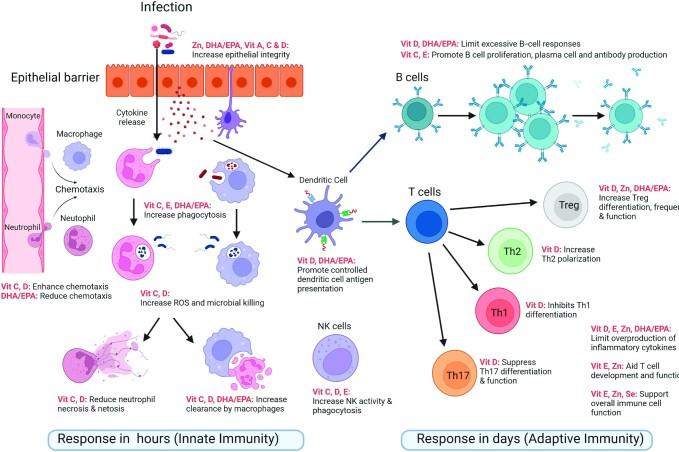
The immune system is weakened by advancing age, often referred to as immunosenescence, increasing the vulnerability to, and frequently the severity of, infectious diseases in older people. This has become very apparent in the current coronavirus disease 2019 (COVID-19) pandemic for which older people are at higher risk of severe outcomes, even those who are fully vaccinated. Aging affects both the innate and adaptive immune systems and is characterized by an imbalanced inflammatory response. Increasing evidence shows that optimal status of nutrients such as vitamins C, D, and E and selenium and zinc as well as the omega-3 (n-3) fatty acids DHA and EPA can help compensate for these age-related changes. While inadequate intakes of these nutrients are widespread in the general population, this is often more pronounced in older people. Maintaining adequate intakes is a challenge for them due to a range of factors such as physical, physiological, and cognitive changes; altered absorption; and the presence of noncommunicable diseases. While nutritional requirements are ideally covered by a balanced diet, this can be difficult to achieve, particularly for older people. Fortified foods and nutritional complements are effective in achieving adequate micronutrient intakes and should be considered as a safe and cost-effective means for older people to improve their nutritional status and hence support their defense against infections. Complementing the diet with a combination of micronutrients, particularly those playing a key role in the immune system such as vitamins C, D, and E and selenium and zinc as well as DHA and EPA, is recommended for older people. Optimal nutrition to support the immune system in older people will remain essential, particularly in the face of the current COVID-19 pandemic and, thus, developing strategies to ensure adequate nutrition for the growing number of older adults will be an important and cost-effective investment in the future.
免疫系统随着年龄的增长而减弱,通常被称为免疫衰老,这增加了老年人感染传染病的易感性和严重程度。在当前的 2019 年冠状病毒病(COVID-19)大流行中,这一点变得非常明显,老年人患严重疾病的风险更高,即使是那些完全接种疫苗的人也是如此。衰老会影响先天和适应性免疫系统,并以不平衡的炎症反应为特征。越来越多的证据表明,维生素 C、D、E 和硒、锌以及欧米伽-3(n-3)脂肪酸 DHA 和 EPA 等营养素的最佳状态可以帮助弥补这些与年龄相关的变化。虽然这些营养素的摄入量不足在普通人群中很普遍,但在老年人中更为明显。由于身体、生理和认知变化、吸收改变以及非传染性疾病的存在,老年人维持足够的摄入量是一个挑战。虽然均衡饮食可以满足营养需求,但对于老年人来说,这可能很难实现。强化食品和营养补充剂可以有效地实现足够的微量营养素摄入,应被视为老年人改善营养状况、从而支持其抗感染能力的安全且具有成本效益的手段。对于老年人,建议在饮食中补充多种微量营养素,特别是那些在免疫系统中发挥关键作用的微量营养素,如维生素 C、D、E、硒和锌以及 DHA 和 EPA。为了支持老年人的免疫系统,最佳营养仍然是必不可少的,特别是在当前 COVID-19 大流行的情况下,因此,制定确保老年人获得足够营养的策略将是对未来的一项重要且具有成本效益的投资。
 Zotero 插件