
基于单次试验分类追踪中风后治疗效果
Tracking the Effect of Therapy With Single-Trial Based Classification After Stroke.
作者信息
Scaglione Alessandro, Conti Emilia, Allegra Mascaro Anna Letizia, Pavone Francesco Saverio
机构信息
Department of Physics and Astronomy, University of Florence, Florence, Italy.
European Laboratory for Non-Linear Spectroscopy, University of Florence, Florence, Italy.
出版信息
Front Syst Neurosci. 2022 May 4;16:840922. doi: 10.3389/fnsys.2022.840922. eCollection 2022.
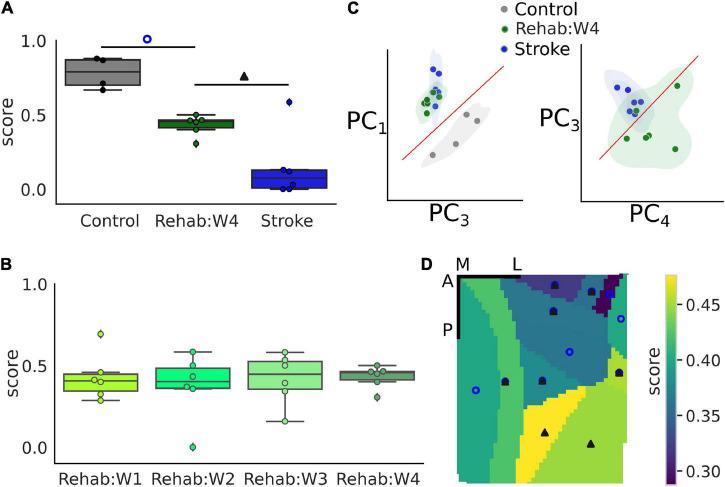
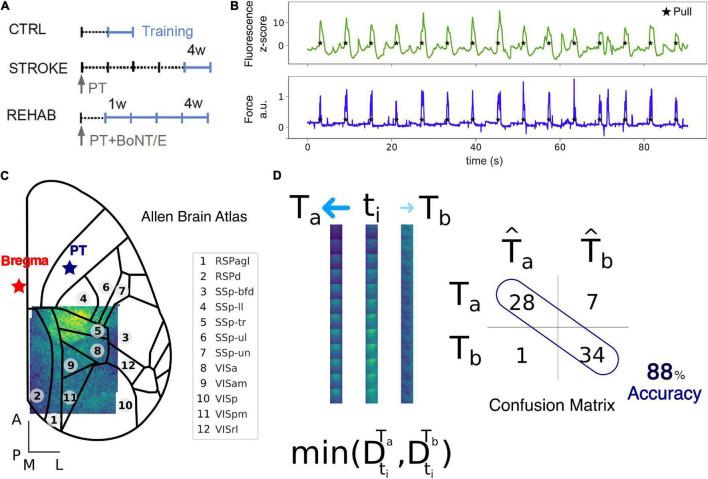
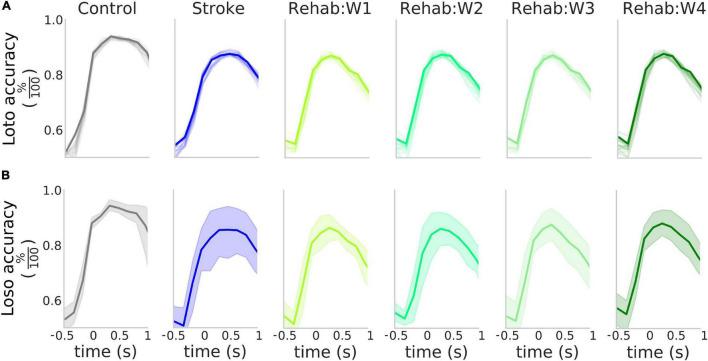
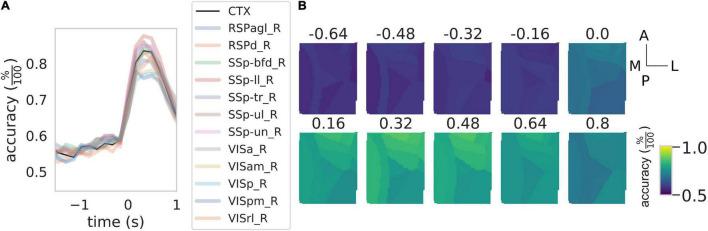
Stroke is a debilitating disease that leads, in the 50% of cases, to permanent motor or cognitive impairments. The effectiveness of therapies that promote recovery after stroke depends on indicators of the disease state that can measure the degree of recovery or predict treatment response or both. Here, we propose to use single-trial classification of task dependent neural activity to assess the disease state and track recovery after stroke. We tested this idea on calcium imaging data of the dorsal cortex of healthy, spontaneously recovered and rehabilitated mice while performing a forelimb retraction task. Results show that, at a single-trial level for the three experimental groups, neural activation during the reward pull can be detected with high accuracy with respect to the background activity in all cortical areas of the field of view and this activation is quite stable across trials and subjects of the same group. Moreover, single-trial responses during the reward pull can be used to discriminate between healthy and stroke subjects with areas closer to the injury site displaying higher discrimination capability than areas closer to this site. Finally, a classifier built to discriminate between controls and stroke at the single-trial level can be used to generate an index of the disease state, the therapeutic score, which is validated on the group of rehabilitated mice. In conclusion, task-related neural activity can be used as an indicator of disease state and track recovery without selecting a peculiar feature of the neural responses. This novel method can be used in both the development and assessment of different therapeutic strategies.
中风是一种使人衰弱的疾病,在50%的病例中会导致永久性运动或认知障碍。促进中风后恢复的治疗方法的有效性取决于疾病状态指标,这些指标可以衡量恢复程度、预测治疗反应或两者兼而有之。在此,我们建议使用任务相关神经活动的单次试验分类来评估疾病状态并跟踪中风后的恢复情况。我们在健康、自发恢复和康复小鼠的背侧皮质钙成像数据上测试了这一想法,这些小鼠在执行前肢回缩任务时。结果表明,在三个实验组的单次试验水平上,相对于视野中所有皮质区域的背景活动,可以高精度地检测到奖励拉动期间的神经激活,并且这种激活在同一组的试验和受试者之间相当稳定。此外,奖励拉动期间的单次试验反应可用于区分健康和中风受试者,靠近损伤部位的区域比远离该部位的区域具有更高的区分能力。最后,在单次试验水平上构建的用于区分对照组和中风组的分类器可用于生成疾病状态指数,即治疗评分,该评分在康复小鼠组中得到验证。总之,任务相关神经活动可以用作疾病状态的指标并跟踪恢复情况,而无需选择神经反应的特定特征。这种新方法可用于不同治疗策略的开发和评估。

 Zotero 插件