
抗氧化基因谱改变了长期新冠后出现神经后遗症的概率。
Antioxidant Genetic Profile Modifies Probability of Developing Neurological Sequelae in Long-COVID.
作者信息
Ercegovac Marko, Asanin Milika, Savic-Radojevic Ana, Ranin Jovan, Matic Marija, Djukic Tatjana, Coric Vesna, Jerotic Djurdja, Todorovic Nevena, Milosevic Ivana, Stevanovic Goran, Simic Tatjana, Bukumiric Zoran, Pljesa-Ercegovac Marija
机构信息
Faculty of Medicine, University of Belgrade, 11000 Belgrade, Serbia.
Clinic of Neurology, Clinical Centre of Serbia, 11000 Belgrade, Serbia.
出版信息
Antioxidants (Basel). 2022 May 12;11(5):954. doi: 10.3390/antiox11050954.
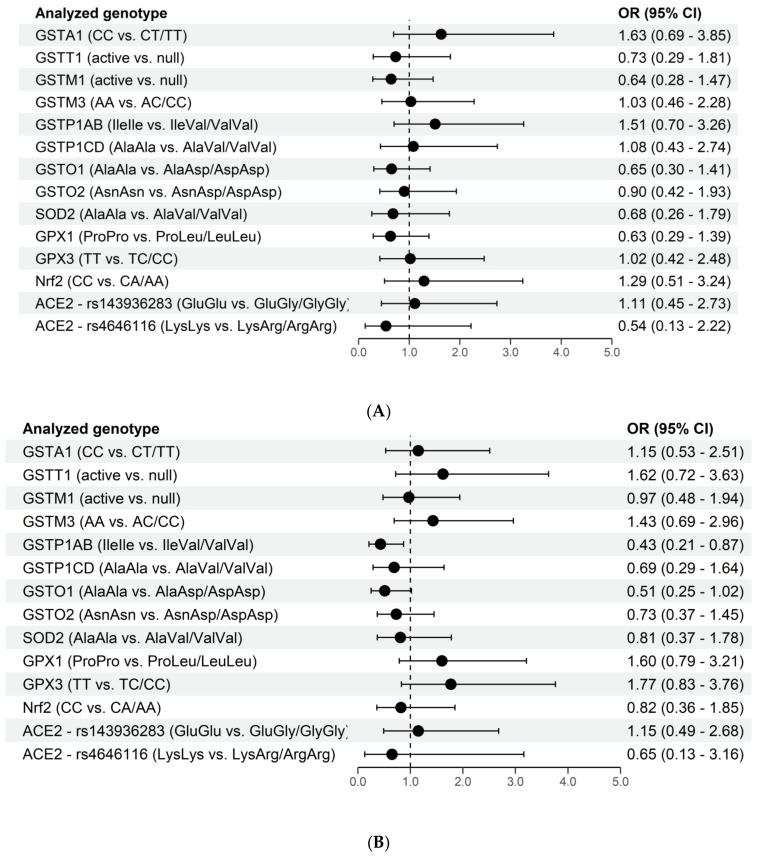
Understanding the sequelae of COVID-19 is of utmost importance. Neuroinflammation and disturbed redox homeostasis are suggested as prevailing underlying mechanisms in neurological sequelae propagation in long-COVID. We aimed to investigate whether variations in antioxidant genetic profile might be associated with neurological sequelae in long-COVID. Neurological examination and antioxidant genetic profile (SOD2, GPXs and GSTs) determination, as well as, genotype analysis of Nrf2 and ACE2, were conducted on 167 COVID-19 patients. Polymorphisms were determined by the appropriate PCR methods. Only polymorphisms in GSTP1AB and GSTO1 were independently associated with long-COVID manifestations. Indeed, individuals carrying or allele exhibited lower odds of long-COVID myalgia development, both independently and in combination. Furthermore, the combined presence of and alleles exhibited cumulative risk regarding long-COVID myalgia in carriers of the combined genotype. Moreover, individuals carrying combined genotype were more prone to developing long-COVID "brain fog", while this probability further enlarged if the allele was also present. The fact that certain genetic variants of antioxidant enzymes, independently or in combination, affect the probability of long-COVID manifestations, further emphasizes the involvement of genetic susceptibility when SARS-CoV-2 infection is initiated in the host cells, and also months after.
了解新冠病毒病(COVID-19)的后遗症至关重要。神经炎症和氧化还原稳态紊乱被认为是长期新冠病毒感染(long-COVID)神经后遗症传播的主要潜在机制。我们旨在研究抗氧化基因谱的变异是否可能与长期新冠病毒感染的神经后遗症相关。对167名COVID-19患者进行了神经学检查、抗氧化基因谱(超氧化物歧化酶2、谷胱甘肽过氧化物酶和谷胱甘肽S-转移酶)测定,以及核因子E2相关因子2和血管紧张素转换酶2的基因型分析。通过适当的聚合酶链反应方法确定多态性。只有谷胱甘肽S-转移酶P1AB和谷胱甘肽S-转移酶O1的多态性与长期新冠病毒感染表现独立相关。事实上,携带或等位基因的个体出现长期新冠病毒感染肌痛的几率较低,无论是单独还是组合出现。此外,和等位基因的联合存在对联合基因型携带者的长期新冠病毒感染肌痛表现出累积风险。此外,携带联合基因型的个体更容易出现长期新冠病毒感染的“脑雾”症状,而如果同时存在等位基因,这种可能性会进一步增加。抗氧化酶的某些基因变异单独或联合影响长期新冠病毒感染表现的概率,这一事实进一步强调了宿主细胞开始感染SARS-CoV-2时以及感染数月后遗传易感性的作用。
 Zotero 插件