
HSPA4 是胎盘植入的生物标志物,可增强血管内皮细胞的血管生成能力。
HSPA4 Is a Biomarker of Placenta Accreta and Enhances the Angiogenesis Ability of Vessel Endothelial Cells.
机构信息
Center for Mitochondrial Research and Medicine and Genomics and Proteomics Core Laboratory, Kaohsiung Chang Gung Memorial Hospital and Chang Gung University College of Medicine, Kaohsiung 833, Taiwan.
Department of Obstetrics and Gynecology, Kaohsiung Chang Gung Memorial Hospital and Chang Gung University College of Medicine, Kaohsiung 833, Taiwan.
出版信息
Int J Mol Sci. 2022 May 19;23(10):5682. doi: 10.3390/ijms23105682.
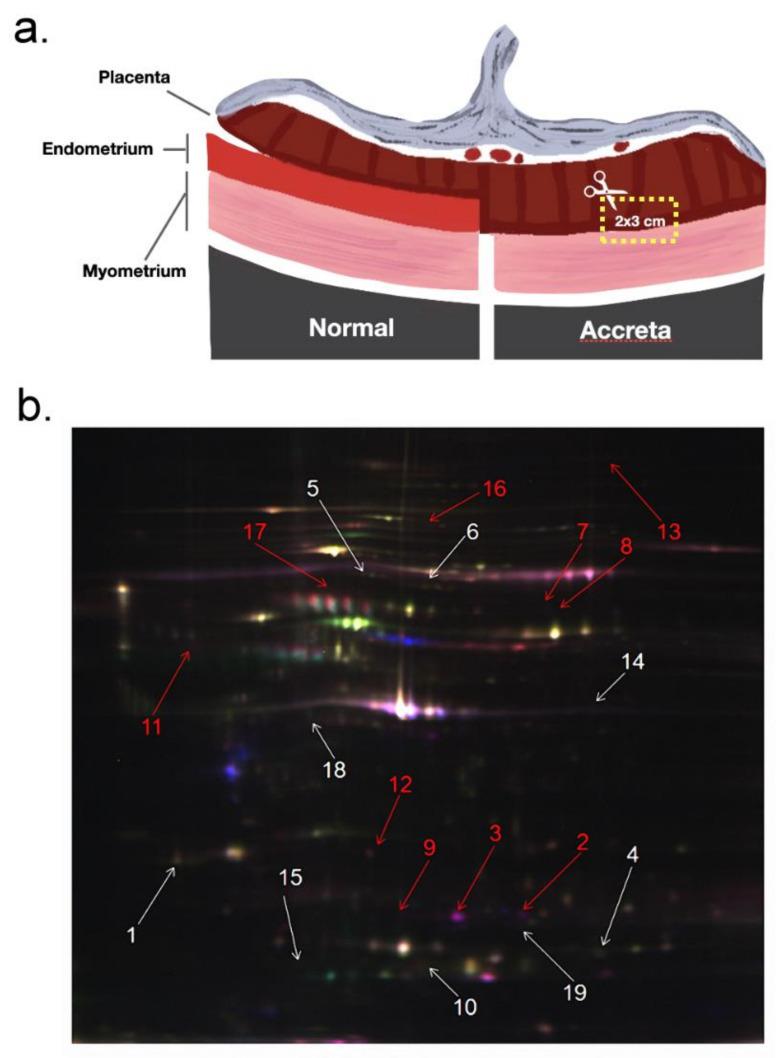
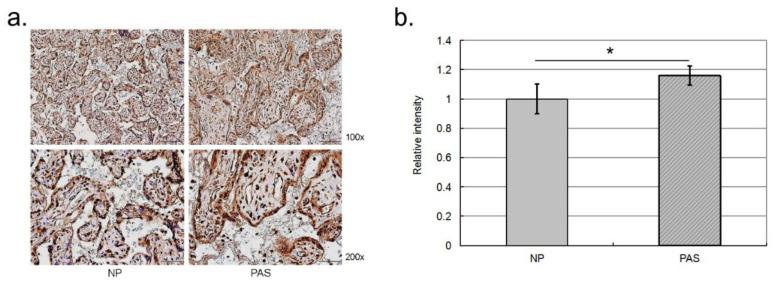
Placenta accreta spectrum (PAS) accounts for 7% of maternal mortality and is associated with intraoperative and postoperative morbidity caused by massive blood loss, infection, and adjacent organ damage. The aims of this study were to identify the protein biomarkers of PAS and to further explore their pathogenetic roles in PAS. For this purpose, we collected five placentas from pregnant subjects with PAS complications and another five placentas from normal pregnancy (NP) cases. Then, we enriched protein samples by specifically isolating the trophoblast villous, deeply invading into the uterine muscle layer in the PAS patients. Next, fluorescence-based two-dimensional difference gel electrophoresis (2D-DIGE) and MALDI-TOF/MS were used to identify the proteins differentially abundant between PAS and NP placenta tissues. As a result, nineteen spots were determined as differentially abundant proteins, ten and nine of which were more abundant in PAS and NP placenta tissues, respectively. Then, specific validation with western blot assay and immunohisto/cytochemistry (IHC) assay confirmed that heat shock 70 kDa protein 4 (HSPA4) and chorionic somatomammotropin hormone (CSH) were PAS protein biomarkers. Further tube formation assays demonstrated that HSPA4 promoted the in vitro angiogenesis ability of vessel endothelial cells, which is consistent with the in vivo scenario of PAS complications. In this study, we not only identified PAS protein biomarkers but also connected the promoted angiogenesis with placenta invasion, investigating the pathogenetic mechanism of PAS.
胎盘部位滋养细胞肿瘤谱(PAS)占产妇死亡率的 7%,与术中及术后大量出血、感染和邻近器官损伤引起的发病率有关。本研究旨在鉴定 PAS 的蛋白生物标志物,并进一步探讨其在 PAS 发病机制中的作用。为此,我们收集了 5 例 PAS 并发症孕妇和 5 例正常妊娠(NP)孕妇的胎盘。然后,我们通过特异性分离 PAS 患者深侵入子宫肌层的滋养细胞绒毛来富集蛋白样本。接下来,我们采用基于荧光的二维差异凝胶电泳(2D-DIGE)和 MALDI-TOF/MS 技术鉴定 PAS 和 NP 胎盘组织中差异丰度的蛋白。结果,确定了 19 个差异丰度蛋白点,其中 10 个和 9 个在 PAS 和 NP 胎盘组织中更为丰富。然后,我们通过 Western blot 分析和免疫组织化学(IHC)分析进行了特异性验证,证实热休克 70kDa 蛋白 4(HSPA4)和绒毛膜促乳素激素(CSH)是 PAS 的蛋白生物标志物。进一步的管形成试验表明,HSPA4 促进了血管内皮细胞的体外血管生成能力,这与 PAS 并发症的体内情况一致。在本研究中,我们不仅鉴定了 PAS 的蛋白生物标志物,还将促进血管生成与胎盘侵袭联系起来,探讨了 PAS 的发病机制。



 Zotero 插件