
通过附着细菌衍生的碳量子点激活被动介孔二氧化硅纳米颗粒层,以保护益生菌并增强其功能。
Activation of a passive, mesoporous silica nanoparticle layer through attachment of bacterially-derived carbon-quantum-dots for protection and functional enhancement of probiotics.
作者信息
Wei Hao, Geng Wei, Yang Xiao-Yu, Kuipers Jeroen, van der Mei Henny C, Busscher Henk J
机构信息
University of Groningen and University Medical Center Groningen, Department of Biomedical Engineering, Antonius Deusinglaan 1, 9713 AV, Groningen, the Netherlands.
School of Chemical Engineering and Technology, Sun Yat-Sen University, Zhuhai, 519082, China.
出版信息
Mater Today Bio. 2022 May 17;15:100293. doi: 10.1016/j.mtbio.2022.100293. eCollection 2022 Jun.
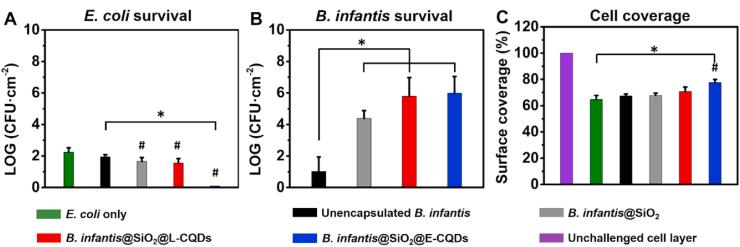
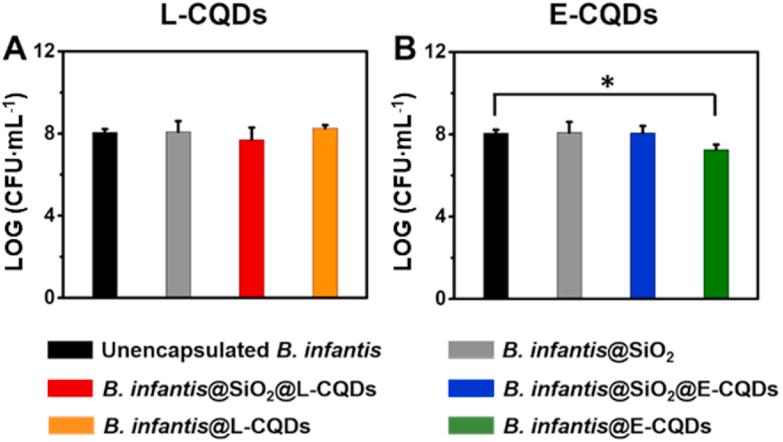
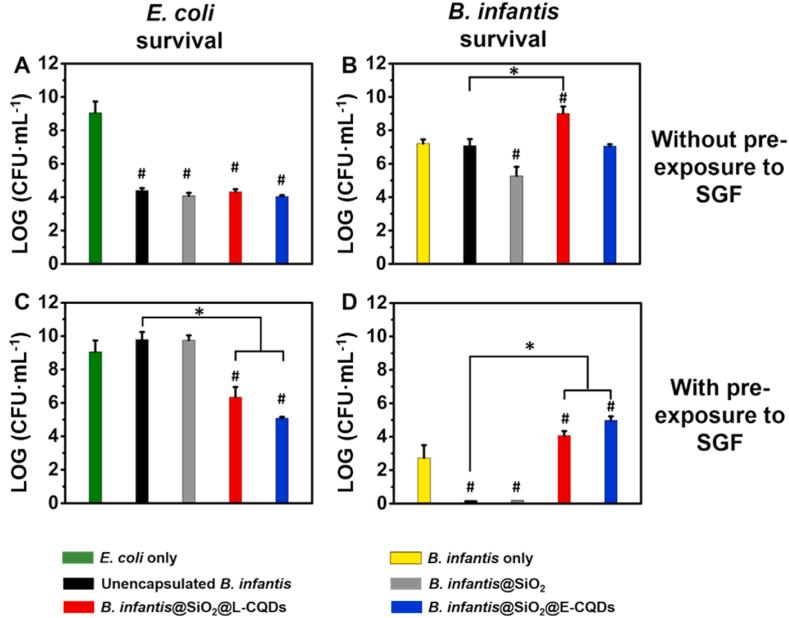
Probiotic bacteria employed for food supplementation or probiotic-assisted antibiotic treatment suffer from passage through the acidic gastro-intestinal tract and unintended killing by antibiotics. Carbon-quantum-dots (CQDs) derived from bacteria can inherit different chemical groups and associated functionalities from their source bacteria. In order to yield simultaneous, passive protection and enhanced, active functionality, we attached CQDs pyrolytically carbonized at 220 °C from or to a probiotic strain () using boron hydroxyl-modified, mesoporous silica nanoparticles as an intermediate encapsulating layer. Fourier-transform-infrared-spectroscopy, X-ray-photoelectron-spectroscopy and scanning-electron-microscopy were employed to demonstrate successful encapsulation of by silica nanoparticles and subsequent attachment of bacterially-derived CQDs. Thus encapsulated possessed a negative surface charge and survived exposure to simulated gastric fluid and antibiotics better than unencapsulated . During assisted antibiotic treatment of intestinal epithelial layers colonized by , encapsulated adhered and survived in higher numbers on epithelial layers than without encapsulation or encapsulated with only silica nanoparticles. Moreover, higher killing due to increased reactive-oxygen-species generation was observed. In conclusion, the active, protective encapsulation described enhanced the probiotic functionality of , which might be considered as a first step towards a fully engineered, probiotic nanoparticle.
用于食品补充或益生菌辅助抗生素治疗的益生菌会在通过酸性胃肠道时受损,并会被抗生素意外杀死。源自细菌的碳量子点(CQD)可以从其源细菌继承不同的化学基团和相关功能。为了实现同时的被动保护和增强的主动功能,我们使用硼羟基修饰的介孔二氧化硅纳米颗粒作为中间包封层,将在220℃下热解碳化的来自嗜酸乳杆菌或植物乳杆菌的CQD附着到益生菌菌株(嗜酸乳杆菌)上。采用傅里叶变换红外光谱、X射线光电子能谱和扫描电子显微镜来证明二氧化硅纳米颗粒成功包封嗜酸乳杆菌以及随后附着细菌衍生的CQD。如此包封的嗜酸乳杆菌具有负表面电荷,并且比未包封的嗜酸乳杆菌在暴露于模拟胃液和抗生素后存活得更好。在用嗜酸乳杆菌定殖的肠上皮层进行嗜酸乳杆菌辅助抗生素治疗期间,包封的嗜酸乳杆菌在上皮层上附着并存活的数量比未包封的嗜酸乳杆菌或仅用二氧化硅纳米颗粒包封的嗜酸乳杆菌更多。此外,观察到由于活性氧生成增加导致的更高的杀菌率。总之,所描述的主动保护包封增强了嗜酸乳杆菌的益生菌功能,这可能被视为迈向完全工程化的益生菌纳米颗粒的第一步。
 Zotero 插件