
硼硫共掺杂石墨烯量子点高灵敏选择性检测多巴胺。
Highly sensitive and selective detection of dopamine with boron and sulfur co-doped graphene quantum dots.
机构信息
Department of Biotechnology, Indian Institute of Technology Roorkee, Roorkee, Haridwar, Uttarakhand, 247667, India.
Department of Physics, Indian Institute of Technology Roorkee, Roorkee, Haridwar, Uttarakhand, 247667, India.
出版信息
Sci Rep. 2022 May 31;12(1):9061. doi: 10.1038/s41598-022-13016-4.
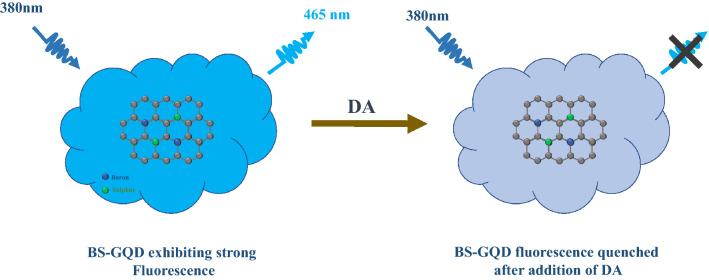
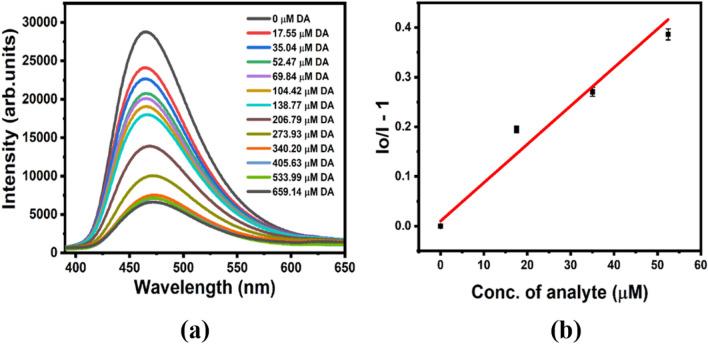
In this work, we report, the synthesis of Boron and Sulfur co-doped graphene quantum dots (BS-GQDs) and its applicability as a label-free fluorescence sensing probe for the highly sensitive and selective detection of dopamine (DA). Upon addition of DA, the fluorescence intensity of BS-GQDs were effectively quenched over a wide concentration range of DA (0-340 μM) with an ultra-low detection limit of 3.6 μM. The quenching mechanism involved photoinduced electron transfer process from BS-GQDs to dopamine-quinone, produced by the oxidization of DA under alkaline conditions. The proposed sensing mechanism was probed using a detailed study of UV-Vis absorbance, steady state and time resolved fluorescence spectroscopy. The high selectivity of the fluorescent sensor towards DA is established. Our study opens up the possibility of designing a low-cost biosensor which will be suitable for detecting DA in real samples.
在这项工作中,我们报告了硼和硫共掺杂石墨烯量子点(BS-GQDs)的合成及其作为一种无标记荧光传感探针在高灵敏度和选择性检测多巴胺(DA)中的应用。加入 DA 后,BS-GQDs 的荧光强度在 DA 的宽浓度范围内(0-340 μM)被有效猝灭,检测限低至 3.6 μM。猝灭机制涉及到 BS-GQDs 与多巴胺-醌之间的光诱导电子转移过程,多巴胺-醌是由 DA 在碱性条件下氧化产生的。通过详细的紫外-可见吸收光谱、稳态和时间分辨荧光光谱研究,探究了传感机制。该荧光传感器对 DA 具有高选择性。我们的研究为设计低成本生物传感器以检测实际样品中的 DA 开辟了可能性。




 Zotero 插件