
化学敏化光动力治疗集成在聚合物纳米颗粒中,可用于 MRI 靶向动脉粥样硬化。
Chemiexcited Photodynamic Therapy Integrated in Polymeric Nanoparticles Capable of MRI Against Atherosclerosis.
机构信息
Department of Radiology, Affiliated Nanjing Drum Tower Hospital of Nanjing University Medical School, Nanjing, 210008, People's Republic of China.
Department of Cardiology, Affiliated Nanjing Drum Tower Hospital of Nanjing University Medical School, Nanjing, 210008, People's Republic of China.
出版信息
Int J Nanomedicine. 2022 May 20;17:2353-2366. doi: 10.2147/IJN.S355790. eCollection 2022.
BACKGROUND
Photodynamic therapy (PDT) has achieved continued success in the treatment of tumors, but its progress in the treatment of atherosclerosis has been limited, mainly due to the low tissue-penetration ability of the excitation light for photosensitizers.
METHODS
In this study, we designed a chemiexcited system producing singlet oxygen in an attempt to apply PDT for the treatment of atherosclerosis without the irradiation of external light. The system designed was polymeric nanoparticles (NPs) equipped with chemical fuel and photosensitizers, cross-linked with an Fe-catechol complex for stabilization and magnetic resonance imaging (MRI).
RESULTS
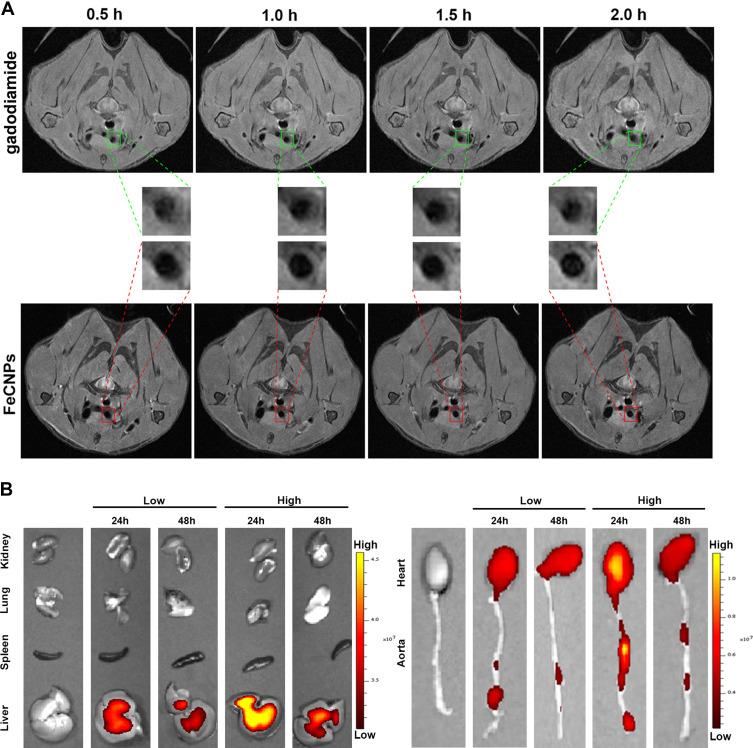
The system (FeCNPs for short) accumulated effectively in plaques, providing persistent and enhanced -weighted contrast ability. FeCNPs also prevented progression of atherosclerosis via macrophage elimination, and obviously reduced plaque size and thickness revealed by -weighted MRI. Expression of CD68, MCP1, and TNFα was significantly reduced after treatment. However, low doses of FeCNPs exhibited better therapeutic efficacy than high doses. Furthermore, low-dose FeCNPs exhibited effective macrophage elimination in aortic arches and abdominal aortae, but inefficiency in the thoracic aorta, aortic hiatus, and aorta-iliac bifurcation.
CONCLUSION
This study provides the first example of a combination of MRI and chemiexcited PDT for atherosclerosis, evidencing the effectiveness of PDT and providing significant pointers for developing nanotherapy on atherosclerosis.
背景
光动力疗法(PDT)在治疗肿瘤方面取得了持续的成功,但在治疗动脉粥样硬化方面的进展有限,主要是由于光敏剂的激发光的组织穿透能力较低。
方法
在本研究中,我们设计了一种化学激发系统,以产生单线态氧,试图在不进行外部光照射的情况下应用 PDT 治疗动脉粥样硬化。设计的系统是带有化学燃料和光敏剂的聚合物纳米颗粒(NPs),用 Fe-儿茶酚络合物交联以实现稳定和磁共振成像(MRI)。
结果
该系统(简称 FeCNPs)在斑块中有效积聚,提供持久和增强的 T2 加权对比能力。FeCNPs 还通过巨噬细胞消除来预防动脉粥样硬化的进展,并通过 T2 加权 MRI 明显减少斑块大小和厚度。治疗后 CD68、MCP1 和 TNFα 的表达明显降低。然而,低剂量的 FeCNPs 比高剂量表现出更好的治疗效果。此外,低剂量的 FeCNPs 在主动脉弓和腹主动脉中有效消除了巨噬细胞,但在胸主动脉、主动脉裂孔和主动脉-髂分叉处无效。
结论
本研究首次提供了 MRI 和化学激发 PDT 联合治疗动脉粥样硬化的范例,证明了 PDT 的有效性,并为动脉粥样硬化的纳米治疗提供了重要的指导。



 Zotero 插件