
一项孟德尔随机化研究,旨在探究炎症在帕金森病中因果关系的作用。
A Mendelian randomization study investigating the causal role of inflammation on Parkinson's disease.
机构信息
Institute for Biomedicine, Eurac Research, Bolzano/Bozen, Italy.
Institute of Neurogenetics, University of Lübeck and University Hospital of Schleswig-Holstein, Lübeck, Germany.
出版信息
Brain. 2022 Oct 21;145(10):3444-3453. doi: 10.1093/brain/awac193.
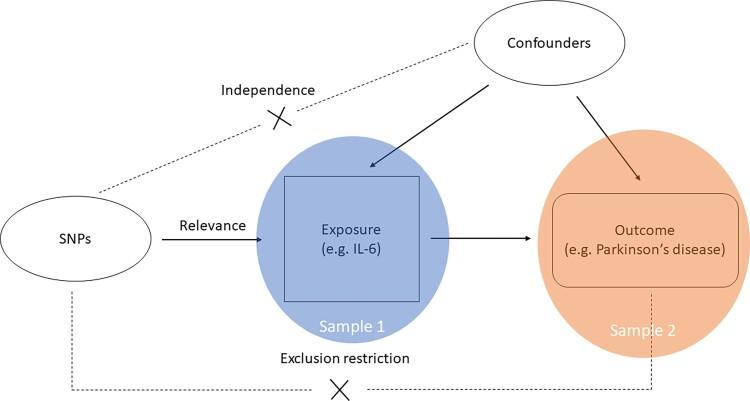
There is increasing evidence for inflammation as a determinant in the pathogenesis of Parkinson's disease, but its role in parkinsonian neurodegeneration remains elusive. It is not clear whether inflammatory cascades are causes or consequences of dopamine neuron death. In the present study, we aim to perform an in-depth statistical investigation of the causal relationship between inflammation and Parkinson's disease using a two-sample Mendelian randomization design. Genetic instruments were selected using summary-level data from the largest genome-wide association studies to date (sample size ranging from 13 955 to 204 402 individuals) conducted on a European population for the following inflammation biomarkers: C-reactive protein, interleukin-6, interleukin 1 receptor antagonist and tumour necrosis factor α. Genetic association data on Parkinson's disease (56 306 cases and 1 417 791 controls) and age at onset of Parkinson's disease (28 568 cases) were obtained from the International Parkinson's Disease Genomics Consortium. On primary analysis, causal associations were estimated on sets of strong (P-value < 5 × 10⁻⁸; F-statistic > 10) and independent (linkage disequilibrium r2 < 0.001) genetic instruments using the inverse-variance weighted method. In sensitivity analysis, we estimated causal effects using robust Mendelian randomization methods and after removing pleiotropic genetic variants. Reverse causation was also explored. We repeated the analysis on different data sources for inflammatory biomarkers to check the consistency of the findings. In all the three data sources selected for interleukin-6, we found statistical evidence for an earlier age at onset of Parkinson's disease associated with increased interleukin-6 concentration [years difference per 1 log-unit increase = -2.364, 95% confidence interval (CI) = -4.789-0.060; years difference per 1 log-unit increase = -2.011, 95% CI = -3.706 to -0.317; years difference per 1 log-unit increase = -1.569, 95% CI = -2.891 to -0.247]. We did not observe any statistical evidence for causal effects of C-reactive protein, interleukin 1 receptor antagonist and tumour necrosis factor α on both Parkinson's disease and its age at onset. Results after excluding possible pleiotropic genetic variants were consistent with findings from primary analyses. When investigating reverse causation, we did not find evidence for a causal effect of Parkinson's disease or age at onset on any biomarkers of inflammation. We found evidence for a causal association between the onset of Parkinson's disease and interleukin-6. The findings of this study suggest that the pro-inflammatory activity of the interleukin-6 cytokine could be a determinant of prodromal Parkinson's disease.
越来越多的证据表明炎症是帕金森病发病机制中的一个决定因素,但它在帕金森神经退行性变中的作用仍不清楚。目前尚不清楚炎症级联反应是多巴胺神经元死亡的原因还是结果。在本研究中,我们旨在使用两样本孟德尔随机化设计对炎症与帕金森病之间的因果关系进行深入的统计研究。使用迄今为止针对欧洲人群进行的最大全基因组关联研究(样本量范围为 13955 至 204402 人)的汇总水平数据选择遗传工具,用于以下炎症生物标志物:C 反应蛋白、白细胞介素 6、白细胞介素 1 受体拮抗剂和肿瘤坏死因子 α。从国际帕金森病基因组学联盟获得了帕金森病(56306 例病例和 1417791 例对照)和帕金森病发病年龄(28568 例病例)的遗传关联数据。在主要分析中,使用逆方差加权法,根据强(P 值<5×10⁻⁸;F 统计量>10)和独立(连锁不平衡 r2<0.001)遗传工具集,对因果关系进行了估计。在敏感性分析中,我们使用稳健的孟德尔随机化方法并去除多效性遗传变异后,估计了因果效应。还探讨了反向因果关系。我们在不同的炎症生物标志物数据源上重复了分析,以检查研究结果的一致性。在为白细胞介素 6 选择的三个数据源中的所有三个数据源中,我们都发现了与白细胞介素 6 浓度升高相关的帕金森病发病年龄较早的统计证据[每增加 1 个对数单位的年龄差异= -2.364,95%置信区间(CI)=-4.789-0.060;每增加 1 个对数单位的年龄差异= -2.011,95%CI=-3.706 至-0.317;每增加 1 个对数单位的年龄差异= -1.569,95%CI=-2.891 至-0.247]。我们没有发现 C 反应蛋白、白细胞介素 1 受体拮抗剂和肿瘤坏死因子 α 对帕金森病及其发病年龄的任何因果效应的统计证据。排除可能的多效性遗传变异后的结果与主要分析的结果一致。当调查反向因果关系时,我们没有发现帕金森病或发病年龄对任何炎症生物标志物有因果效应的证据。我们发现帕金森病发病与白细胞介素 6 之间存在因果关系的证据。这项研究的结果表明,白细胞介素 6 细胞因子的促炎活性可能是帕金森病前驱期的一个决定因素。


 Zotero 插件