
从视网膜到运动神经元:蝾螈视觉运动转换的基础。
From retina to motoneurons: A substrate for visuomotor transformation in salamanders.
机构信息
Département de Pharmacologie-Physiologie, Faculté de médecine et des sciences de la santé, Université de Sherbrooke, Sherbrooke, Quebec, Canada.
Centre de recherche du Centre Hospitalier Universitaire de Sherbrooke, Sherbrooke, Quebec, Canada.
出版信息
J Comp Neurol. 2022 Oct;530(14):2518-2536. doi: 10.1002/cne.25348. Epub 2022 Jun 3.
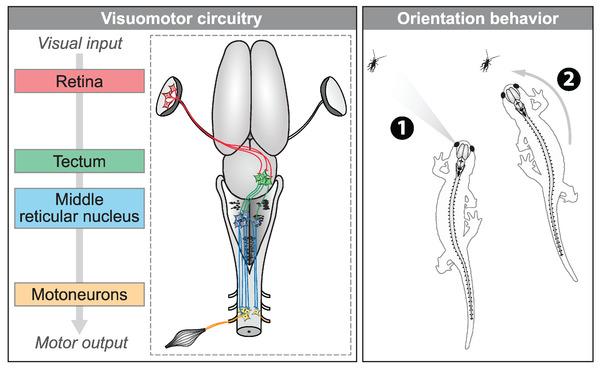
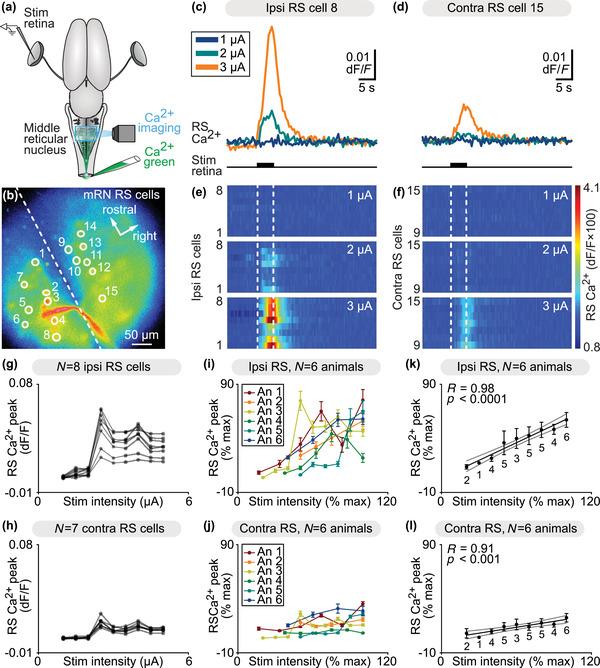
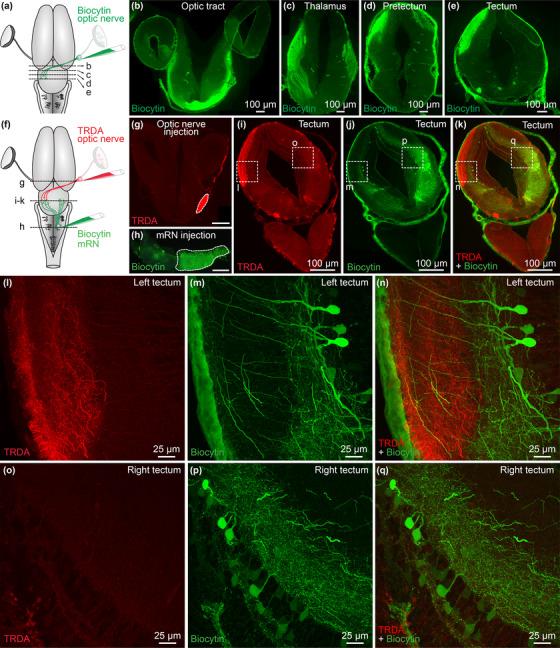
The transformation of visual input into motor output is essential to approach a target or avoid a predator. In salamanders, visually guided orientation behaviors have been extensively studied during prey capture. However, the neural circuitry involved is not resolved. Using salamander brain preparations, calcium imaging and tracing experiments, we describe a neural substrate through which retinal input is transformed into spinal motor output. We found that retina stimulation evoked responses in reticulospinal neurons of the middle reticular nucleus, known to control steering movements in salamanders. Microinjection of glutamatergic antagonists in the optic tectum (superior colliculus in mammals) decreased the reticulospinal responses. Using tracing, we found that retina projected to the dorsal layers of the contralateral tectum, where the dendrites of neurons projecting to the middle reticular nucleus were located. In slices, stimulation of the tectal dorsal layers evoked glutamatergic responses in deep tectal neurons retrogradely labeled from the middle reticular nucleus. We then examined how tectum activation translated into spinal motor output. Tectum stimulation evoked motoneuronal responses, which were decreased by microinjections of glutamatergic antagonists in the contralateral middle reticular nucleus. Reticulospinal fibers anterogradely labeled from tracer injection in the middle reticular nucleus were preferentially distributed in proximity with the dendrites of ipsilateral motoneurons. Our work establishes a neural substrate linking visual and motor centers in salamanders. This retino-tecto-reticulo-spinal circuitry is well positioned to control orienting behaviors. Our study bridges the gap between the behavioral studies and the neural mechanisms involved in the transformation of visual input into motor output in salamanders.
视觉输入到运动输出的转换对于接近目标或躲避捕食者至关重要。在蝾螈中,视觉引导的定向行为在猎物捕获期间得到了广泛研究。然而,涉及的神经回路尚未得到解决。使用蝾螈脑制剂、钙成像和示踪实验,我们描述了一个神经基质,视网膜输入通过该基质转化为脊髓运动输出。我们发现,刺激视网膜会在中网状核的网状脊髓神经元中引起反应,中网状核已知控制蝾螈的转向运动。在视顶盖(哺乳动物中的上丘)中微注射谷氨酸能拮抗剂会降低网状脊髓反应。通过示踪,我们发现视网膜投射到对侧顶盖的背层,投射到中网状核的神经元的树突位于那里。在切片中,刺激顶盖的背层会在从中网状核逆行标记的深层顶盖神经元中引起谷氨酸能反应。然后,我们研究了顶盖激活如何转化为脊髓运动输出。顶盖刺激会引起运动神经元反应,而在对侧中网状核中微注射谷氨酸能拮抗剂会降低这些反应。从中网状核的示踪剂注射处向前标记的网状脊髓纤维优先分布在同侧运动神经元树突的附近。我们的工作建立了一个连接蝾螈视觉和运动中枢的神经基质。这个视网膜-顶盖-网状-脊髓回路非常适合控制定向行为。我们的研究弥合了行为研究与蝾螈中视觉输入转化为运动输出所涉及的神经机制之间的差距。


 Zotero 插件