
中国糖尿病足溃疡的微生物感染与抗生素耐药性:文献综述。
Microbial Infection and Antibiotic Susceptibility of Diabetic Foot Ulcer in China: Literature Review.
机构信息
Diabetic Foot Care Center, Department of Endocrinology and Metabolism, West China Hospital, Sichuan University, Chengdu, China.
出版信息
Front Endocrinol (Lausanne). 2022 May 19;13:881659. doi: 10.3389/fendo.2022.881659. eCollection 2022.
OBJECTIVE
To investigate the microbial spectrum isolated from foot ulcers among diabetic patients in China, which was conducted to help clinicians choose optimal antibiotics empirically.
METHOD
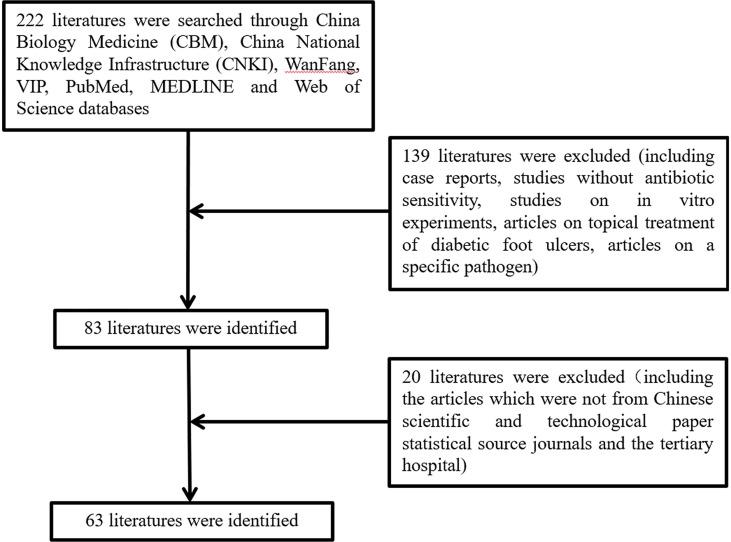
The PubMed, MEDLINE, Web of Science, China Biology Medicine (CBM), China National Knowledge Infrastructure (CNKI), WanFang, and VIP databases were searched for studies published between 2015 to 2019, that report primary data on diabetic foot infection (DFI) and antibiotic susceptibility in China.
RESULT
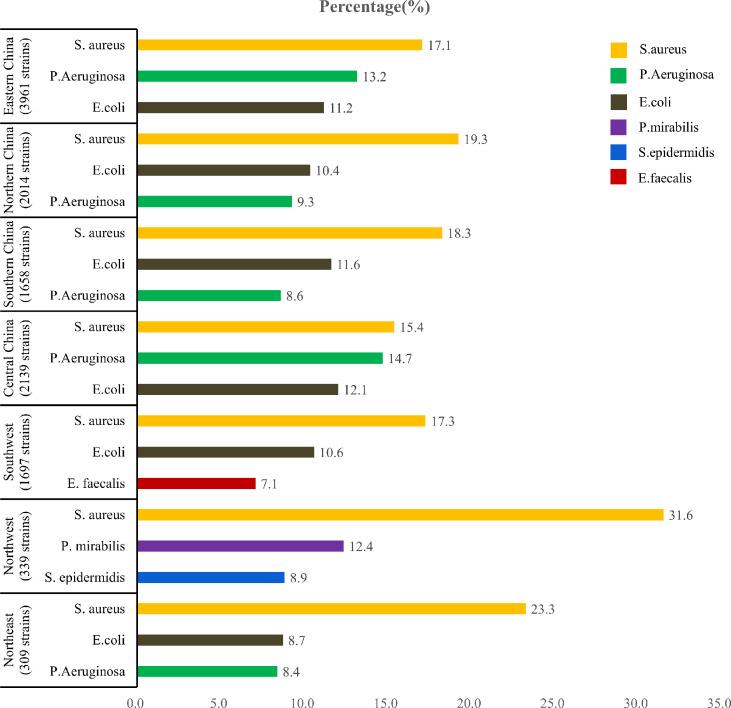
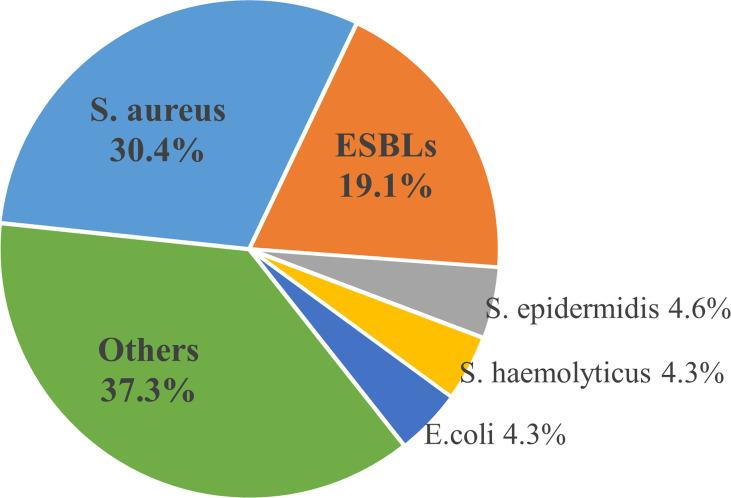
A total of 63 articles about DFI and antibiotic susceptibility tests among diabetic patients in China were included. There were 11,483 patients with an average age of 60.2 ± 10.1 years and a mean course of 10.6 ± 5.0 years between 2010 and 2019, covering most geographical regions of China. The prevalence of Gram-positive (GP) bacteria (43.4%) was lower than that of Gram-negative (GN) (52.4%). The most prevalent pathogens isolated were Staphylococcus aureus (17.7%), Escherichia coli (10.9%), Pseudomonas aeruginosa (10.5%), Klebsiella pneumoniae (6.2%), Staphylococcus epidermidis (5.3%), Enterococcus faecalis (4.9%), and fungus (3.7%). The prevalence of polymicrobial infection was 22.8%. GP bacteria were sensitive to linezolid, vancomycin, and teicoplanin. More than 50% of GN bacteria were resistant to third-generation cephalosporins, while the resistance rates of piperacillin/tazobactam, amikacin, meropenem, and imipenem were relatively low. Among the 6017 strains of the isolated organisms, 20% had multi-drug resistance (MDR). Staphylococcus aureus (30.4%) was the most predominant MDR bacteria, followed by extended-spectrum β-lactamase (ESBL) (19.1%).
CONCLUSION
The microbial infection of foot ulcers among diabetic patients in China is diverse. The microbial spectrum is different in different geographic regions and Staphylococcus aureus is the predominant bacteria. Polymicrobial and MDR bacterial infections on the foot ulcers are common. This study could be valuable in guiding the empirical use of antibiotics for diabetic foot infections.
目的
调查中国糖尿病患者足部溃疡分离的微生物谱,旨在帮助临床医生经验性地选择最佳抗生素。
方法
检索 2015 年至 2019 年间发表的关于中国糖尿病足感染(DFI)和抗生素药敏性的原始数据的研究,检索 PubMed、MEDLINE、Web of Science、中国生物医学文献数据库(CBM)、中国知网(CNKI)、万方和维普数据库。
结果
共纳入 63 篇关于中国糖尿病患者 DFI 和抗生素药敏试验的文章。共有 11483 例患者,平均年龄为 60.2±10.1 岁,2010 年至 2019 年的平均病程为 10.6±5.0 年,涵盖了中国大部分地区。革兰阳性(GP)细菌(43.4%)的患病率低于革兰阴性(GN)细菌(52.4%)。分离出的最常见病原体依次为金黄色葡萄球菌(17.7%)、大肠杆菌(10.9%)、铜绿假单胞菌(10.5%)、肺炎克雷伯菌(6.2%)、表皮葡萄球菌(5.3%)、粪肠球菌(4.9%)和真菌(3.7%)。混合感染的患病率为 22.8%。GP 细菌对利奈唑胺、万古霉素和替考拉宁敏感。超过 50%的 GN 细菌对第三代头孢菌素耐药,而哌拉西林/他唑巴坦、阿米卡星、美罗培南和亚胺培南的耐药率相对较低。在 6017 株分离菌中,有 20%为多重耐药(MDR)。金黄色葡萄球菌(30.4%)是最主要的 MDR 细菌,其次是超广谱β-内酰胺酶(ESBL)(19.1%)。
结论
中国糖尿病患者足部溃疡的微生物感染多种多样。不同地理区域的微生物谱不同,金黄色葡萄球菌是主要细菌。足部溃疡的多微生物和 MDR 细菌感染很常见。本研究可指导糖尿病足感染的经验性使用抗生素。

 Zotero 插件