
多发性硬化症患者在接受第二和第三剂 SARS-CoV-2 mRNA 疫苗后用克拉屈滨片治疗的纵向体液反应。
Longitudinal humoral response in MS patients treated with cladribine tablets after receiving the second and third doses of SARS-CoV-2 mRNA vaccine.
机构信息
Department of Neurology and Laboratory of Neuroimmunology and the Agnes-Ginges Center for Neurogenetics, Hadassah- Medical Center. Faculty of Medicine, Hebrew University of Jerusalem. Jerusalem, Israel.
Department of Neurology, Rambam Health Care Campus and Technion Faculty of Medicine, Haifa, Israel.
出版信息
Mult Scler Relat Disord. 2022 Jul;63:103863. doi: 10.1016/j.msard.2022.103863. Epub 2022 May 10.
BACKGROUND
Multiple sclerosis (MS) patients receive immunomodulatory treatments which can influence their ability to maintain vaccine specific serological response overtime. MS patients treated with cladribine tablets developed a positive serology response following two doses of mRNA COVID-19 vaccine. However, there is only limited data regarding the effect of cladribine tablets on long-term humoral response after the second and the third booster.
METHODS
Serology response to SARS-CoV-2 was tested in healthy controls (HCs) and MS patients treated with cladribine tablets 6 and 9-12 months after the second dose, and 1 and 3-6 months following the third booster-dose of the BTN162b2 mRNA vaccine.
RESULTS
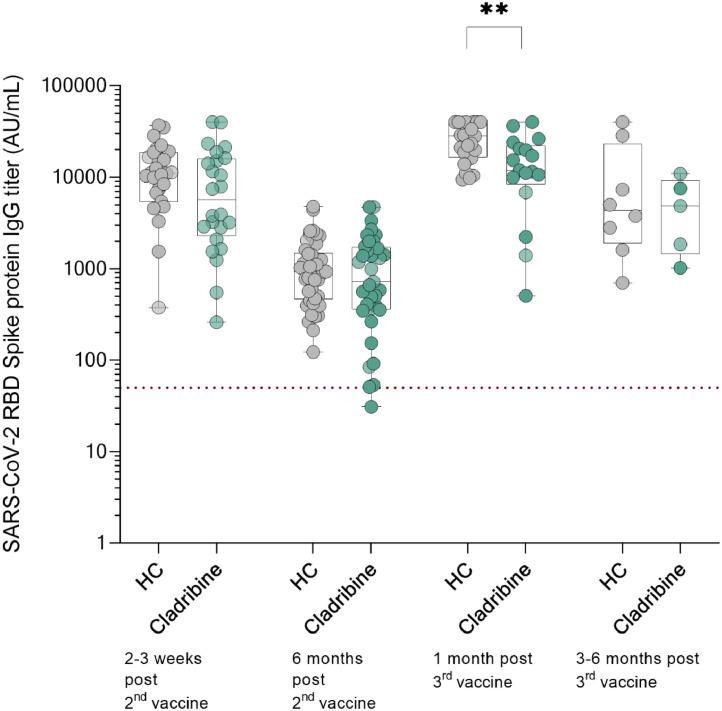
Thirty-five out of 36 MS patients treated with cladribine tablets and 100% (46/46) of HCs had a positive serology response up to 10 months after the second vaccine dose. In addition, all cladribine tablets -treated MS patients (22/22) and HCs (24/24) had a positive robust serology response following the third vaccine with a positive humoral response sustain up to 6 months. One month after the third vaccine dose IgG levels were significantly lower in patients treated with cladribine tablets compared to HCs (15,598+11,313 vs 26,394+11,335, p<0.01). Six-month post second vaccine and 3-6 months post third vaccine there was no difference in IgG levels between the groups (1088.0 ± 1072.0 vs 1153.0 ± 997.1, p = 0.79; 5234+4097 vs 11,198+14,679, p = 0.4).
CONCLUSION AND RELEVANCE
MS patients treated with cladribine tablets have sustained positive vaccine specific serology response following the second and third SARS-CoV-2 vaccine dose.
背景
多发性硬化症(MS)患者接受免疫调节治疗,这可能会影响他们维持疫苗特异性血清学反应的能力。接受克拉屈滨片治疗的 MS 患者在接种两剂 mRNA COVID-19 疫苗后产生了阳性血清学反应。然而,关于克拉屈滨片对第二剂和第三剂加强针后长期体液反应的影响,数据有限。
方法
在接种第二剂疫苗后 6 个月和 9-12 个月,以及接种第三剂 BTN162b2 mRNA 疫苗后 1 个月和 3-6 个月,检测健康对照(HCs)和接受克拉屈滨片治疗的 MS 患者的 SARS-CoV-2 血清学反应。
结果
36 例接受克拉屈滨片治疗的 MS 患者中有 35 例(35/36)和 100%(46/46)的 HCs 在第二剂疫苗后 10 个月内血清学反应呈阳性。此外,所有接受克拉屈滨片治疗的 MS 患者(22/22)和 HCs(24/24)在接种第三剂疫苗后均产生了阳性且强烈的血清学反应,并且这种体液反应可持续 6 个月。第三剂疫苗接种后 1 个月,接受克拉屈滨片治疗的患者的 IgG 水平明显低于 HCs(15598+11313 比 26394+11335,p<0.01)。第二剂疫苗接种后 6 个月和第三剂疫苗接种后 3-6 个月,两组之间的 IgG 水平没有差异(1088.0+1072.0 比 1153.0+997.1,p=0.79;5234+4097 比 11198+14679,p=0.4)。
结论和相关性
接受克拉屈滨片治疗的 MS 患者在接种第二剂和第三剂 SARS-CoV-2 疫苗后,持续产生针对疫苗的阳性血清学反应。
 Zotero 插件