
膀胱癌诊断和管理中的种族不平等和其他社会差异。
Racial inequity and other social disparities in the diagnosis and management of bladder cancer.
机构信息
The New York Proton Center, New York, New York, USA.
Montefiore Medical Center, Department of Radiation Oncology, Bronx, New York, USA.
出版信息
Cancer Med. 2023 Jan;12(1):640-650. doi: 10.1002/cam4.4917. Epub 2022 Jun 8.
BACKGROUND
We investigate the impact of gender, race, and socioeconomic status on the diagnosis and management of bladder cancer in the United States.
METHODS
We utilized the National Cancer Database to stratify cases of urothelial cell carcinoma of the bladder as early (Tis, Ta, T1), muscle invasive (T2-T3, N0), locally advanced (T4, N1-3), and metastatic. Multivariate binomial and multinomial logistic regression analyses identified demographic characteristics associated with stage at diagnosis and receipt of cancer-directed therapies. Odds ratios (OR) are reported with 95% confidence intervals.
RESULTS
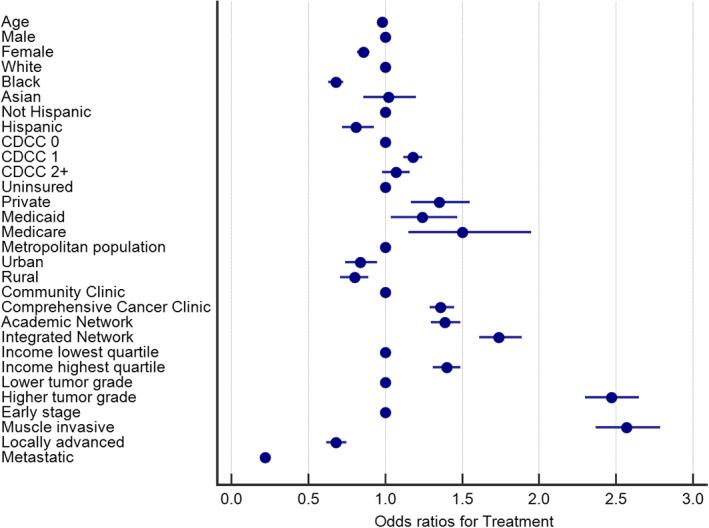
After exclusions, we identified 331,714 early, 72,154 muscle invasive, 15,579 locally advanced, and 15,161 metastatic cases from 2004-2016. Relative to diagnosis at early stage, the strongest independent predictors of diagnosis at muscle invasive, locally advanced, and metastatic disease included Black race (OR = 1.19 [1.15-1.23], OR = 1.49 [1.40-1.59], OR = 1.66 [1.56-1.76], respectively), female gender (OR = 1.21 [1.18-1.21], OR = 1.16 [1.12-1.20], and OR = 1.34 [1.29-1.38], respectively), and uninsured status (OR = 1.22 [1.15-1.29], OR = 2.09 [1.94-2.25], OR = 2.57 [2.39-2.75], respectively). Additional demographic factors associated with delayed diagnosis included older age, treatment at an academic center, Medicaid insurance and patients from lower income/less educated/more rural areas (all p < 0.01). Treatment at a non-academic center, older age, women, Hispanic and Black patients, lower income and rural areas were all less likely to receive cancer-directed therapies in early stage disease (all p < 0.01). Women, older patients, and Black patients remained less likely to receive treatment in muscle invasive, locally advanced, and metastatic disease (all p < 0.01).
CONCLUSION
Black race was the strongest independent predictor of delayed diagnosis and substandard treatment of bladder cancer.
背景
我们研究了性别、种族和社会经济地位对美国膀胱癌诊断和治疗的影响。
方法
我们利用国家癌症数据库,将膀胱癌的尿路上皮细胞癌病例分为早期(Tis、Ta、T1)、肌层浸润性(T2-T3、N0)、局部进展性(T4、N1-3)和转移性。多变量二项式和多项逻辑回归分析确定了与诊断时分期和接受癌症靶向治疗相关的人口统计学特征。比值比(OR)报告了 95%置信区间。
结果
排除后,我们从 2004 年至 2016 年确定了 331714 例早期、72154 例肌层浸润性、15579 例局部进展性和 15161 例转移性病例。与早期诊断相比,黑人种族(OR=1.19[1.15-1.23])、女性(OR=1.21[1.18-1.21])和无保险状态(OR=1.22[1.15-1.29])是诊断为肌层浸润性、局部进展性和转移性疾病的最强独立预测因素,OR=1.49[1.40-1.59])、女性(OR=1.16[1.12-1.20])和无保险状态(OR=1.34[1.29-1.38])。其他与诊断延迟相关的人口统计学因素包括年龄较大、在学术中心接受治疗、医疗补助保险以及来自低收入/教育程度较低/农村地区的患者(均 p<0.01)。在非学术中心接受治疗、年龄较大、女性、西班牙裔和非裔美国人患者、低收入和农村地区的患者在早期疾病中接受癌症靶向治疗的可能性均较低(均 p<0.01)。女性、老年患者和非裔美国人患者在肌层浸润性、局部进展性和转移性疾病中接受治疗的可能性仍然较低(均 p<0.01)。
结论
黑人种族是非裔美国人膀胱癌诊断和治疗标准降低的最强独立预测因素。
 Zotero 插件