
从雄性 C57BL/6J 小鼠粪便微生物组成预测宿主年龄。
Host Age Prediction from Fecal Microbiota Composition in Male C57BL/6J Mice.
机构信息
Temasek Life Sciences Laboratorygrid.226688.0, Singapore, Singapore.
Department of Biological Sciences, National University of Singapore, Singapore, Singapore.
出版信息
Microbiol Spectr. 2022 Jun 29;10(3):e0073522. doi: 10.1128/spectrum.00735-22. Epub 2022 Jun 8.
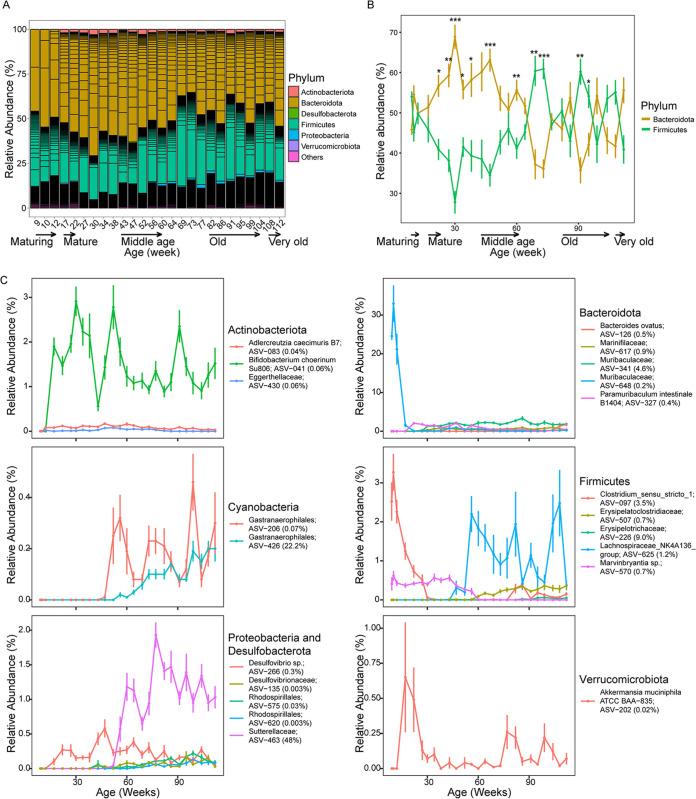
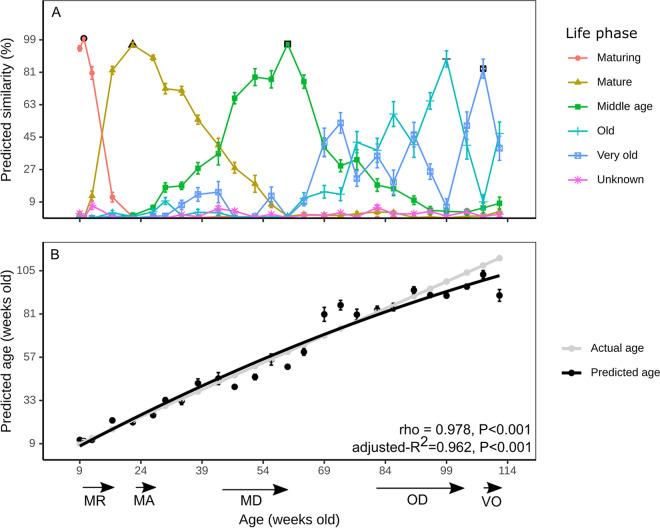
The lifelong relationship between microorganisms and hosts has a profound impact on the overall health and physiology of the holobiont. Microbiome composition throughout the life span of a host remains largely understudied. Here, the fecal microbiota of conventionally raised C57BL/6J male mice was characterized throughout almost the entire adult life span, from "maturing" (9 weeks) until "very old" (112 weeks) age. Our results suggest that microbiota changes occur throughout life but are more pronounced in maturing to middle-age mice than in mice later in life. Phylum-level analysis indicates a shift of the -to- ratio in favor of in old and very old mice. More amplicon sequence variants (ASVs) were transient with varying successional patterns than ASVs, which varied primarily during maturation. Microbiota configurations from five defined life phases were used as training sets in a Bayesian model, which effectively enabled the prediction of host age. These results suggest that age-associated compositional differences may have considerable implications for the interpretation and comparability of animal model-based microbiome studies. The sensitivity of the age prediction to dietary perturbations was tested by applying this approach to two age-matched groups of C57BL/6J mice that were fed either a standard or western diet. The predicted age for the western diet-fed animals was on average 27 ± 11 (mean ± standard deviation) weeks older than that of standard diet-fed animals. This indicates that the fecal microbiota-based predicted age may be influenced not only by the host age and physiology but also potentially by other factors such as diet. The gut microbiome of a host changes with age. Cross-sectional studies demonstrate that microbiota of different age groups are distinct but do not demonstrate the temporal change that a longitudinal study is able to show. Here, we performed a longitudinal study of adult mice for over 2 years. We identified life stages where compositional changes were more dynamic and showed temporal changes for the more abundant species. Using a Bayesian model, we could reliably predict the life stages of the mice. Application of the same training set to mice fed different dietary regimens revealed that life-stage age predictions were possible for mice fed the same diet but less so for mice fed different diets. This study sheds light on the temporal changes that occur within the gut microbiota of laboratory mice over their life span and may inform researchers on the appropriate mouse age for their research.
微生物和宿主之间的终身关系对整个生物体的健康和生理学有着深远的影响。宿主生命周期中的微生物组组成在很大程度上仍未得到充分研究。在这里,我们描述了常规饲养的 C57BL/6J 雄性小鼠粪便微生物组在几乎整个成年期的特征,从“成熟”(9 周)到“非常老”(112 周)。我们的研究结果表明,微生物组的变化发生在整个生命周期中,但在成熟到中年的小鼠中比在生命后期的小鼠中更为明显。门水平分析表明,随着年龄的增长,-与-的比例向有利于-的方向转变。与-相比,更多的扩增子序列变异(ASV)具有不同的连续模式,而-的 ASV 则主要在成熟过程中发生变化。来自五个定义明确的生命阶段的微生物组构型被用作贝叶斯模型的训练集,该模型有效地实现了对宿主年龄的预测。这些结果表明,与年龄相关的组成差异可能对动物模型为基础的微生物组研究的解释和可比性产生重大影响。我们通过应用该方法对两组年龄匹配的 C57BL/6J 小鼠进行了测试,一组喂食标准饮食,另一组喂食西方饮食,以测试年龄预测对饮食干扰的敏感性。与标准饮食喂养的动物相比,西方饮食喂养的动物的预测年龄平均大 27±11(平均值±标准差)周。这表明,基于粪便微生物组的预测年龄不仅受宿主年龄和生理学的影响,还可能受其他因素的影响,如饮食。宿主的肠道微生物组随年龄而变化。横断面研究表明,不同年龄组的微生物组是不同的,但不能显示纵向研究能够显示的时间变化。在这里,我们对成年小鼠进行了超过 2 年的纵向研究。我们确定了组成变化更为动态的生命阶段,并显示出更丰富物种的时间变化。我们使用贝叶斯模型可以可靠地预测小鼠的生命阶段。将相同的训练集应用于喂食不同饮食方案的小鼠表明,对于喂食相同饮食的小鼠,生命阶段的年龄预测是可能的,但对于喂食不同饮食的小鼠则不太可能。这项研究揭示了实验室小鼠肠道微生物组在其生命周期内发生的时间变化,并为研究人员提供了有关其研究的适当小鼠年龄的信息。



 Zotero 插件