
金属抗性决定簇 CrdA 的铜结合和寡聚化研究
Copper Binding and Oligomerization Studies of the Metal Resistance Determinant CrdA from .
机构信息
Department of Chemistry, Faculty of Science, University of Zagreb, Horvatovac 102a, 10000 Zagreb, Croatia.
Department of Biology, University of Padua, Via Ugo Bassi 58/B, 35131 Padua, Italy.
出版信息
Molecules. 2022 May 24;27(11):3387. doi: 10.3390/molecules27113387.
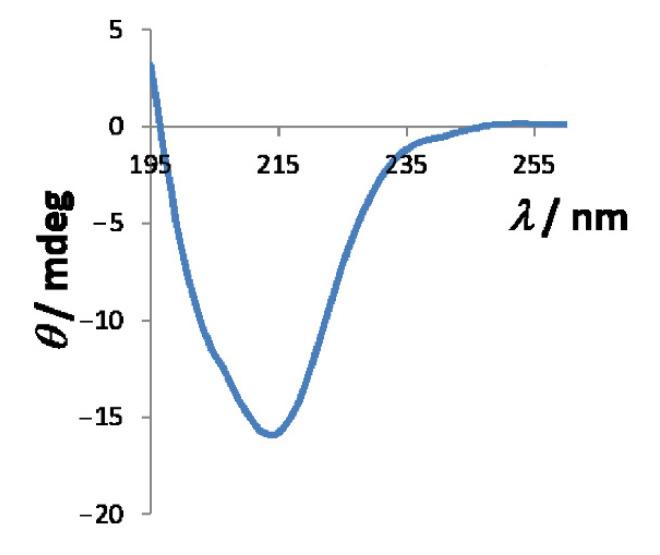
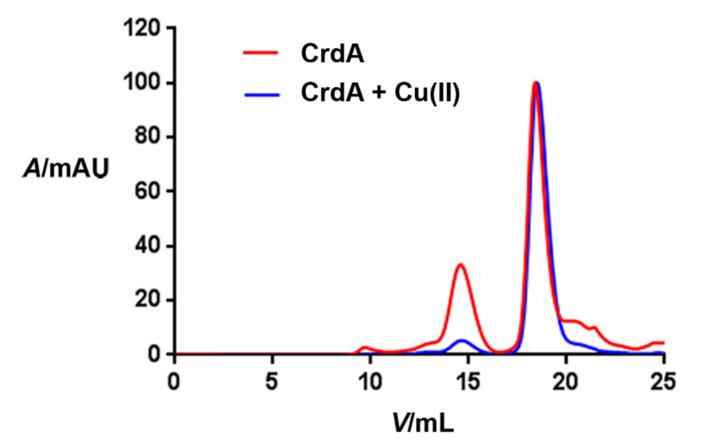
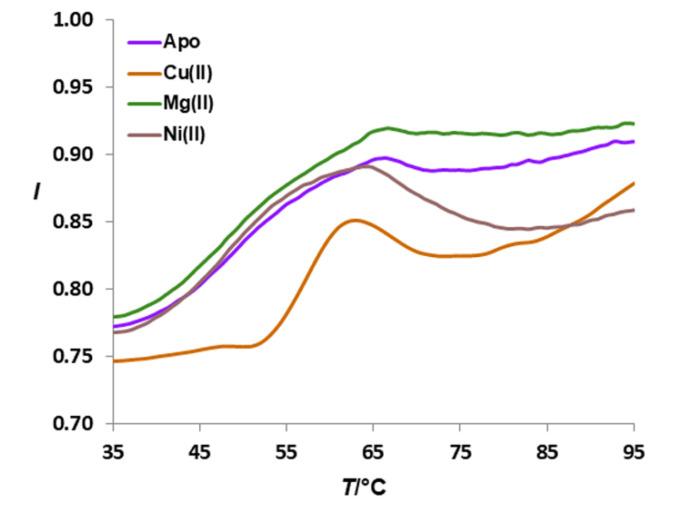
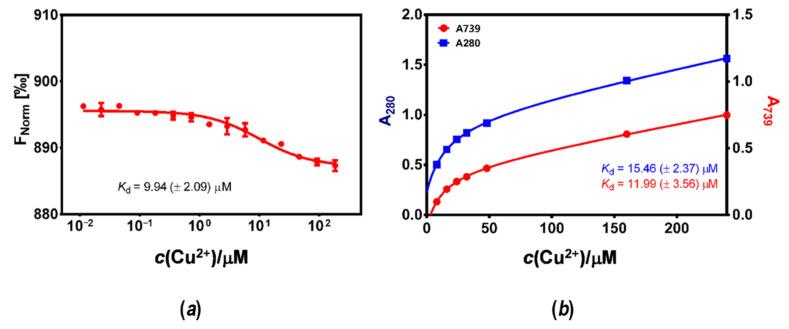
Within this research, the CrdA protein from (CrdA), a putative copper-binding protein important for the survival of bacterium, was biophysically characterized in a solution, and its binding affinity toward copper was experimentally determined. Incubation of CrdA with Cu(II) ions favors the formation of the monomeric species in the solution. The modeled CrdA structure shows a conserved methionine-rich region, a potential binding site for Cu(I), as in the structures of similar copper-binding proteins, CopC and PcoC, from and from , respectively. Within the conserved amino acid motif, CrdA contains two additional methionines and two glutamic acid residues (MXMPGMXXXM) in comparison to CopC and PcoC but lacks the canonical Cu(II) binding site (two His) since the sequence has no His residues. The methionine-rich site is in a flexible loop and can adopt different geometries for the two copper oxidation states. It could bind copper in both oxidation states (I and II), but with different binding affinities, micromolar was found for Cu(II), and less than nanomolar is proposed for Cu(I). Considering that CrdA is a periplasmic protein involved in chaperoning copper export and delivery in the cell and that the affinity of the interaction corresponds to a middle or strong metal-protein interaction depending on the copper oxidation state, we conclude that the interaction also occurs in vivo and is physiologically relevant for .
在这项研究中,从 (CrdA)中鉴定出了一种假定的铜结合蛋白 CrdA 蛋白,该蛋白对于细菌的生存至关重要,我们对其在溶液中的生物物理特性进行了表征,并通过实验确定了其与铜的结合亲和力。CrdA 与 Cu(II) 离子孵育有利于在溶液中形成单体物种。建模的 CrdA 结构显示出保守的富含蛋氨酸的区域,这是铜结合蛋白 CopC 和 PcoC 的潜在 Cu(I) 结合位点,分别来自 和 。在保守的氨基酸基序中,与 CopC 和 PcoC 相比,CrdA 含有两个额外的蛋氨酸和两个谷氨酸残基(MXMPGMXXXM),但缺乏典型的 Cu(II) 结合位点(两个 His),因为该序列没有 His 残基。富含蛋氨酸的位点位于柔性环中,可以为两种铜氧化态采用不同的几何形状。它可以结合两种氧化态的铜(I 和 II),但结合亲和力不同,Cu(II) 的结合亲和力为微摩尔,Cu(I) 的结合亲和力小于纳摩尔。考虑到 CrdA 是一种周质蛋白,参与铜输出和在 细胞中的递呈,并且相互作用的亲和力对应于中等或强金属-蛋白相互作用,具体取决于铜的氧化态,我们得出结论,这种相互作用也发生在体内,并且对 具有生理相关性。



 Zotero 插件